

When I first started reading about @Fabric Foundation , one line immediately stayed in my mind: a global, open network to build, govern, own, and evolve general-purpose robots.
At first, it sounds ambitious. Maybe even futuristic. But when I slowed down and asked myself the right questions, it began to make practical sense.
Let me explain it the way I actually understood it by questioning everything.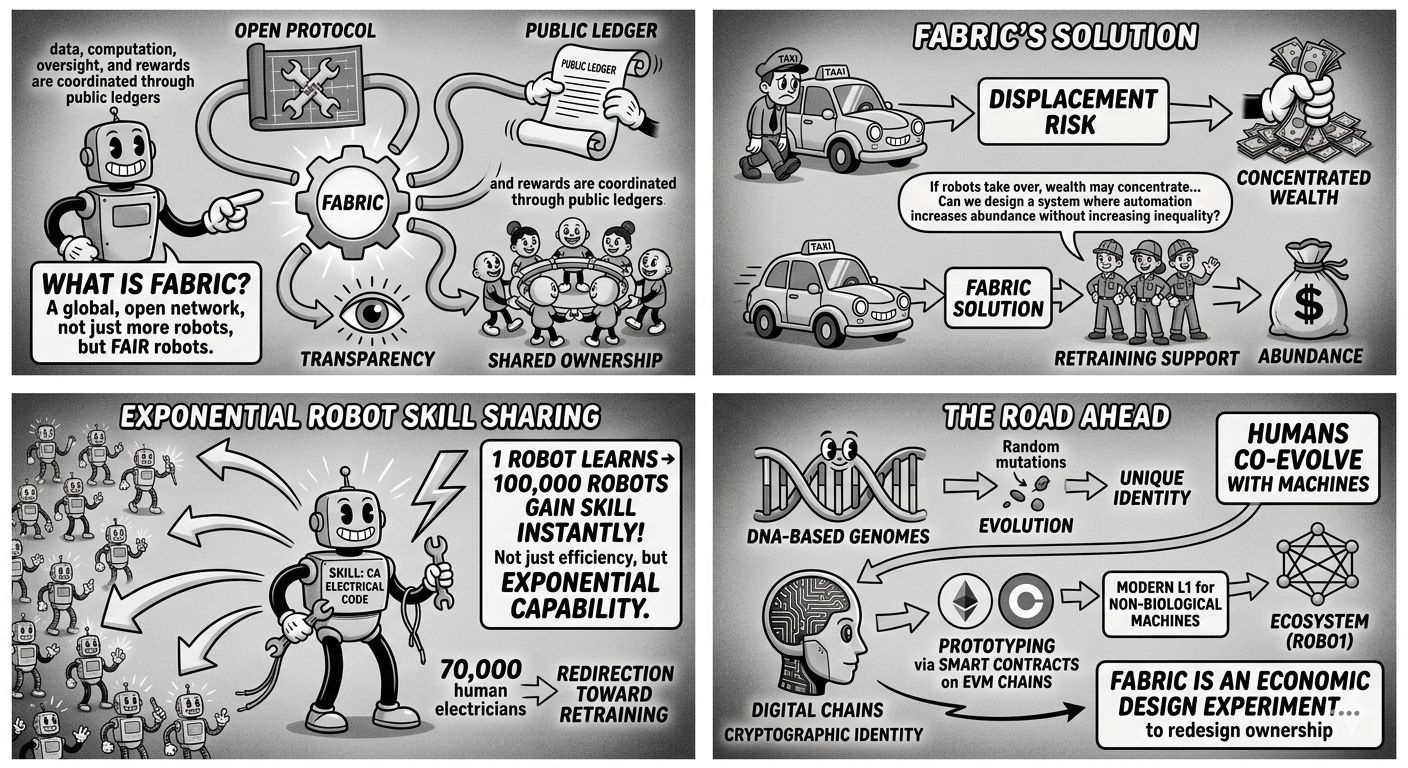
What is Fabric in simple terms?
Fabric is not just about robots. It’s about who controls them, who benefits from them, and how their skills are shared.
Instead of one company owning powerful robots and all the data they generate, Fabric proposes an open protocol where data, computation, oversight, and rewards are coordinated through public ledgers. That means transparency. That means shared ownership. That means participation.
So the real idea is not “more robots.”
The idea is fair robots.
Why do we even need something like this?
Let’s be honest. Robots and AI are already replacing tasks.
Self-driving systems like Waymo show fewer accidents compared to distracted human drivers. Machines don’t get tired. They don’t lose focus. Over time, they will become cheaper, safer, and more efficient.
Now here’s the uncomfortable question:
If robots become the “best” option in cost and safety…
What happens to the people doing those jobs today?
Taxi driving, for example, has historically been an entry point for economic mobility. Many families built stability from those jobs. If robots take over completely, wealth may concentrate in the hands of whoever owns the machines.
So Fabric is asking a deeper question:
Can we design a system where automation increases abundance without increasing inequality?
That’s the real call to action.
What makes robots fundamentally different from humans?
Humans learn step by step.
We spend years practicing.
Some studies say 10,000 hours of deliberate practice are needed for mastery. Electricians, doctors, engineers each builds skill slowly, personally.
But machines don’t work like that.
If one robot learns a skill say, electrical compliance under California law that knowledge can be replicated instantly across thousands of robots.
Think about that.
One trained robot could theoretically share its expertise with 100,000 others in seconds.
That is not just efficiency.
That is exponential capability.
Can you give me a practical example?
Take electricians in California.
A human journeyman electrician may take 4–5 years of training and earn around $60+ per hour. That makes sense expertise takes time.
Now imagine a robot that:
Learns the California Electrical Code
Gains physical dexterity
Performs safely and consistently
Once it masters the skill, that capability can scale across thousands of units.
Operational costs might drop dramatically.
Benefits?
Lower infrastructure costs
Consistent compliance
Fewer workplace injuries
Real-time documentation
But again here’s the hard question:
What happens to 70,000 human electricians?
Fabric doesn’t ignore this risk. It proposes that part of the economic value generated by robots should be redirected toward retraining and participation. That’s not charity that’s structural design.
What is the “winner takes all” risk?
History shows that technology markets often centralize.
If one company controls the best robotic operating system, the best training data, and the most scalable hardware they could dominate entire sectors.
Plumbing. HVAC. Logistics. Healthcare support.
Now imagine that dominance extending globally.
That concentration of capability equals concentration of economic power.
Fabric recognizes this risk early.
Instead of waiting for monopolies to form, it proposes open coordination mechanisms from the start.
What is the long-term vision?
The long-term idea is something bold: material abundance.
Why should a car cost a third of someone’s annual salary? Why should families choose between food and medication?
There’s no physical law forcing scarcity at that level. Much of it is structural inefficiency.
If robots can reduce production cost drastically and if ownership is distributed goods and services could become more affordable and widely available.
Fabric imagines a world where:
People fractionally own robotic networks
Skill updates improve machine performance
Machines generate value
That value supports human education and development
Instead of humans competing against robots, humans co-evolve with them.
Where does the architectural inspiration come from?
This part fascinated me.
Fabric draws inspiration from biology.
Humans store identity and instructions in DNA. Small mutations drive evolution.
Fabric suggests a digital parallel:
Robots having cryptographic identities stored on chains.
Each robot would publicly expose metadata about:
Capabilities
Rule sets
Composition
Operational constraints
In other words, robots become verifiable digital organisms.
Transparent. Accountable. Traceable.
That’s powerful.
What about implementation?
Fabric is not just theory.
The proposal includes:
Prototyping via smart contracts on existing EVM chains
Gradual development of a specialized Layer 1 tailored for non-biological agents
Community-driven design
Hackathons, grants, and competitions to accelerate development
The goal isn’t a closed corporate lab.
The goal is an ecosystem.
So what is my honest takeaway?
Fabric is not just a robotics project.
It’s an economic design experiment.
It accepts that automation is inevitable.
It questions who benefits.
It proposes open coordination before centralization hardens.
Instead of fighting robots, it tries to redesign ownership.
Instead of fearing skill displacement, it explores skill replication with redistribution.
Instead of scarcity, it aims at abundance.
Will it work? That depends on execution, governance, and participation.
But I respect one thing deeply:
It doesn’t pretend the risks don’t exist.
It confronts them.
And in a world where robotics is accelerating faster every year, that kind of structural thinking might be exactly what we need.
If we are serious about building a future with intelligent machines, then the real question is not:
“Can we build them?”
The real question is:
“Can we build them in a way that benefits everyone?”
Fabric Foundation is trying to answer that.
