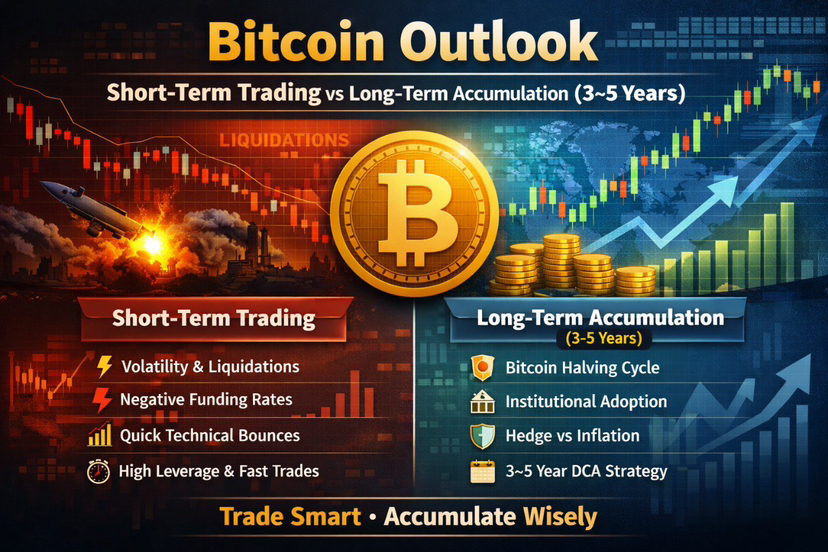
Bitcoin Outlook: Short-Term Trading vs Long-Term Accumulation (3–5 Years)
With rising geopolitical tensions and ongoing macro uncertainty, many traders are asking the same question:
How would Bitcoin react in the short term — and what does it mean for long-term holders?
Let’s break it down clearly.
Short-Term Trading Perspective (Days to Weeks)
In the event of major geopolitical conflict (for example, a U.S.–Iran escalation), markets typically shift into risk-off mode.
What usually happens:
Immediate sharp sell-off.
Long liquidations spike.
Volatility increases dramatically.
Funding rates often turn deeply negative.
A technical bounce follows after panic selling exhausts.
Bitcoin often drops first due to liquidity and leverage being flushed out. However, once excessive longs are cleared and open interest resets, short squeezes and relief rallies become more likely.
Short-term trading approach:
Do NOT catch the falling knife.
Wait for liquidation spikes and funding extremes.
Reduce leverage.
Trade momentum, not prediction.
Be cautious holding leveraged positions overnight during high-impact news cycles.
In volatile environments, survival and capital preservation are more important than aggressive entries.
Long-Term Accumulation Perspective (3–5 Years)
Zooming out changes everything.
Bitcoin is no longer just a speculative asset. It is increasingly influenced by:
Institutional adoption
ETF capital flows
Monetary policy
Government debt expansion
Global currency instability
Key long-term drivers:
1. Supply Reduction (Halving Cycles)
Bitcoin issuance decreases every four years. Long-term supply pressure continues to tighten.
2. Debt & Money Printing
If global tensions lead to higher spending and debt expansion, inflation concerns grow. Hard assets historically benefit from this narrative.
3. Geopolitical Instability
Prolonged instability often increases demand for non-sovereign assets.
Long-term strategy:
View sharp panic drops as DCA opportunities.
Avoid all-in entries.
Accept volatility (30–50% drawdowns are normal in Bitcoin cycles).
Hold with a 3–5 year conviction window.
Short-term volatility does not invalidate long-term structural trends.
Trader vs Accumulator Mindset
Short-term traders focus on:
Volatility
Liquidation levels
Funding rates
Momentum
Long-term investors focus on:
Monetary cycles
Supply mechanics
Adoption trends
Macro liquidity
Both approaches can work — but mixing them often leads to emotional mistakes.
Final Thoughts
If conflict headlines hit the market, expect volatility first.
But over longer horizons, the real question is not “Will Bitcoin drop?”
It is: “What happens when global debt expands and fiat confidence weakens?”
Short-term chaos.
Long-term structural evolution.
Trade smart. Accumulate wisely.