
I first learned about @Fabric Foundation while reading a whitepaper on decentralized robotics. It struck me as a bold idea. I had always viewed AI in robots as unreliable. Machines making decisions without clear checks seemed risky. My perspective shifted as I dug deeper. Fabric Foundation changed how I see trust in autonomous systems.
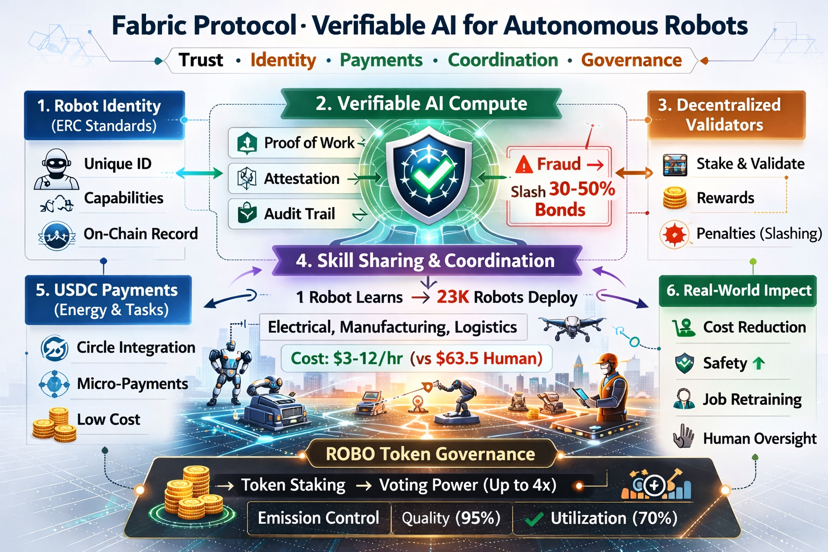
At first I was skeptical. Blockchain for robots sounded like buzzwords. I thought AI needed central control for safety. Then I explored the protocol’s design. It uses verifiable compute. This means robots prove their actions with cryptographic attestations. Validators check the work. They stake bonds. If fraud happens bonds get slashed by 30-50%. This builds accountability. I felt doubt fade. Real trust emerged without a single overseer.
I recall my time working with industrial robots in a factory. They followed scripts but failed in new tasks. Fabric Foundation solves this through coordination. Robots share skills instantly. For example electrician robots can scale fast. One robot learns a task. It shares with thousands. In California twenty three thousand units could handle all electrical work. Costs drop to three to twelve dollars per hour. Humans charge sixty three point five zero. This saves money but displaces seventy three thousand jobs. Fabric adds payments too. Robots use USDC for energy via Circle integration. My experience showed me the need for such systems. Emotions stirred. Excitement mixed with concern for workers.
Deeper analysis revealed identity’s role. Each robot gets a unique cryptographic identity. It follows ERC standards. This exposes capabilities openly. Humans audit actions in real time. I thought about Waymo taxis. They have eight times fewer accidents than human drivers. Fabric extends this. It verifies AI decisions on chain. No tampering possible. Data from the protocol shows adaptive emissions. Rewards tie to contributions. Utilization targets seventy percent. Quality aims for ninety five percent. Bonds require two epochs of work. This resists fake identities. My understanding grew. Skepticism turned to respect.
Governance impressed me most. Token holders lock $ROBO for voting power. Longer locks give more influence up to four times. It sets parameters like emission rates. No central control. Just decentralized signals. Real world examples include hardware like Unitree bots. They integrate with OM1 OS. Skills become modular chips. Like apps for robots. In manufacturing supply chains efficiency rises. Injuries fall. Seven hundred fatalities avoided yearly in electrical work alone. Yet retraining is key. Fabric’s foundation funds this. Emotional insight hit. Technology serves humanity when aligned.
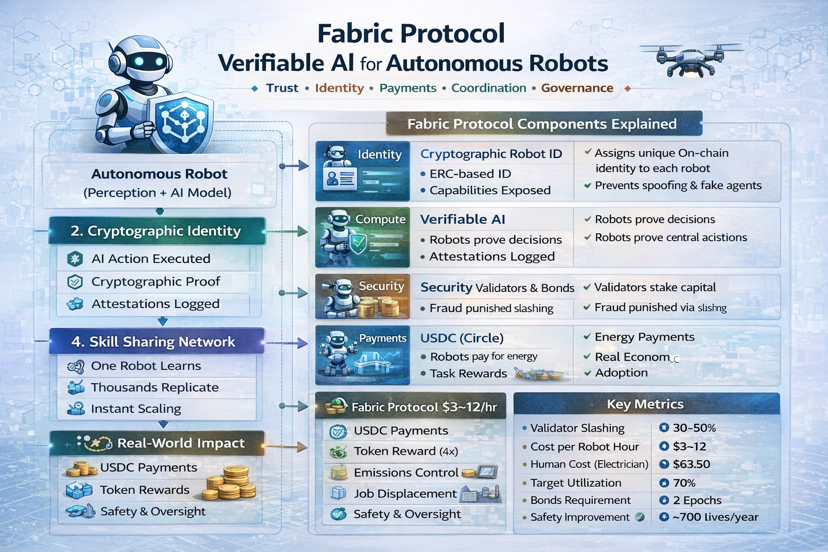
Fabric Protocol proves verifiable AI is real for autonomous robots. It combines identity payments and coordination on blockchain. Numbers show potential. Token supply caps at ten billion. Rewards favor quality work. I now see a future where machines act reliably. Humans stay in charge. This path feels right. Calm assurance guides me forward.