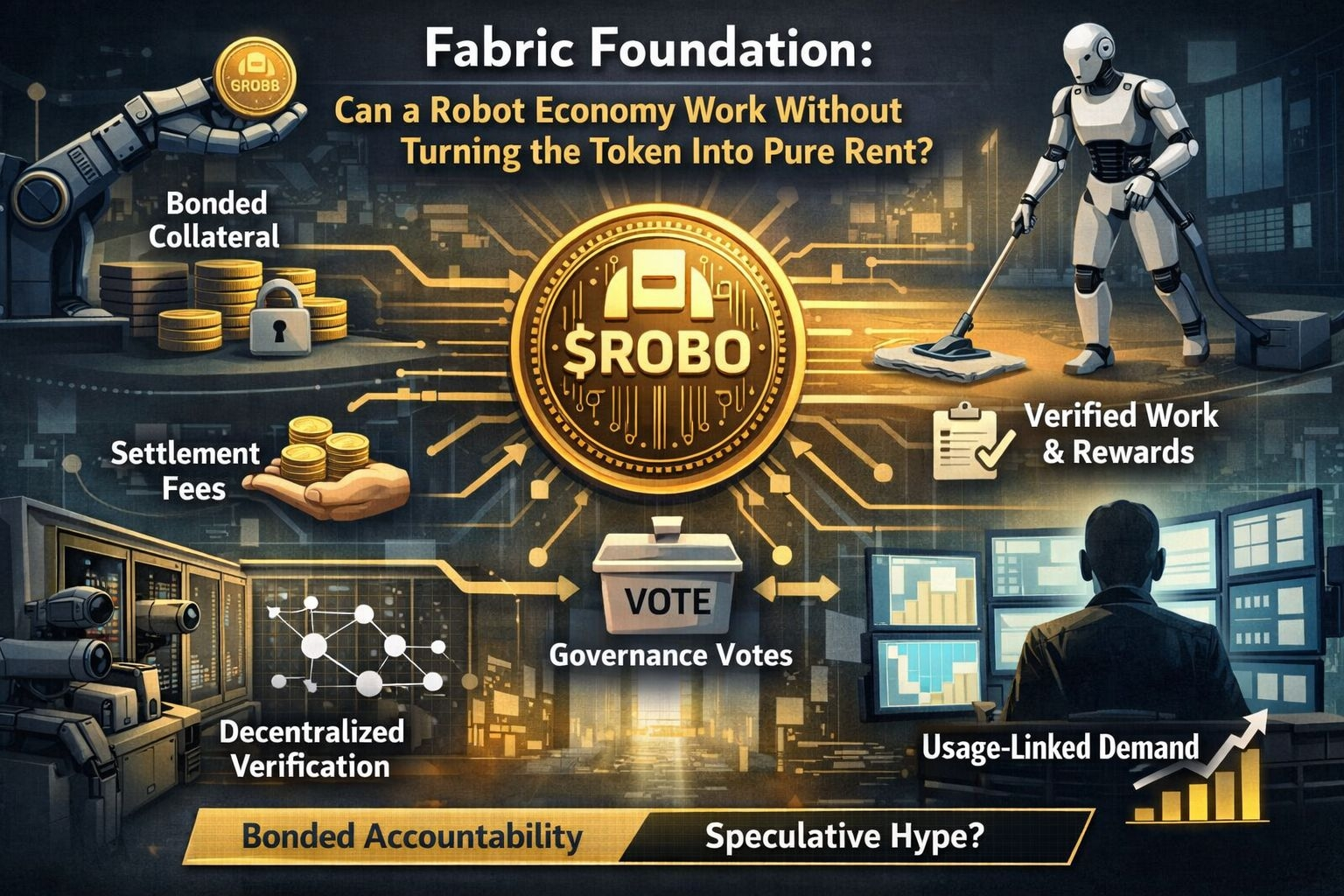
My practical rubric for robotics tokens is simple.If the token only sits at the edge of the system, I lose interest.If the token is required everywhere, I get cautious.Fabric caught my attention because it is trying to sit in the uncomfortable middle. Not a meme wrapper around AI. Not a pure payments coin either. ROBO is supposed to secure robot operators, settle work, gate participation, coordinate governance, and reward verified contribution - all without becoming a passive yield story. That is a serious design ambition. It is also where most projects become messy.Fabric’s real bet is not “robots on blockchain”; it is that a robot network can tie token demand to actual work while making bad behavior economically expensive.Fabric does not position ROBO mainly as a speculative asset. It positions it as operating collateral for a machine economy. Robot operators post refundable performance bonds to register hardware and provide services. Tasks generate fees. Validators check outcomes. Contributors are rewarded only when work is verified. In theory, this creates a loop where usage creates demand, and misconduct destroys value through slashing and suspension.
That is more interesting than the usual “stake token, secure network, hope number goes up” model.The whitepaper gives Robo six operational roles. The most important to me are the first three.
First, access and work bonds: operators lock Robo as a security reservoir. The bond requirement scales with declared capacity, which means larger robot throughput should require more locked collateral. Second, transaction settlement: network-native fees are paid in $ROBO, even if tasks are quoted in stable-value terms off-chain and then converted on-chain. Third, device delegation bonds: token holders can support specific devices by augmenting the operator bond, but the paper is explicit that this is not passive PoS-style yield; usage credits depend on verified service actually happening.
This matters because Fabric is trying to answer a problem crypto people should recognize: how do you create token demand from productive use rather than from narrative alone? The paper’s answer is a stack of “demand sinks.” Bonds lock tokens. Fees create settlement demand. Governance uses veROBO signaling. Revenue can translate into market buybacks via a fee-conversion mechanism. And the aggregate demand model explicitly combines work bonds, fee conversion, and governance lockups rather than pretending one source of demand will carry the whole system.I think that is the strongest part of the design.
The second strong part is that Fabric tries to make rewards contingent on proof of work done inside the protocol, not on capital sitting idle. The whitepaper says token holdings alone do not generate rewards. Participants need contribution scores, minimum active days, and quality-adjusted outcomes. Rewards are haircut if quality falls or fraud is detected, with penalty effects that can persist across epochs. That is much closer to a labor market or service economy than a traditional staking system.In other words, Fabric is not just asking, “Who locked tokens?”It is asking, “Who actually produced something useful, and was it good?”That is the right question for robotics. A robot network should not reward presence. It should reward verified performance.
A small scenario makes the point clearer. Imagine a cleaning robot fleet serving office buildings. In a weak token design, operators could farm emissions just by registering devices and staying technically online. In Fabric’s model, that should be harder. The operator needs bonded collateral. The robot must remain available. If quality drops below threshold, reward eligibility is suspended. If fraud is proven, part of the earmarked stake is slashed and the robot has to re-bond to resume operations. That is a much more grounded incentive structure than “number of wallets staked.”
Still, this is where my skepticism starts.Fabric’s token design looks coherent on paper, but coherence is not the same as market fit. The model depends on reliable verification, honest quality signals, sane oracle behavior for USD-denominated bonds, and enough real robot activity to make settlement demand matter. If usage stays thin, then even a sophisticated utility design can feel over-engineered. If verification is noisy, contributors will fight the scoring system instead of improving the machines. And if governance remains concentrated early on, veROBO can become formal decentralization wrapped around practical central control. The whitepaper itself acknowledges evolving governance and early-stage concentration risk.That is the tradeoff I keep coming back to.Fabric is trying to build a token that behaves less like a chip in a casino and more like working capital in an industrial network. I like that direction. But industrial systems are unforgiving. A good crypto mechanism is not enough. The hard part is whether real operators, validators, and developers will tolerate the added complexity because it genuinely improves trust, fraud resistance, and coordination. The recent official blog post reinforces this positioning - fees, identity, verification, coordination, governance - but the open question is still execution, not conceptual coverage.
So my current view is cautious but interested.Fabric’s most original idea is not that robots need tokens. Many projects can say that.Its more serious claim is that robot networks need bonded accountability, work-linked rewards, and usage-linked demand in the same system. If that works, Robo could look less like a narrative vehicle and more like operational infrastructure. If it does not, the design may end up being too complicated for the amount of real economic activity the network can attract.
How will Fabric prevent quality scores from becoming the main attack surface for reward gaming?What real-world pilot will first prove that Robo demand comes from robot usage, not just token launch activity?What happens to operator economics if bond requirements rise faster than robot revenueWhich metric should outsiders watch first: bonded devices, verified tasks, fee volume, or buyback volume?