
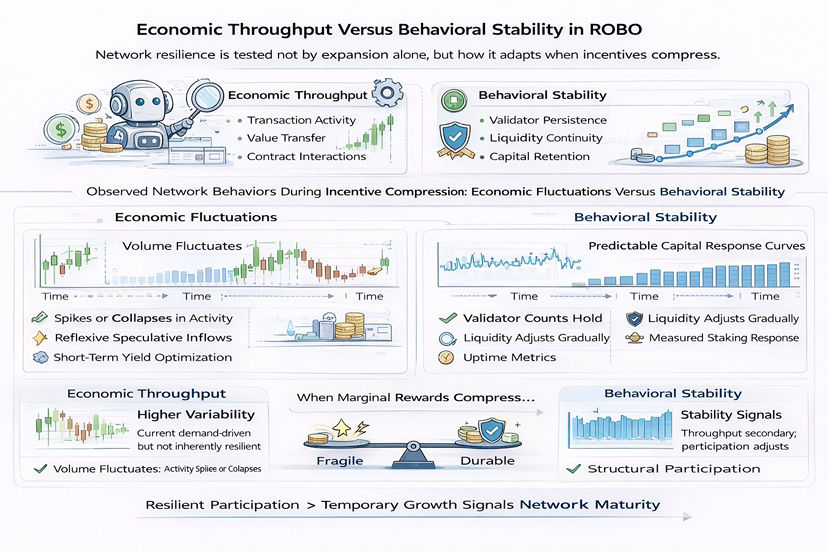
I have found that the real measure of a network is not how it expands under favorable incentives, but how it behaves when those incentives compress. Growth phases can mask fragility. Incentive normalization exposes it. When marginal rewards decline, participation either stabilizes or thins. That inflection is where network quality becomes visible.
Economic throughput in ROBO, transaction activity, value transfer, contract interactions can fluctuate with cycles of demand. But throughput alone does not signal resilience. It can be subsidized. It can be reflexive. It can be temporary. Behavioral stability, by contrast, is harder to engineer. It is revealed in validator persistence, liquidity continuity, and capital retention when reward gradients flatten.
The on chain activity data supports various useful indicators. Validator counts have stayed in a fairly small operational range during emission changes, with very few examples of abrupt operator turnover. Validator uptime hasn’t changed by much during low transaction activity periods; in addition, these uptime metrics support the conclusion that validators are supporting their infrastructure commitment over a longer term time frame than just for yield maximization purposes.
When it comes to staking participation, we see more of a measured response from participants than an impulsive withdrawal. Adjustments to the reward schedule have not resulted in synchronized delegation withdraws. In general, capital has reallocated to other validators gradually over time. Participants with longer-term staking will appear to be the least affected by changes in emissions; thus, participants with shorter-term capital will tend to move their capital much more regularly than those with longer-term capital.This dispersion is healthy. Homogeneous behavior under stress is usually a warning sign.
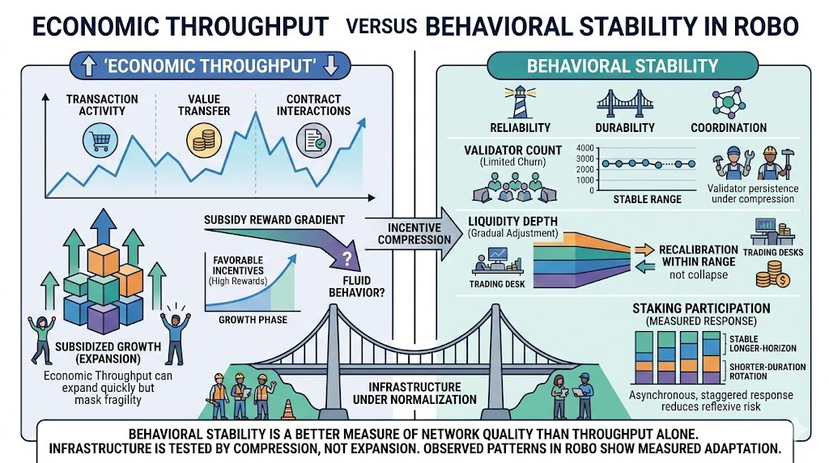
During volatility clusters, order book depth has compressed incrementally rather than collapsing. Exchange inflow patterns have not displayed sustained spikes typically associated with broad distribution events. Liquidity has adjusted, but it has not vacated. That distinction matters. When incentives narrow, does liquidity fragment immediately, or does it recalibrate within range? In ROBO’s case, recalibration has been the dominant pattern.
Reward response timing further reinforces this interpretation. Behavioral elasticity appears staggered across participant classes. Validators, delegators, and liquidity providers have not reacted in unison to emission recalibrations. Such asynchrony reduces reflexive risk. It implies a mix of strategic and tactical capital rather than purely mercenary flows.
From a long term capital perspective, these patterns suggest that ROBO’s economic throughput is not the primary anchor of network value. Structural participation is. Throughput can expand quickly in favorable cycles and contract just as quickly. Stability compounds more slowly. It builds through consistent operator presence, disciplined liquidity behavior, and predictable capital response curves.
This is why I increasingly frame ROBO as infrastructure rather than opportunity. Infrastructure is defined by reliability under compression. It is tested during normalization, not expansion. The question is not whether activity can grow. It is whether coordination persists when growth slows.
Risk remains. Incentive design always carries second order effects. But the observable behavior so far reflects measured adaptation rather than disorder. Validator participation has held. Liquidity has adjusted without cascading withdrawal. Retention signals suggest structural commitment among longer horizon participants.
Durability is rarely loud. It appears in the absence of panic. In ROBO, the distinction between economic throughput and behavioral stability is becoming clearer. And in evaluating network maturity, I place greater weight on the latter.
@Fabric Foundation #ROBO $ROBO
