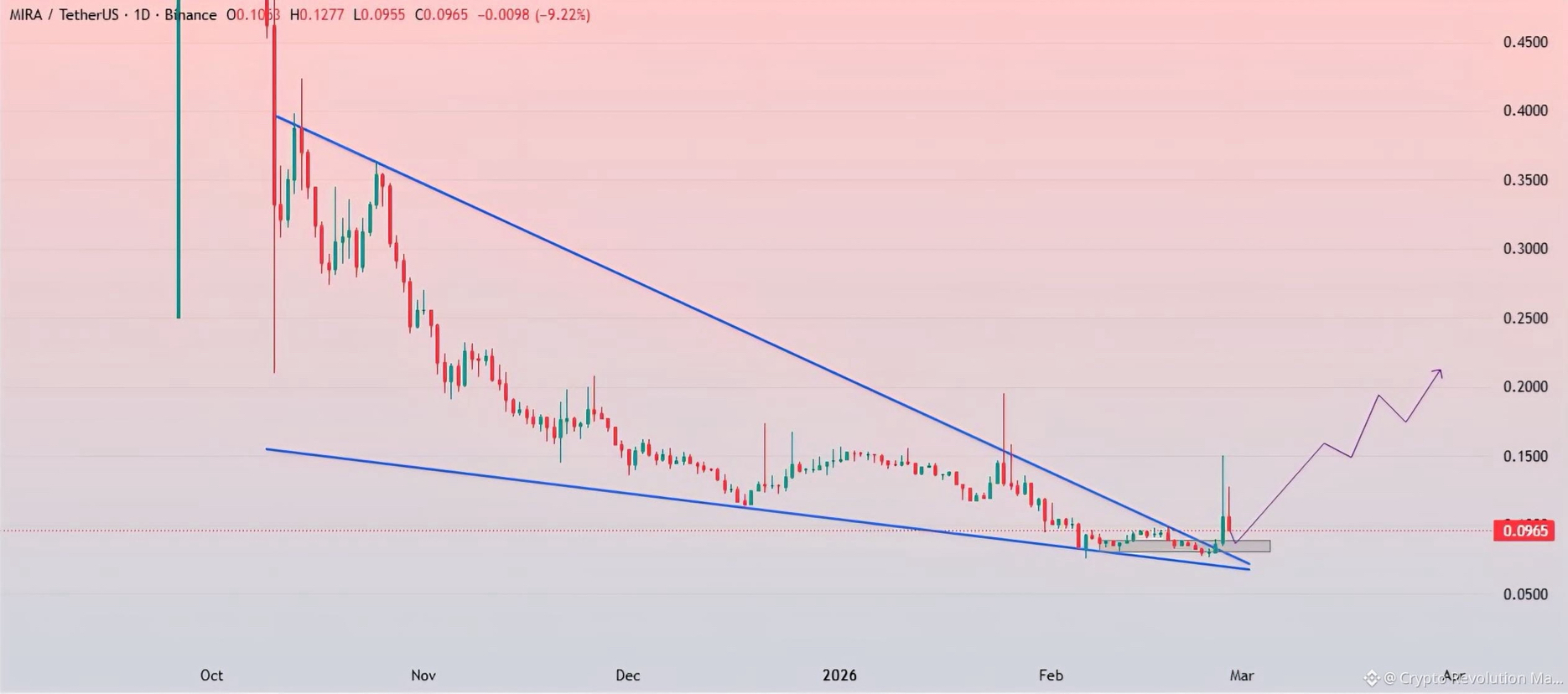
MIRA is beginning to show structural strength again. After an extended period of compression and steady accumulation, momentum appears to be shifting. With increasing visibility through the Binance Square CreatorPad campaign, exposure is expanding just as supply tightens — a combination that often precedes stronger directional movement. But the larger story goes far beyond short-term price dynamics.
At its core, Mira Network is addressing one of the most fundamental challenges in artificial intelligence: trust. Modern AI systems, particularly large language models, generate outputs that sound coherent and authoritative regardless of their factual accuracy. Hallucinations, reasoning inconsistencies, and subtle biases remain persistent issues. Today, these problems are typically mitigated through human review, centralized moderation, or expensive retraining cycles. While effective to a degree, those approaches are slow, costly, and inherently centralized.
Mira introduces a different framework. Instead of placing blind trust in the model itself, the protocol focuses on verifying the output. AI-generated responses are decomposed into structured claims that can be independently evaluated. Rather than assessing an entire response as a single unit, the system isolates factual assertions and distributes them across a decentralized network of validators. Each validator participates in assessing claim accuracy, and their influence within the network is dynamically recalculated based on historical precision rather than stake alone.
This dynamic influence weighting mechanism is central to the design. Reputation is not static; it evolves continuously. Validators with consistent accuracy gain greater weighting, while minor deviations compound over time into gradual influence decay. This introduces a performance-based trust layer where authority is earned and maintained through verifiable precision. The recalibration process operates continuously, block by block, without reliance on centralized intervention.
Cryptographic proof systems anchor verified outcomes, ensuring transparency and auditability. Once claims are validated, results can be referenced with mathematical guarantees rather than subjective assurance. This combination of decomposition, distributed verification, and cryptographic anchoring creates an automated trust framework that adapts in real time.
The implications are significant. As AI agents become more autonomous—executing trades, conducting research, generating code, or making operational decisions—the need for verifiable outputs increases exponentially. Infrastructure that can validate AI behavior at scale becomes critical. Mira is positioning itself not as another AI model, but as middleware: a reliability layer sitting between generation and execution.
Beyond verification, the ecosystem provides developer tooling that simplifies integration. Modular workflows, customizable validation logic, and accessible SDK frameworks reduce the complexity of embedding verification into AI-native applications. This lowers development overhead and accelerates deployment timelines for teams building agent-based systems.
From a market perspective, the combination of technical narrative and expanding exposure through Binance Square CreatorPad increases visibility at a time when accumulation appears to be maturing. Infrastructure protocols often gain momentum when their utility narrative aligns with broader sector trends. In this case, decentralized AI verification intersects directly with the growth of autonomous agents and on-chain AI systems.
If AI becomes the execution layer of the internet, verification becomes the trust layer beneath it. That structural thesis is what differentiates Mira’s positioning. Rather than competing in model performance, it focuses on reliability, accountability, and scalable validation.MIRA’s current market structure may reflect growing awareness, but the deeper value proposition lies in the architecture. In a world where machine-generated outputs increasingly influence financial, informational, and operational decisions, trust infrastructure is not optional. It is foundational.
@Mira - Trust Layer of AI $MIRA
Trust Layer of AI