
When people hear about a new crypto project, they usually assume it’s another startup trying to build a product, raise funding, and eventually dominate a market. That assumption isn’t wrong most of the time. But sometimes, a project isn’t trying to become a company at all. It’s trying to become infrastructure. And that difference quietly changes everything.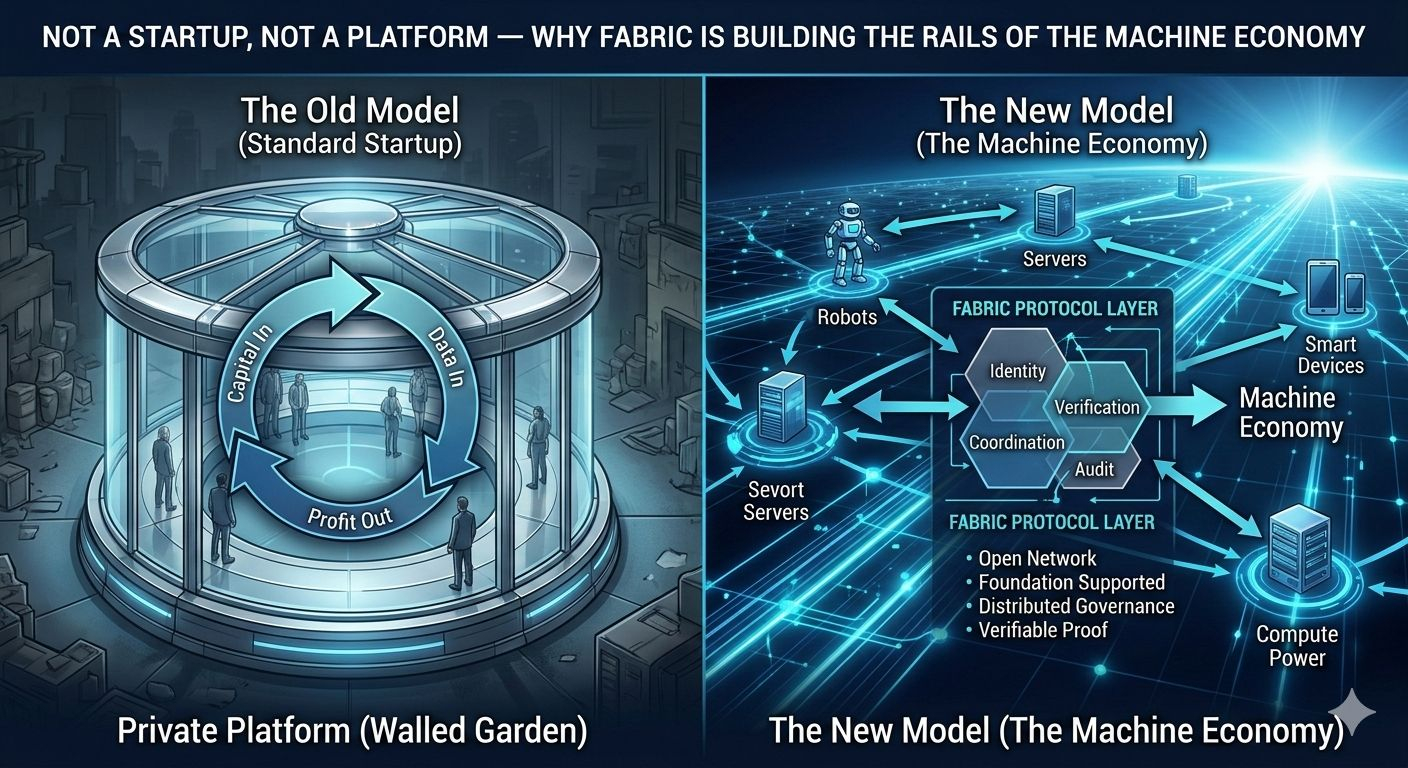
Fabric seems to fall into that second category. Instead of positioning itself as a company that owns a product, controls users, and monetizes every interaction, it presents itself as an open network supported by a foundation. At first glance, that might sound like a small structural choice. In reality, it reflects a completely different philosophy about power, growth, and responsibility.
To understand why this matters, think about how the internet evolved. The core of the internet wasn’t built as a private product. The protocols that power it were open. Anyone could build on them. No single company owned the foundation of how data moved across the world. Companies like Google, Amazon, and Facebook were built on top of that shared layer, but they didn’t own the layer itself. That openness allowed innovation to explode.
Blockchain technology revived that same spirit. Instead of private databases controlled by corporations, public blockchains created shared systems where anyone could participate. They weren’t perfect, and they came with new challenges, but they shifted the conversation from “Who owns this?” to “Who can access this?”
Fabric appears to be applying that same mindset to AI and robotics. Rather than building a robotics company that controls machines, data, and decision-making behind closed doors, the idea is to create a protocol where machines can be identified, verified, and coordinated openly. That’s not just a technical shift. It’s a cultural one.
As machines become more intelligent and more present in the physical world, trust becomes a serious issue. If a robot makes a decision that affects people, who is accountable? If an AI system executes an action, how can anyone verify what actually happened? In a traditional company model, the answer is simple: you trust the company. But trust in companies is fragile. It depends on reputation, regulation, and internal transparency that the public rarely sees.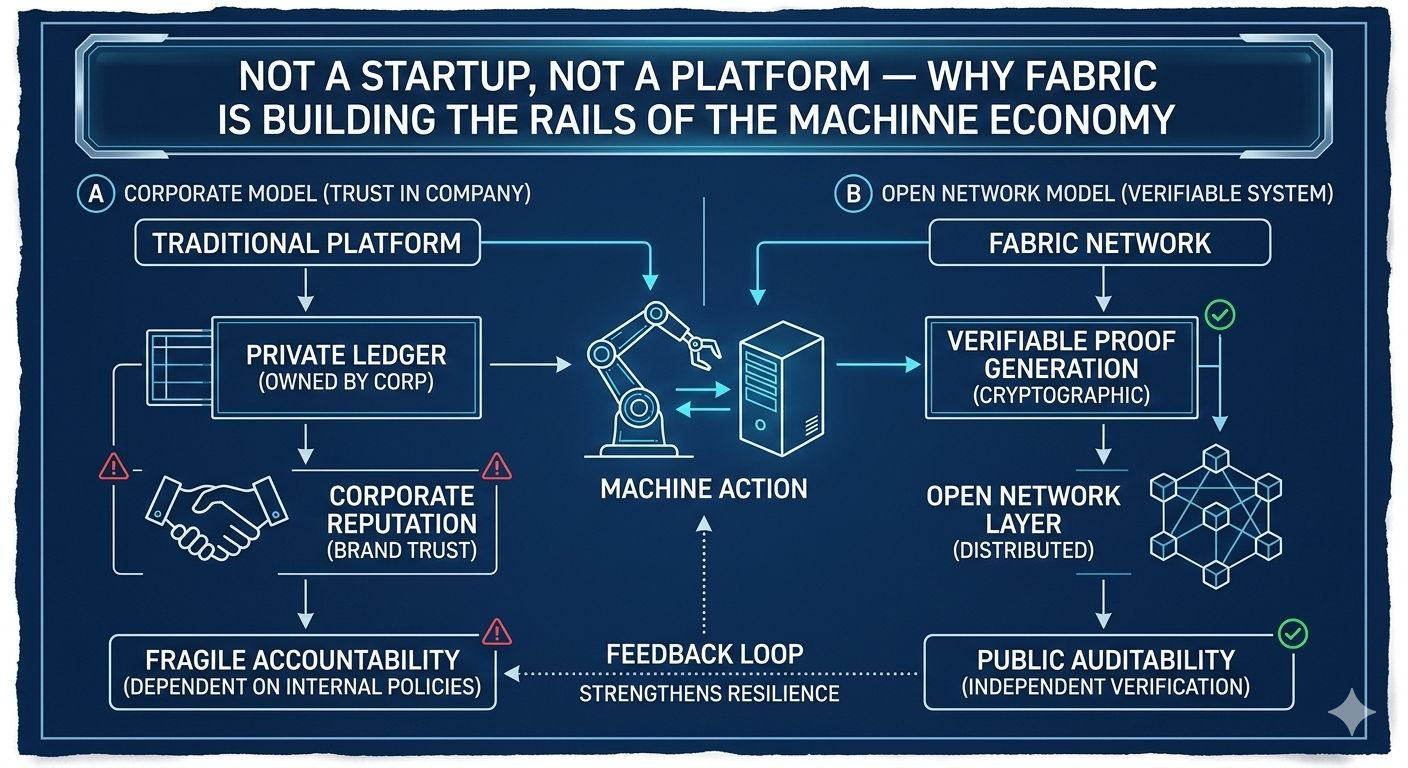
An open network tries to solve this differently. Instead of asking people to trust an organization, it uses verifiable systems so actions can be audited independently. It’s not about believing someone’s word; it’s about checking proof. That idea feels subtle, but over time it changes how responsibility works.
There’s also an emotional layer to this conversation. People are increasingly uneasy about technology being controlled by a handful of massive corporations. From social media to cloud infrastructure, centralization has created enormous power imbalances. Fabric’s choice to build as an open network instead of a private company seems to respond to that unease. It suggests that the coordination layer of future machines shouldn’t belong to a single boardroom.
Of course, openness isn’t automatically better. It’s harder. A company can move fast because decisions are centralized. A network has to coordinate across many participants. Governance becomes complicated. Incentives must be aligned carefully. Tokens, voting systems, and foundations introduce new forms of politics. It’s slower and sometimes messy.
But that messiness can also be strength. When many stakeholders participate, the system is less dependent on one leader’s vision. It can adapt. It can survive beyond its founders. It can evolve in ways a single company might never allow.
There’s also a long-term perspective here. If AI and robotics truly become core infrastructure for society — handling logistics, automation, even public services — then whoever controls that coordination layer holds enormous influence. Building it as a company concentrates that influence. Building it as a network distributes it.
Fabric’s approach feels less like launching an app and more like laying down digital rails. Rails are not glamorous. They don’t belong to one passenger. They exist so many trains can move. That’s a different ambition. It’s slower to monetize and harder to control, but potentially more resilient.
None of this guarantees success. Open networks can fail. They can become fragmented or captured by insiders. Token economies can become speculative rather than productive. Governance can stall. The open model is not automatically noble or effective simply because it is decentralized.
But the intention matters. Choosing to build an open network instead of a company signals a belief that infrastructure should be shared, that machine intelligence should be verifiable, and that coordination should not depend entirely on corporate authority.
At its core, this isn’t just about Fabric. It’s about the kind of technological future we’re moving toward. Do we want the systems that coordinate intelligent machines to be privately owned platforms, or public networks anyone can build on? Do we want trust to come from brand reputation, or from open verification?
Fabric seems to be placing its bet on openness. It’s a bold bet, and not the easiest one. But if the next era of technology truly reshapes how machines and humans interact, building that foundation as a shared network rather than a closed company could turn out to be one of the most important decisions made at this stage.
