@Mira A Human Story About Trust, Doubt, and the Futureof AILet me start with something simple.Have you ever asked AI a serious question… and felt a tiny knot in your stomach after reading the answer?
It sounded confident.It looked polished.It felt intelligent.But deep down you wondered,
What if this is wrong?That small feeling of doubt is not paranoia.
It is instinct.And Mira Network is built around that instinct.
The Fear We Don’t Say Out Loud
AI today is powerful. Almost magical.
It writes.It analyzes.It explains.It predicts.But it also hallucinates.It can invent facts.
It can misquote studies.
It can confidently give incorrect legal or medical information.
And it does not know when it is wrong.
That is fine when asking for a recipe.
It is not fine when asking about surgery risks.
Or investment decisions.
Or autonomous systems controlling machines.
As AI becomes more embedded in our lives, the cost of being wrong increases.
That is where Mira begins.
What Mira Network Really Is
Mira Network is not trying to make AI smarter.
It is trying to make AI trustworthy.
It adds a verification layer between AI output and real world action.
Instead of blindly accepting what one model says, Mira breaks the answer into small, checkable claims.
Then those claims are sent across a network of independent validators.
Multiple systems examine each claim.
If enough agree according to defined rules, the claim becomes verified.
If they disagree, it is flagged.
The result is recorded on chain so it cannot be secretly altered later.
So instead of one AI saying “trust me,”
you get a network saying “we checked.”
That feels different.It feels safer.Why This Feels Important on a Human Level
Trust is fragile.One major AI mistake in healthcare or finance could damage public confidence for years.
People do not reject technology because it is new.
They reject it when it hurts them.
Mira tries to prevent that damage before it happens.
It slows the system down just enough to ask,
Has this been verified?
In a world obsessed with speed, that pause matters.
How It Works in Simple Words
Imagine AI writes a paragraph.
Mira breaks it into smaller claims.
For example, if the AI says:
This medication reduces blood pressure by 20 percent in adults according to a 2021 study
Mira extracts:
The medication nameThe percentage claim
The target groupThe study referenceEach claim is sent to independent verifier nodes.
Different AI models or validators check each piece.
They evaluate independently.
If consensus is reached, the claim is marked verified.If not, it remains uncertain.
The verification is anchored cryptographically.
No one can quietly rewrite history later.That is accountability.
The Role of the MIRA TokenMira Network uses a native token called MIRA.
This token is not just for trading.It aligns incentives.
Validators must stake tokens to participate.If they validate honestly, they earn rewards.
If they act dishonestly, they risk losing their stake.Applications pay verification fees in MIRA.
Token holders can vote on governance decisions.
This creates economic responsibility.Verification is not based on reputation alone.
It is backed by skin in the game.
Market tracking and price information for MIRA can be viewed on Binance price pages, providing transparency into supply and performance.
But long term strength will depend on usage, not price charts.The Ecosystem
Mira is infrastructure.It supports others.Participants include:
Validator node operatorsDevelopers integrating verificationAI model contributorsGovernance participants
Token holdersPotential use cases include:Healthcare AI tools
Financial analytics platformsAutonomous agentsRobotics systems
Content authenticity layersAnywhere trust matters, verification becomes valuable.
The Road Ahead
Mira’s roadmap focuses on gradual decentralization and adoption.Refining verification modelsExpanding validator participationImproving developer toolsSupporting real world integrations
Strengthening governanceThis is not a quick cycle story.
It is a foundation building story.
Infrastructure is rarely glamorous.But it is essential.The Hard TruthVerification is not easy.If validators share similar biases, consensus can still be flawed.Economic concentration can threaten decentralization.Verification adds latency.Privacy must be protected.Regulatory clarity is still evolving.
These challenges are real.But ignoring the problem of AI reliability is riskier.
The Bigger Emotional Question
We are entering an era where machines influence decisions at scale.
The real question is not how intelligent they are.The real question is whether we can trust them.
Mira Network is trying to build that trust layer.
It says:Before AI influences health
Before AI influences wealthBefore AI influences safetyVerify first.That philosophy is simple.Responsibility before automation.Final Thoughts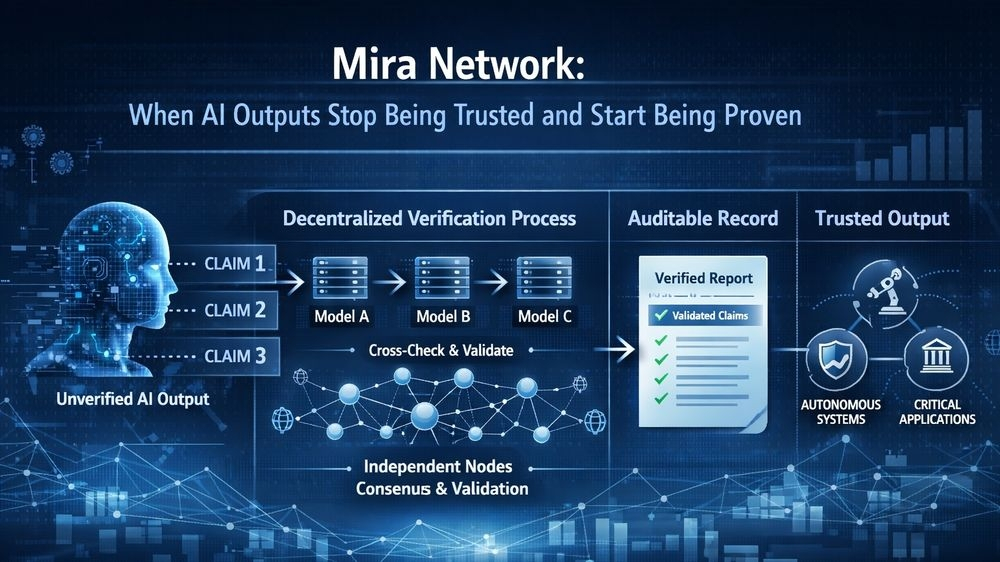
Mira Network feels less like a hype project and more like a safety mechanism.It does not promise perfection.It promises accountability.
If AI is going to shape the future, society will demand systems that can be audited, verified, and challenged.
Mira is building infrastructure for that demand.In the end, technology succeeds when people feel safe using it.
And safety begins with trust.If you would like, I can now create:A powerful investor narrativeA simplified beginner explanationOr a deep technical architecture breakdownTell me which direction you want next.@Mira #NIRA $MIRA