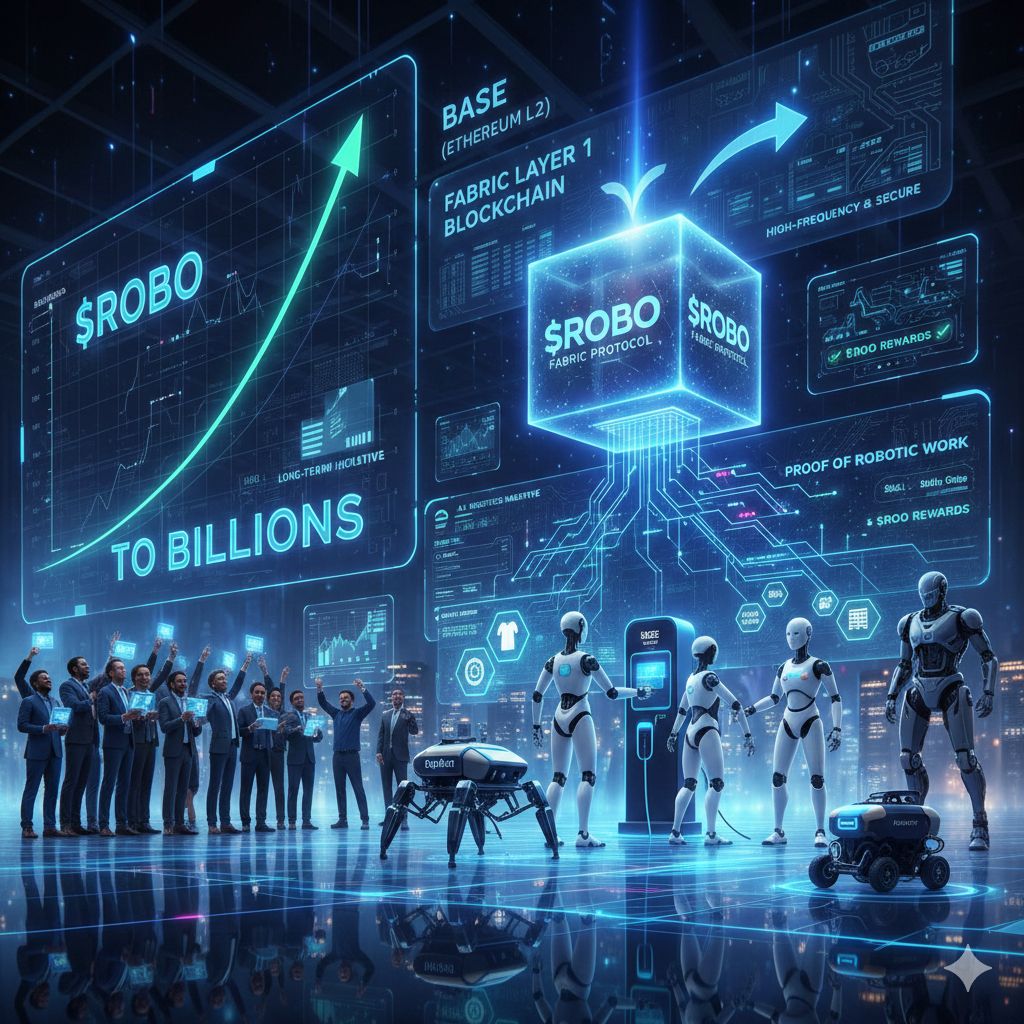
In the dynamic world of decentralized technology, every now and then a project emerges that truly captures the imagination, hinting at a future that once belonged to the realm of science fiction. The Fabric Protocol, powered by its ROBO token, is undoubtedly one of these. Currently in its thrilling early adoption phase, Fabric Protocol isn't just another crypto project; it's laying the fundamental groundwork for a future where AI and robotics converge, promising a "DePIN" (Decentralized Physical Infrastructure Network) that could reshape industries and amass a valuation stretching into the billions.
From Base Layer 2 to its Own Robotic Highway
One of the most exciting aspects of Fabric Protocol's journey is its strategic evolution. While $ROBO currently thrives as a Layer 2 solution on Base, leveraging Ethereum's robust security and scalability, this is merely a stepping stone. The vision for Fabric Protocol extends far beyond, anticipating a future where billions of robots will need to communicate and transact at lightning speed.
Imagine a world where every industrial robot, every autonomous delivery drone, and every household helper needs to pay for its own electricity, purchase new "skills," or even earn rewards for completing tasks. Such a future demands an infrastructure specifically built for the unique demands of high-frequency, machine-to-machine transactions. This is why the Fabric Foundation is diligently working towards the launch of its own dedicated Layer 1 blockchain. This move will not only ensure unparalleled security but also provide the necessary bandwidth and low latency for a truly decentralized robotic economy to flourish. It's about building a digital highway tailored for the speed and volume of future robot interactions, far surpassing the capabilities of general-purpose blockchains.
The AI x Robotics Narrative: A Magnet for Long-Term Visionaries
The convergence of Artificial Intelligence and Robotics is not just a technological trend; it's a narrative that has captivated both innovators and investors alike. We're witnessing a paradigm shift where robots are no longer just pre-programmed machines but intelligent entities capable of learning, adapting, and interacting with their environment.
Fabric Protocol sits at the very heart of this revolution. By providing the decentralized infrastructure for robot identities, autonomous payments, and proof of robotic work, it's enabling a future where robots are not just physical assets but active, contributing members of a digital economy. This powerful blend of cutting-edge AI capabilities with the tangible utility of robotics creates a compelling long-term investment thesis.
Savvy traders and investors are recognizing this profound potential. They understand that while the initial stages involve building the foundational layers, the eventual scale of this DePIN could be staggering. Holding $ROBO tokens isn't just about speculating on market trends; it's about investing in the very backbone of the future robotic economy. It's a bet on innovation, on efficiency, and on a future where machines and humans collaborate in unprecedented ways.
Beyond the Hype: Tangible Impact and Future Potential
While the talk of billions and groundbreaking technology might sound abstract, the practical implications of Fabric Protocol are very real. It’s paving the way for:
Verifiable Robot Identities: Ensuring trust and accountability in an increasingly automated world.
Autonomous Economic Activity: Robots will be able to manage their own finances, leading to new business models and efficiencies.
Decentralized Robotic Services: A global marketplace for robotic skills and services, accessible to anyone.
Enhanced Security: A dedicated Layer 1 blockchain will safeguard sensitive machine data and transactions.
The journey from early adoption to widespread integration is always a complex one, but Fabric Protocol has laid out a clear, ambitious, and deeply thoughtful roadmap. It understands that to truly unleash the potential of AI and robotics, a robust, secure, and decentralized financial infrastructure is not just an advantage, but a necessity. As we move further into the 21st century, the Fabric Protocol and its ROBO token are poised to become not just a significant player, but potentially one of the defining projects shaping the automated world of tomorrow. The future, it seems, is being built by robots, powered by ROBO.