


Every technological epoch eventually consolidates. Railroads did. Telecommunications did. The internet-despite its open beginnings-tilted toward platform concentration.
Artificial intelligence is following a similar arc. Frontier models cluster inside well-capitalized labs. Compute is geographically and financially centralized. Access, increasingly, is permissioned.
Robotics may be next.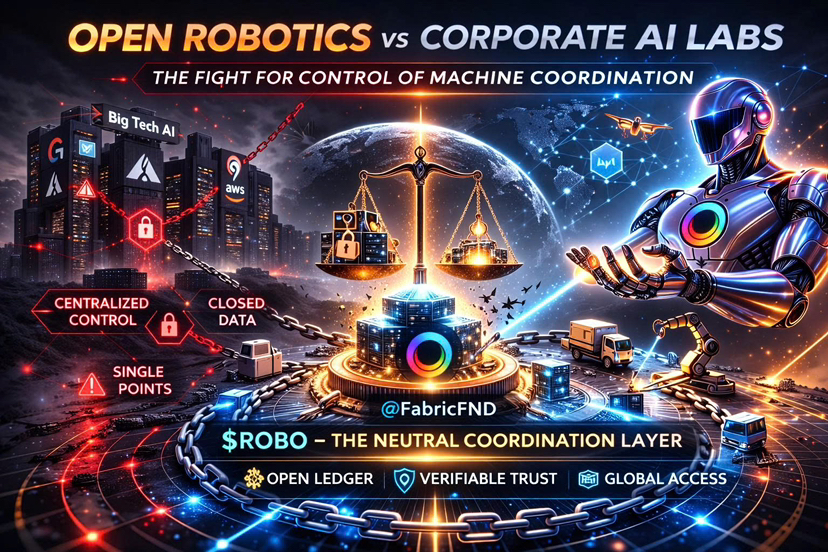
General-purpose robots-capable of adapting across environments rather than executing narrow, repetitive tasks-will demand massive coordination across data providers, model developers, hardware manufacturers, and regulatory bodies. The temptation, naturally, is vertical integration. One entity owns the stack. One entity dictates standards.
Yet @FabricFND appears to be taking a different stance. Through $ROBO, it proposes that coordination itself should be public infrastructure.
This is not an anti-corporate argument. Corporations excel at execution. But when physical intelligence becomes economically material, control of coordination layers transforms into structural power. Whoever governs interoperability defines who can participate.
Fabric Protocol introduces a ledger-mediated framework where robotic computation, data contributions, and governance logic converge transparently. The subtlety here matters. The ledger is not merely recording activity-it is shaping how collaboration occurs.
In centralized robotics ecosystems, collaboration often happens through contractual agreements, proprietary APIs, and closed datasets. Efficiency is high. Openness is conditional. Under the $ROBO model, collaboration aspires to be protocol-native. Rules are embedded in shared infrastructure rather than negotiated behind closed doors.
Critics might argue that decentralization in robotics is impractical. Hardware manufacturing demands capital. Safety standards require strict oversight. Distributed governance, if poorly managed, can fragment decision-making. These are valid concerns. Open systems are rarely frictionless.
However, concentration carries its own fragility. A vertically integrated robotics ecosystem risks single points of failure-technical, political, or economic. If general-purpose robots become embedded in logistics chains, healthcare systems, or energy grids, systemic dependency on a handful of providers becomes strategically sensitive.
By anchoring coordination to a public ledger, @FabricFND positions $ROBO as a counterbalance. Not necessarily to eliminate corporate participation, but to prevent unilateral dominance of the collaboration layer. In this framing, $ROBO functions less like a speculative asset and more like governance infrastructure.
There is also a geopolitical dimension. As AI increasingly intersects with national security and industrial policy, robotics governance may become entangled in sovereign competition. A neutral protocol layer offers a third axis-neither state-controlled nor corporate-exclusive. Whether such neutrality can be preserved is uncertain, yet the architectural intent signals foresight.
From a market perspective, this introduces a differentiated thesis. Many AI-adjacent tokens rely heavily on narrative momentum. Fabric’s positioning is more infrastructural. Infrastructure narratives mature slowly. They are evaluated not by demos alone but by ecosystem durability, developer traction, and regulatory adaptability.
Adoption remains the open variable. Protocols do not achieve neutrality by declaration. They earn it through usage. For $ROBO to solidify as a coordination primitive, robotic builders must perceive value in transparency, shared governance, and verifiable computation. That cultural shift may take time.
Still, the underlying question grows louder: as machines become agents capable of economic interaction, who arbitrates their interoperability?
If the answer consolidates entirely within a handful of labs, robotics may replicate the concentration dynamics already visible in AI. If, instead, coordination layers are embedded in open protocols, competitive landscapes widen.
@FabricFND seems to be wagering that openness at the infrastructure layer creates resilience at scale. It is a structural bet, not a marketing flourish.
And structural bets rarely reveal their importance in early cycles.
They matter most when scale exposes fault lines.
In that future scenario-where general-purpose robots operate across industries, borders, and regulatory regimes-the presence or absence of a neutral coordination substrate could determine whether robotics evolves as a shared utility or a gated domain.
$ROBO, therefore, is not merely about token economics. It is about who sets the rules when machines collaborate.
The market may price volatility in the short term. History, however, tends to reward architectures that anticipate power concentration before it crystallizes.