
I have spent a lot of time watching the strange relationship between traditional finance and cryptocurrency slowly evolve. For years, Bitcoin felt like something that lived outside the financial world most investors knew. It was part technology experiment, part financial rebellion, and part community movement. People who wanted to invest in it had to learn things that traditional investors never worried about: private keys, cold wallets, seed phrases, and crypto exchanges that operated very differently from stock markets.
But the moment that truly made me pause was when BlackRock decided to step directly into the Bitcoin ecosystem. When a company that manages trillions of dollars begins building financial products around Bitcoin, it changes the entire conversation. I remember thinking that this was not just another crypto story. Something bigger was happening.
That curiosity pushed me to spend time researching how their Bitcoin ETF actually works. The more I looked into it, the more I realized that the product is essentially a bridge between two very different financial worlds. On one side there is the familiar environment of brokerage accounts, regulated exchanges, and institutional asset managers. On the other side there is the decentralized and often chaotic world of cryptocurrencies.
The product that sits in the middle of that bridge is called iShares Bitcoin Trust (IBIT). Instead of requiring investors to buy Bitcoin directly, the fund allows them to gain exposure to Bitcoin’s price simply by purchasing shares. These shares trade on NASDAQ, just like any other ETF. To a traditional investor looking at their brokerage account, it appears no different from buying a stock index fund or a commodity ETF.
What makes it interesting is what happens behind the scenes. The ETF actually holds real Bitcoin to support the shares that investors trade. Each share represents a small portion of the Bitcoin owned by the fund. When I first understood this structure, it became clear why so many investors were waiting for something like this. It removes the technical barriers that often discourage people from entering the crypto market.
Another part of the system that caught my attention during my research was the custody structure. Security has always been one of the biggest concerns surrounding digital assets. In the case of IBIT, the Bitcoin held by the fund is stored by Coinbase through its institutional platform Coinbase Prime. The coins are kept in cold storage, meaning they remain offline and isolated from internet-connected systems.
This detail might sound technical, but it is actually important. In the early days of cryptocurrency, stories of hacked exchanges and lost funds made many investors cautious. By storing assets in offline wallets and separating them from operational systems, the ETF aims to reduce the risks that previously defined much of the crypto industry.
While researching how the ETF maintains its pricing, I discovered another mechanism that keeps everything aligned with the real Bitcoin market. The fund uses a process where new shares can be created or removed depending on investor demand. If more investors begin buying the ETF, additional shares can be issued and the fund purchases more Bitcoin. If investors start selling, the opposite can happen. This system helps the ETF’s share price move closely with the price of Bitcoin itself.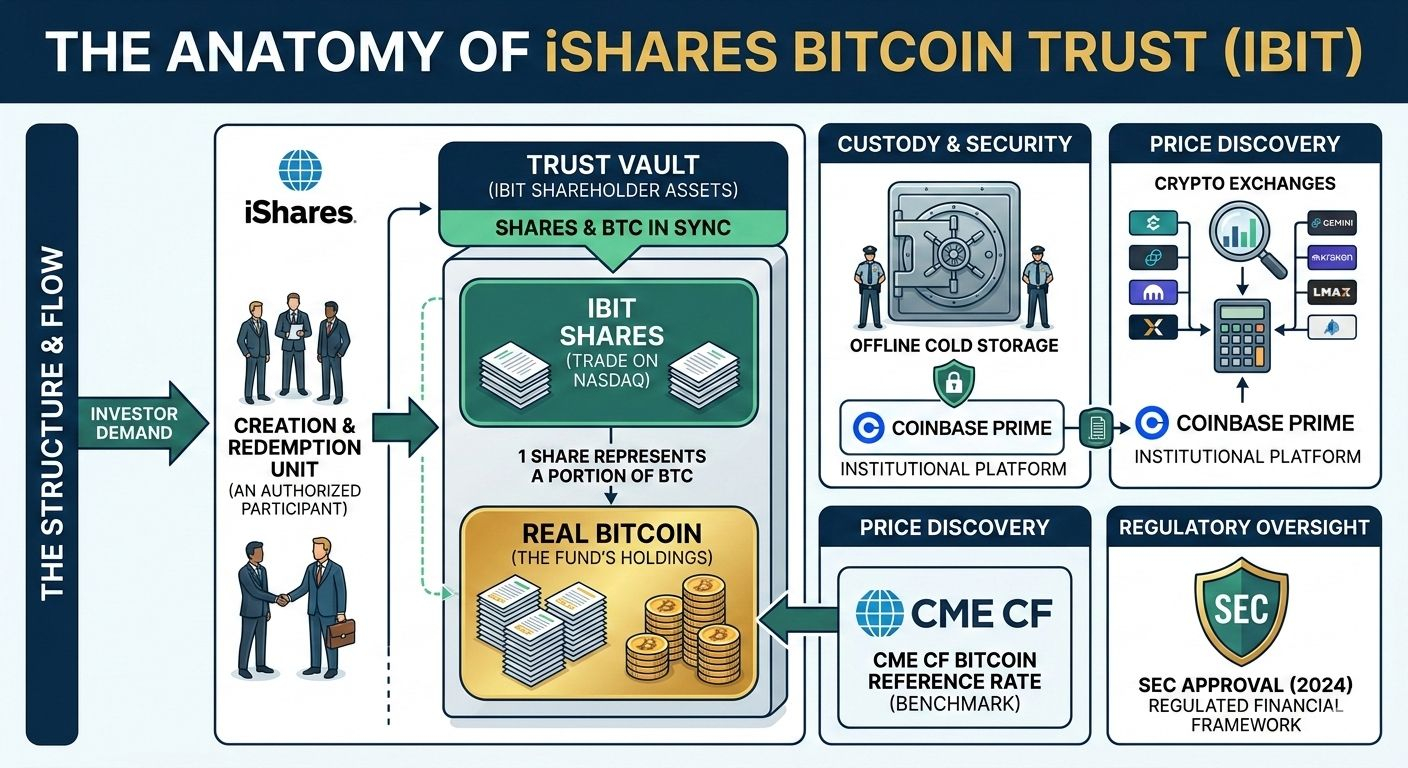
To determine the value of the Bitcoin held by the fund, the ETF relies on the CME CF Bitcoin Reference Rate. This benchmark collects price data from several major cryptocurrency exchanges and calculates an average reference price. By doing this, the ETF avoids relying on the price from a single exchange that might experience unusual volatility.
The approval of the ETF itself was another turning point worth reflecting on. The product was approved by the U.S. Securities and Exchange Commission in early 2024 after years of debate about whether spot Bitcoin ETFs should exist in the United States. Watching that decision unfold made it clear that the regulatory attitude toward Bitcoin had begun to shift. Instead of keeping the asset entirely outside regulated markets, authorities were beginning to allow it into the traditional financial framework.
What surprised me most after digging into the numbers was how quickly the ETF grew. Within a short time, it accumulated massive amounts of Bitcoin, eventually holding hundreds of thousands of coins. Considering that Bitcoin’s supply is limited, seeing a single institutional product hold such a significant portion of the asset was remarkable.
As I kept following the story, I noticed that the idea did not stop in the United States. BlackRock later expanded its offering internationally with the iShares Bitcoin ETP (IB1T), bringing similar exposure to investors in Europe. The product eventually appeared on the London Stock Exchange, extending access to investors who prefer regulated markets but still want exposure to Bitcoin’s price movements.
After spending time researching all of this, I started to see the ETF less as a simple investment product and more as a signal of how the financial landscape is changing. Bitcoin began as an experiment built outside traditional institutions. Now those same institutions are creating structures to integrate it into their systems.
Watching this transition has been fascinating. The ETF does not change Bitcoin itself, and it does not remove the volatility or uncertainty that comes with the asset. What it does change is how investors interact with it. Instead of navigating the technical complexities of crypto infrastructure, investors can now access Bitcoin through the same tools they use for stocks and other funds.
In a way, the existence of IBIT tells a story about how financial innovation often works. New technologies rarely replace existing systems overnight. Instead, they slowly connect with them, building bridges that allow people from one world to step into another.
And after spending time studying this shift, it feels like Bitcoin has quietly crossed that bridge into mainstream finance.