
When I think about the future of robotics, one pattern keeps standing out to me. Many people assume robotics will naturally become a broad, competitive industry with many players building different machines. But when I look at how advanced technologies usually evolve, I see a different possibility winner-takes-all dynamics.
And I think robotics could follow that same path if it develops without open protocols.
To understand why, I find it helpful to look at how modern technology ecosystems actually grow. In many digital domains, the company that controls the core platform operating system, data layer, or network tends to accumulate advantages that compound over time. More users generate more data. More data improves performance. Better performance attracts more users. Eventually, competitors struggle to keep up.
I see similar forces emerging in robotics.
Advanced robots are not just hardware. They depend on software stacks, training data, control models, simulation environments, and update pipelines. The organization that owns the largest deployed fleet can collect the most real-world interaction data. That data improves perception and decision models. Those improved models make the robots more capable and attractive. More adoption then generates even more data.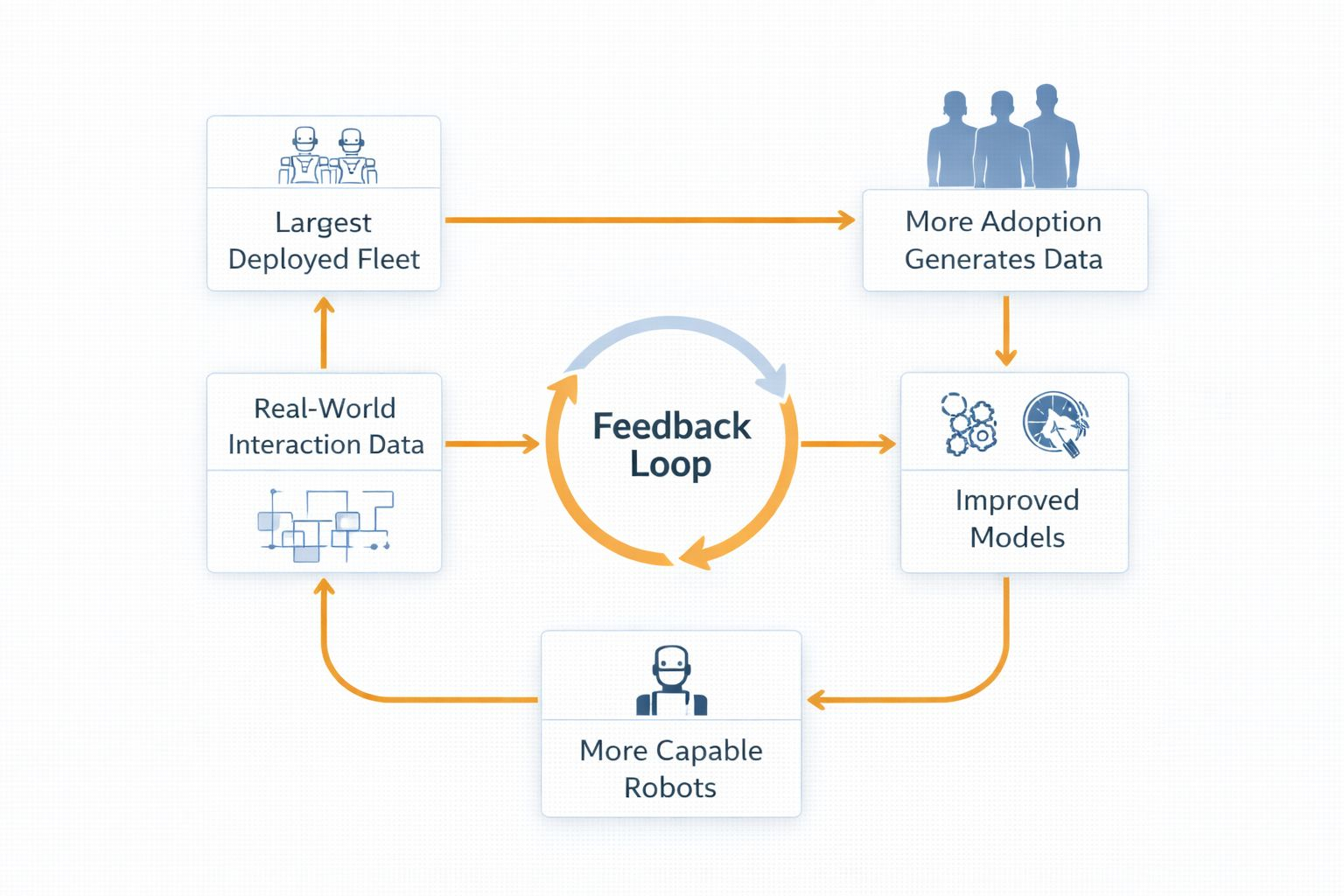
This creates a feedback loop.
Without open protocols, that loop stays inside one company’s ecosystem. The robots, the data, the learning improvements, and the deployment network all reinforce each other privately. Over time, the leading platform gains structural advantages that others cannot easily replicate. At that point, the market begins to concentrate.
We have already seen this pattern in other domains. Mobile operating systems consolidated around a few platforms. Cloud infrastructure concentrated among a small number of providers. Large AI models are trending toward similar dominance because of compute and data scale. The underlying mechanism is not unique to software it is a property of networked technologies.
I think robotics has the same ingredients, but in the physical world.
This is where I see the relevance of the Fabric Foundation approach. Fabric treats robots not as isolated products but as participants in an open network with shared infrastructure. Identity, data exchange, coordination rules, and verifiable behavior can exist at protocol level rather than inside proprietary stacks.
If robotics evolves through open protocols, learning and coordination can be distributed instead of captured. Different manufacturers and developers can contribute to a shared ecosystem rather than competing through closed silos. Capability growth becomes collective rather than monopolized.
Without that openness, the trajectory looks different. Imagine one company deploying millions of robots across logistics, manufacturing, and public environments. Those machines continuously collect interaction data and refine their models. Competitors with smaller fleets cannot match the learning speed. Customers choose the more capable platform, reinforcing its lead. Over time, the dominant ecosystem becomes the default infrastructure for physical automation.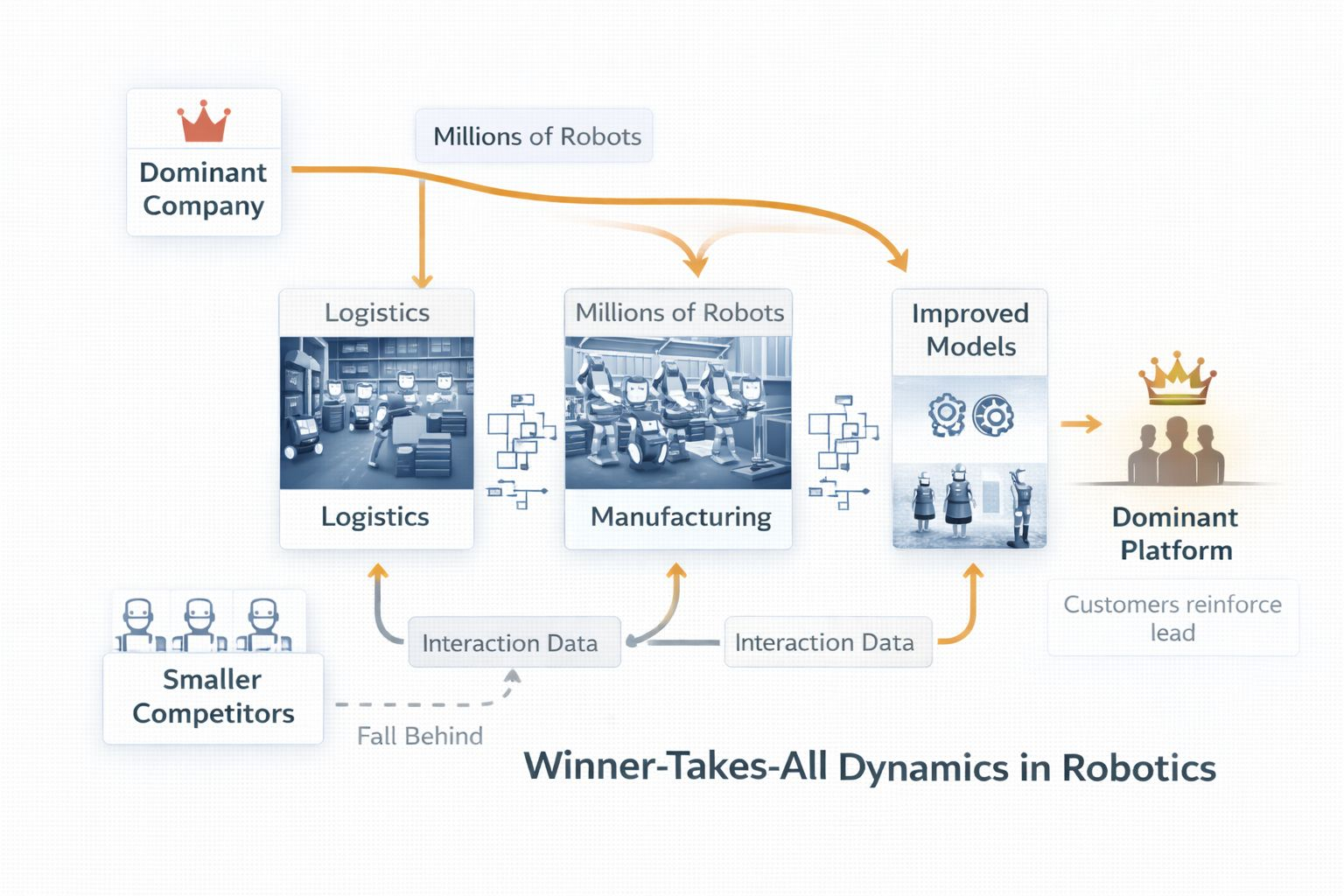
That is the essence of winner-takes-all dynamics in robotics.
From my perspective, the question is not whether concentration is possible it is whether the architecture of robotics encourages or prevents it. Closed ecosystems amplify feedback loops that favor consolidation. Open protocols distribute those loops across participants.
This is why I think the conversation about robotics should not only focus on capability. It should also focus on structure. The way robots connect, share information, and coordinate may determine whether the industry becomes plural or dominated.
Fabric thesis suggests that open robotics infrastructure can counterbalance winner-takes-all forces before they fully emerge. Instead of a few platforms owning robot intelligence and data, the network itself becomes the shared layer where machines interoperate and evolve.
In that sense, openness is not just an ideological preference. It is a structural safeguard.
If robotics becomes the physical layer of automation for society, its architecture will shape who controls it. Without open protocols, the natural economics of data, scale, and learning could push the field toward concentration.
And that is why I see open robotics not only as a technical direction, but as a competitive necessity for the long-term health of the ecosystem. @Fabric Foundation #robo $ROBO
