
@Mira - Trust Layer of AI $MIRA #MIRA

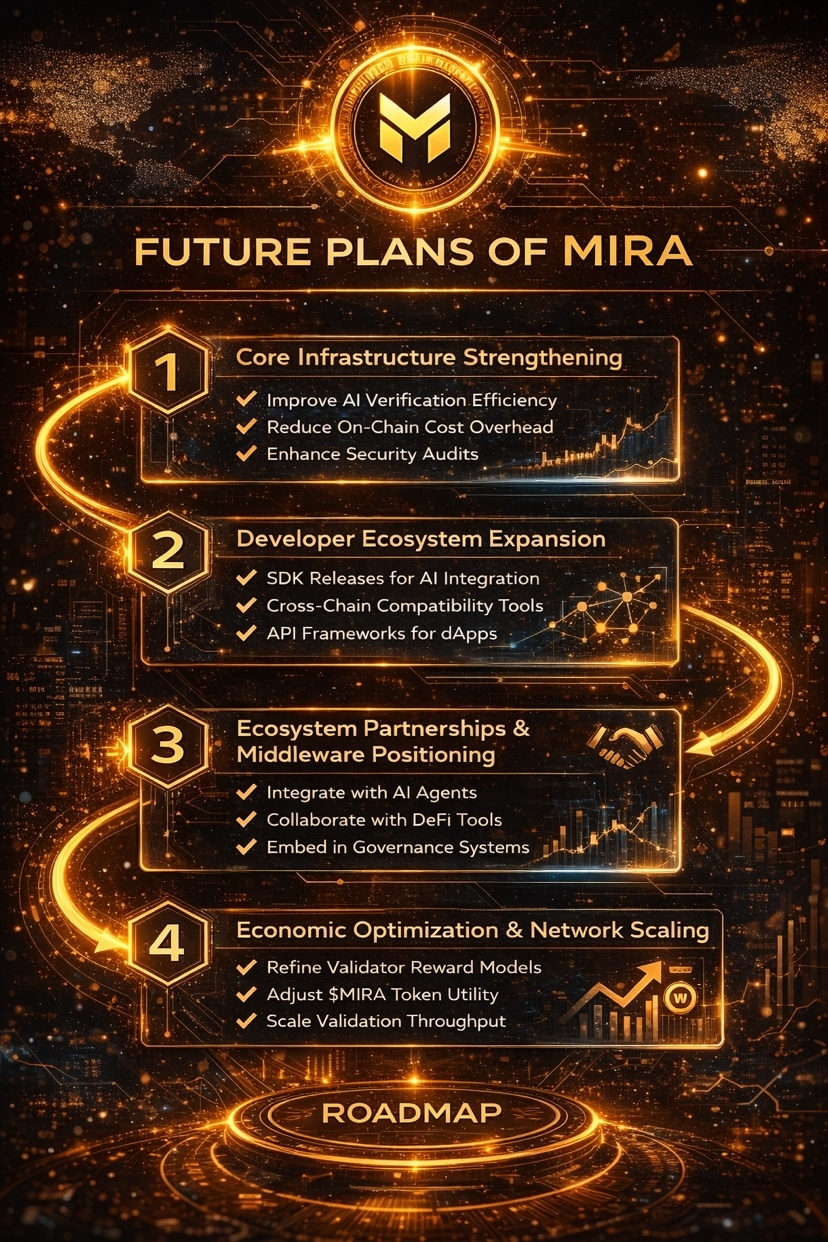
Phase 1: Core Infrastructure Strengthening
The first priority is reinforcing the verification engine itself. This includes:
Improving computational efficiency of AI validation
Reducing on-chain cost overhead
Enhancing security audits and protocol resilience
At this stage, the focus is technical robustness. Without scalable and cost-effective verification, ecosystem adoption remains limited. This phase builds the foundation.
Phase 2: Developer Ecosystem Expansion
Infrastructure gains value when developers integrate it. Likely roadmap components include:
SDK releases for easier AI validation integration
Cross-chain compatibility tools
API frameworks for AI agents and dApps
The objective here is lowering integration friction. If developers can seamlessly embed MIRA’s verification layer into DeFi protocols, DAOs, or AI trading systems, network effects begin forming.
Phase 3: Ecosystem Partnerships & Middleware Positioning
Once technical stability and developer accessibility are established, strategic partnerships become critical. This may involve:
Integration with AI agent platforms
Collaboration with DeFi automation tools
Embedding verification within governance systems
At this stage, MIRA transitions from a standalone protocol to middleware infrastructure. The token $MIRA could see increased demand if verification becomes embedded within transaction flows.
Phase 4: Economic Optimization & Network Scaling
Long-term sustainability depends on incentive alignment. Future plans likely include:
Refining staking or validator reward models
Adjusting token utility based on network usage
Scaling validation throughput without centralization trade-offs
This phase determines whether MIRA evolves into durable infrastructure or remains a thematic experiment.
Long-Term Vision
If decentralized AI matures into a multi-agent ecosystem executing financial logic autonomously, verifiable computation becomes a systemic requirement rather than a feature. Under that scenario, MIRA’s roadmap positions it as a structural component of the Web3 intelligence stack.
Execution, integration depth, and real usage metrics will ultimately determine whether $MIRA captures lasting infrastructure value.