

What they aren't doing is talking to each other. Fabric Protocol fixes that.
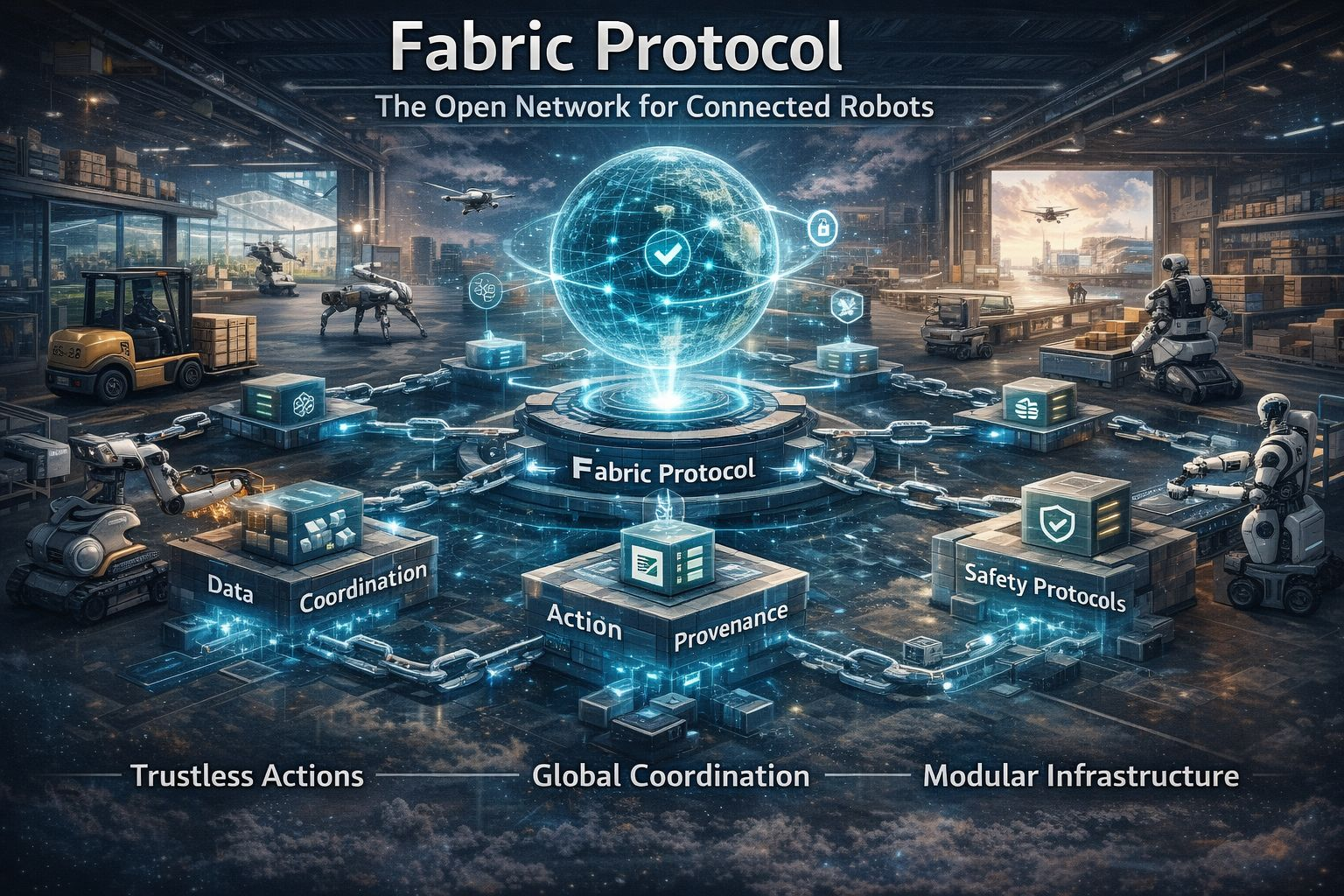
Most people miss the real bottleneck in robotics. It's not battery life or servo motors. It's coordination. A warehouse bot in Stuttgart and a logistics drone in Singapore operate in parallel universes. Different manufacturers. Different software stacks. Zero trust. Fabric builds the bridge—a global open network where machines prove their actions, share their learning, and collaborate without corporate middlemen taking a cut.
The Fabric Foundation, being non-profit, changes the incentive structure completely. No quarterly earnings to juice. No shareholders demanding token pumps. Just infrastructure designed to outlast hype cycles. That's rare in this space. Most "decentralized" projects are centralized grifts with extra steps. Fabric's structure forces patience. It forces actual utility.
Here's how it works. Every robot action gets hashed to a public ledger. Not for blockchain tourists. For verifiability. When an autonomous forklift claims it moved a pallet, the protocol proves it. When a surgical assistant adjusts its grip, that decision is auditable. This isn't surveillance. It's trust minimization. Humans don't need to believe corporate press releases. They can verify the compute directly.
The modular architecture matters more than the marketing suggests. Hardware agnostic. AI model agnostic. Safety standard agnostic. A farm robot in Kenya and a factory arm in Japan can share the same coordination layer without sharing the same manufacturer. That's the network effect that compounds. More nodes, stronger verification, better training data for everyone. The protocol becomes more valuable as it becomes more neutral.
Agent-native infrastructure is the subtle revolution. Most robotics treats AI as a feature. Fabric treats autonomous agents as the foundation. These aren't scripted automatons following lines of code. They're reasoning systems making context-aware decisions within transparent guardrails. The difference is ownership. Traditional robots execute commands. Fabric agents negotiate, learn, and evolve within constraints everyone can inspect.
Base deployment was a strategic choice, not a trend chase. Low fees matter when you're coordinating thousands of edge devices. Fast finality matters when safety decisions need immediate consensus. Coinbase's distribution matters for reaching developers who can't afford Ethereum mainnet but still need mainnet-grade security. Fabric optimizes for the builders actually shipping hardware, not the speculators farming airdrops.
Three pillars hold this together. Data coordination ensures robots share verified truth, not marketing claims. Compute coordination distributes processing across the network, avoiding single points of failure. Regulation coordination encodes safety standards into smart contracts that participants opt into. It's governance without the committee meetings.
I've watched enough infrastructure plays to recognize the pattern. The projects that survive aren't the loudest. They're the ones solving boring, critical problems that everyone else skips. Verifiable computing isn't sexy. Cross-border robot coordination isn't viral. But these are the primitives that enable everything else.
Fabric isn't selling a better robot. It's selling a better system for robots to exist within. Open protocols beat proprietary platforms. Verifiable actions beat trusted brands. Modular stacks beat monolithic silos. The infrastructure age for robotics is starting. Fabric is laying the foundation.
#ROBO $ROBO @Fabric Foundation
