Think of the traditional electricity grid power companies generate energy, consumers pay for it, and a central authority manages distribution. Now imagine replacing that central authority with a self-governing, open protocol where every participant whether human, developer, or machine interacts under transparent, programmable rules. That is roughly the architecture Fabric Protocol is attempting to build for the global robotics economy, and ROBO is the current running through its wires.
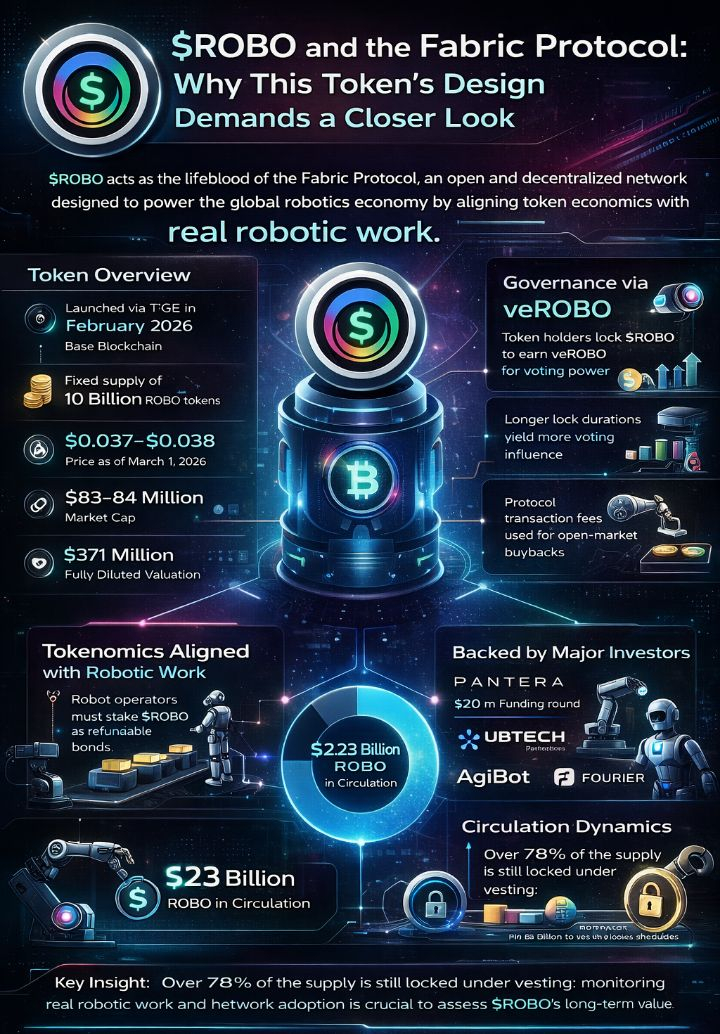
Launched via Token Generation Event in February 2026, ROBO operates on the Base blockchain with a fixed total supply of 10 billion tokens, of which approximately 2.23 billion are currently in circulation. As of March 1, 2026, the token trades around $0.037–$0.038, with a market capitalization near $83–84 million and a fully diluted valuation of roughly $371 million signaling that the market is pricing in significant future network expansion relative to today's liquid supply. The 24-hour trading volume has surged to approximately $120–157 million across 21 exchanges and 47 markets, a figure that substantially exceeds the circulating market cap itself a ratio that points to intense early-stage price discovery rather than settled equilibrium. The token is listed on Binance Alpha, with ROBO/USDT on Bybit registering the heaviest single-pair volume. The Fabric Foundation recently opened a $ROBO claim portal for airdrop recipients, with claims open until March 13, expanding on-chain holder distribution beyond exchange speculation into community participation. What makes these figures analytically interesting is not their magnitude alone, but the structural rationale behind them: roughly 22% of the total supply is currently circulating, meaning over 78% remains locked under vesting schedules including investor tranches subject to a one-year cliff followed by 36-month linear unlocks a dilution risk that any serious observer of this token must track carefully against actual network adoption metrics.
Where ROBO genuinely differentiates itself is in how its tokenomics are wired to real network behavior rather than passive capital accumulation. Most utility tokens in the DePIN and AI-adjacent space essentially reward holding, creating reflexive buy-and-wait dynamics that detach token price from actual service output. Fabric's design inverts this. Robot operators must stake $ROBO as refundable work bonds to register hardware meaning every additional robot unit onboarded removes tokens from liquid supply proportionally. Protocol revenue drives open-market buybacks, coupling transaction throughput directly to demand-side pressure. Governance weight is earned by locking tokens into veROBO positions, where longer lock durations yield greater voting influence over emission sensitivity, quality thresholds, and slashing parameters creating meaningful opportunity cost for short-term holders. The Adaptive Emission Engine further distinguishes the model: rather than static block rewards, emissions adjust dynamically based on two live signals network utilization relative to capacity, and service quality scores with a circuit breaker capping per-epoch changes at 5% to prevent destabilizing feedback loops. Participation in the Proof-of-Contribution layer which covers task completion, compute supply, data provision, validation, and modular skill chip development requires sustained activity, as contribution scores decay without continued output. None of this generates rewards for passive holders. The protocol, at its design level, is deliberately inhospitable to capital parking.
The governance and security architecture of Fabric Protocol reflects an understanding that decentralized robotics infrastructure faces a problem that traditional DeFi protocols do not: machines interacting with the physical world carry consequences that on-chain slashing mechanisms alone cannot fully account for. The veROBO governance framework addresses this by concentrating protocol decision-making authority in participants with demonstrated long-term alignment operators, developers, and contributors who have skin in the network's operational quality rather than distributing it equally to all token holders regardless of participation. From a community standpoint, the protocol has attracted backing from Pantera Capital following a $20 million funding round, and has forged hardware integrations with humanoid robot manufacturers including UBTech, AgiBot, and Fourier, lending the ecosystem credibility beyond the typical whitepaper-stage DePIN project. Whether Fabric Protocol can translate this structural ambition into measurable adoption tracked through Proof of Robotic Work metrics, bonded hardware growth, and genuine transaction volume between machines rather than speculative trading will ultimately determine whether $ROBO becomes embedded infrastructure or remains another well-designed token searching for its network.
Conclusion: $ROBO is an architecturally serious attempt to align token economics with the operational realities of a machine-driven economy. Its fixed supply, work-bond staking, adaptive emissions, and contribution-gated rewards form a coherent utility framework that stands apart from passive-yield token models. The near-term challenge is straightforward: with over 78% of supply yet to enter circulation and real-world robot deployment still in early stages, the gap between the protocol's design integrity and its demonstrated network scale remains wide. Researchers and analysts watching this space would do well to monitor bonded hardware counts and on-chain transaction volume as the leading indicators of whether $ROBO's structural demand thesis is bearing out in practice.@Fabric Foundation #ROBO $ROBO