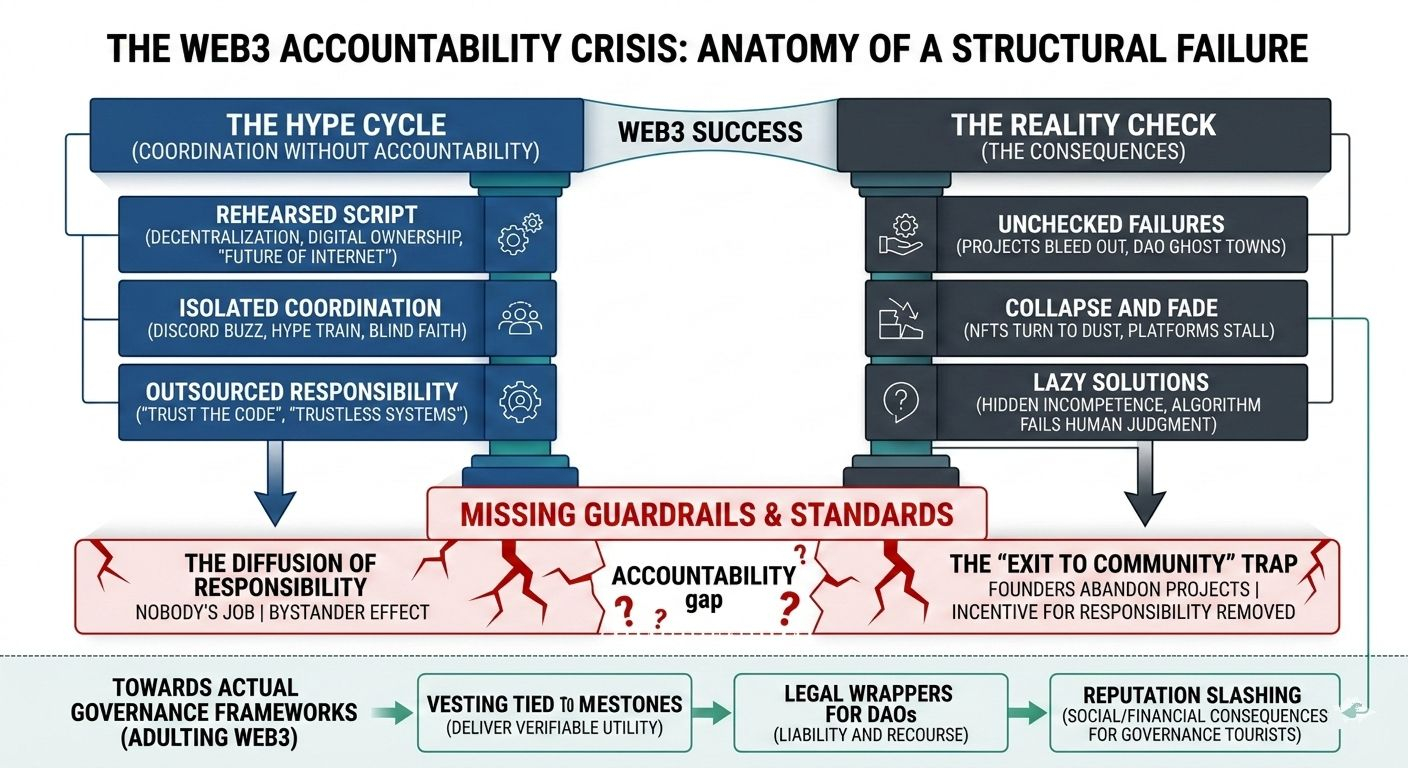
Let’s be honest: the Web3 hype train is running out of steam, and it’s not because the tech is bad. It’s because the "vibes" aren’t enough anymore. We’ve all heard the same rehearsed script about decentralization, digital ownership, and the "future of the internet." It sounds great on a pitch deck, but in the real world, it’s becoming a bit of a mess. Why? Because we’ve obsessed over coordination while completely ignoring accountability.
The industry talks a big game about empowering the "little guy" and taking back control of our data. But when you actually look under the hood, it’s mostly just blind faith. We’re told to "trust the code," but code doesn’t care when a project quietly bleeds out or a DAO turns into a ghost town because nobody can agree on a simple decision. Without someone—or something—being responsible, "decentralization" is often just a fancy word for "nobody’s job."
We’ve all seen how this plays out. A project gets massive hype, the Discord is buzzing, and then… nothing. It just fades. There’s no big explosion, just a quiet disappearance into the graveyard of failed protocols. Platforms collapse, NFTs turn into digital dust, and DAOs stall out because there was never a clear process for making the hard calls. The hype cycles never mention these failures, which happen simply because there were no guardrails to keep things moving once the initial excitement wore off.
And frankly, most of the "solutions" out there are lazy. People hide behind terms like "trustless systems" and "smart contracts" as if they’re magic spells that solve human incompetence. But at the end of the day, you can’t just outsource responsibility to an algorithm. We need systems that actually hold people—and the tech they build—to some kind of standard when the rubber hits the road.
This is where something like Fabric Protocol actually starts to make sense. Look, it’s not some flashy "savior" project that’s going to make everyone an overnight millionaire. It’s actually kind of boring, which is exactly why it’s necessary. It focuses on the unsexy, "under-the-hood" stuff: data coordination, computation, and actual regulation via a public ledger. It’s trying to put some structure into a space that has been way too freeform for its own good. By building a foundation for safe human-machine collaboration, it’s offering a way to create things that might actually last more than one bull market.
If Web3 is ever going to grow up and scale, we have to stop obsessing over decentralization for its own sake and start worrying about whether the stuff we’re building actually works. Whether it’s a game, an NFT, or a governance system, it needs a layer of accountability to stay relevant. Fabric’s focus on the mechanics of coordination might not win any "most hyped" awards, but it’s the kind of heavy lifting that keeps the lights on and the system functional.
Bottom line: we need less talk about "the future" and more focus on the systems that make the present work. Accountability, real incentives, and actual consequences—that’s the missing piece. Fabric Protocol isn't a magic wand, but it’s a serious, grounded attempt to bridge that gap. It’s not the end-all, but it’s a step toward something that doesn't just look good on Twitter, but actually functions in the real world.
$ROBO @Fabric Foundation #ROBO