
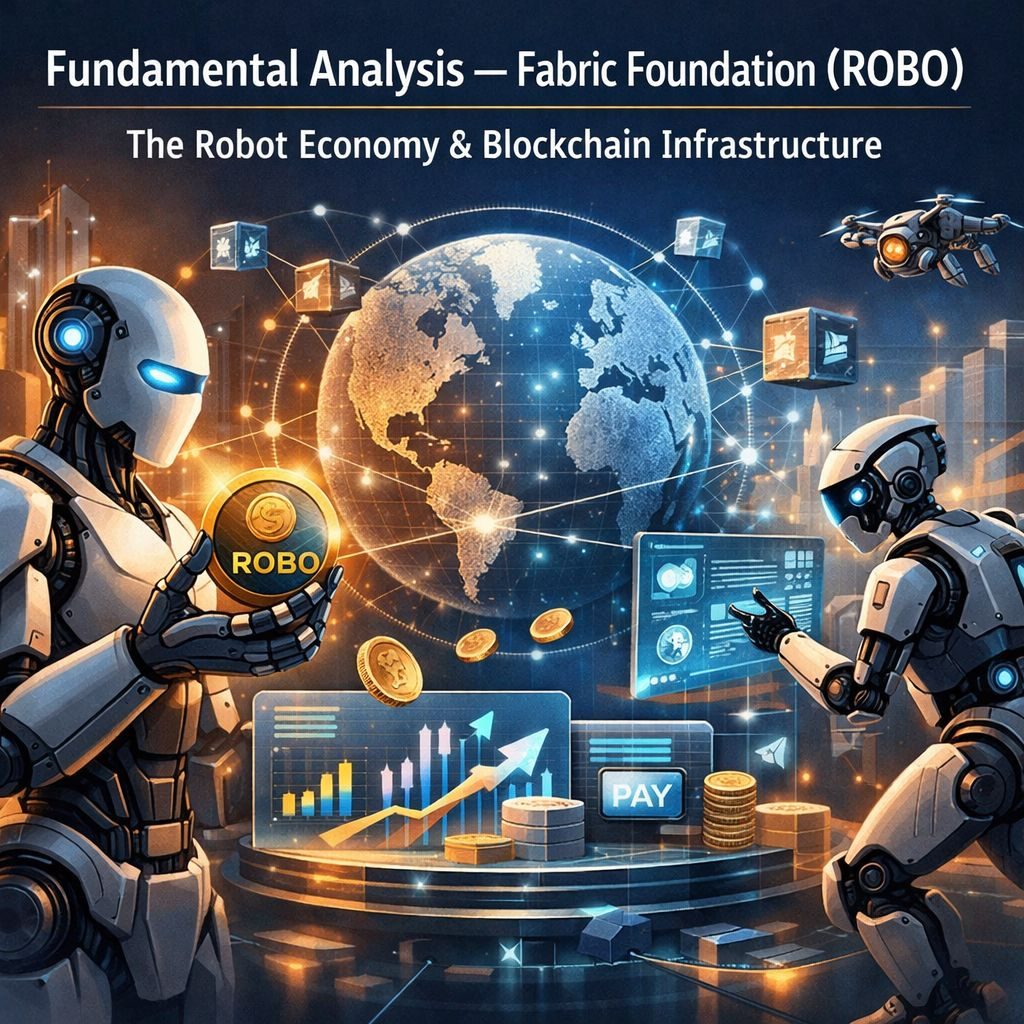
# Fundamental Analysis — Fabric Foundation (@Fabric Foundation $ROBO )
The **Fabric Foundation** is emerging as one of the most ambitious projects at the intersection of blockchain, artificial intelligence, and robotics. Rather than focusing on traditional crypto sectors like DeFi or payments, Fabric is attempting to build the economic and governance infrastructure for what it calls the **“Robot Economy”** — a future where autonomous machines participate directly in global markets.
## Project Vision and Core Idea
Fabric Foundation operates as a non-profit organization focused on creating systems that allow intelligent machines and humans to collaborate safely and transparently. The project recognizes a major gap in today’s technological landscape: robots and AI agents can perform tasks, but they lack financial identity, payment rails, and governance frameworks required to operate independently in real-world economies. ([fabric.foundation][1])
Fabric aims to solve this by building decentralized infrastructure where machines can have on-chain identities, receive payments, verify actions, and coordinate work using blockchain technology. In simple terms, Fabric is trying to create the **financial and coordination layer for autonomous robots**, similar to how the internet became the communication layer for humans.
## Role of the ROBO Token
The ecosystem revolves around its native token, **ROBO**, which functions as both a utility and governance asset. According to the project, ROBO is used for network fees, identity verification, payments, and participation in protocol governance. ([fabric.foundation][2])
Since robots cannot open bank accounts or hold legal documents, Fabric proposes crypto wallets and on-chain identities as substitutes. Every interaction — from machine-to-machine payments to verification processes — is expected to run through the ROBO token economy.
Initially deployed on Coinbase’s Base Layer-2 network, Fabric plans to evolve into its own Layer-1 blockchain as adoption grows, allowing it to capture value generated by robotic economic activity. ([fabric.foundation][2])
## Key Developments
2026 marked a major turning point for Fabric Foundation:
* **Token Launch & Exchange Listings:** ROBO officially entered open market trading in February 2026, launching across major exchanges and enabling price discovery after early distribution phases. ([HOKANEWS.COM][3])
* **Airdrop & Community Distribution:** The project introduced an airdrop system designed to decentralize ownership and incentivize early ecosystem participation. ([AInvest][4])
* **Liquidity Incentives:** Early participants received incentives tied to liquidity pools, helping bootstrap network activity and adoption. ([web.ourcryptotalk.com][5])
* **Market Adoption Momentum:** Listings on top-tier exchanges significantly increased accessibility, liquidity, and investor visibility. ([CoinMarketCap][6])
These developments signal Fabric’s transition from concept stage into an actively traded and expanding ecosystem.
## Technology and Ecosystem Direction
Fabric’s broader infrastructure focuses on solving coordination challenges in robotics. Today, robotic fleets operate in isolated systems owned by corporations. Fabric proposes an open network where anyone can contribute capital, coordination, or operational input and share in automation-generated value. ([fabric.foundation][7])
The ecosystem also integrates operating systems and interoperability layers that allow robots from different manufacturers to work together under a unified framework, pushing toward standardized machine economies.
## Roadmap and Future Outlook
Fabric’s roadmap centers on several long-term milestones:
1. **Expansion of on-chain robot identity and payment systems**
2. **Migration toward a dedicated Layer-1 blockchain**
3. **Scaling decentralized robotic labor markets**
4. **Global governance frameworks for human-machine alignment**
5. **Real-world deployment across industries such as logistics, healthcare, and manufacturing**
The long-term goal is ambitious: enabling robots to function as autonomous economic participants rather than tools owned by centralized institutions.
## Fundamental Strengths and Risks
**Strengths**
* Unique narrative combining AI, robotics, and blockchain
* Real-world economic use case beyond speculation
* Strong focus on governance and alignment of intelligent systems
**Risks**
* Robotics adoption remains early-stage
* Execution complexity is extremely high
* Token volatility following recent listings
## Final Assessment
Fabric Foundation represents a high-risk, high-vision project attempting to build infrastructure for a future machine-driven economy. If autonomous robotics becomes widespread, systems enabling machine identity, payments, and coordination could become essential digital infrastructure. However, success depends heavily on real-world adoption rather than crypto market momentum alone.
#FabricFoundation #FUND #Crypto #Blockchain #DeFi #Altcoin