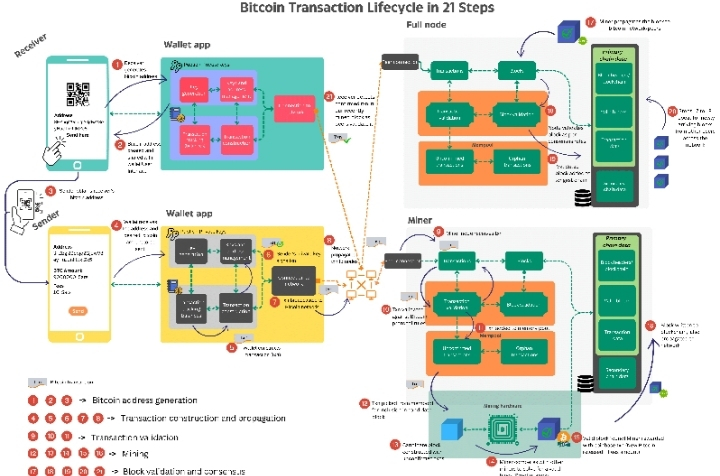
Trust in digital money does not come from speed, convenience, or brand names. It comes from process. Every cryptocurrency transaction lives in a temporary state of uncertainty before it becomes part of a shared history. That waiting period is not a flaw in the system; it is the system doing its most important work. Verification is the quiet mechanism that turns a signed message into an economic fact, and without it, cryptocurrencies would collapse into nothing more than editable spreadsheets.
At its core, a blockchain transaction is simply a statement: one address claims to send value to another. On its own, that statement means very little. Anyone can broadcast messages. What matters is whether the network collectively agrees that the sender had the right to spend those funds and that the same funds were not spent elsewhere. This is where verification enters, not as a single action, but as a layered process involving cryptography, incentives, and time.
When a transaction is created, it is first signed using a private key. This signature proves ownership without revealing identity. Nodes across the network can independently verify the signature using the corresponding public key, ensuring the transaction was authorized by the holder of the funds. At this stage, however, the transaction is only valid in theory. It still exists in a shared waiting area, often called the mempool, alongside thousands of other unconfirmed transactions competing for inclusion.
In Proof of Work systems, verification advances through computation. Miners collect pending transactions and attempt to package them into a block. To do this, they must solve a cryptographic puzzle that requires substantial computational effort. This puzzle is not meant to be clever; it is meant to be expensive. The cost ensures that proposing an invalid block is economically irrational, because the network will reject it and the miner will lose both time and energy.
Once a miner successfully produces a block, the network checks it. Every node independently verifies that each transaction follows the rules, that no coins were created out of thin air, and that no double-spending occurred. If the block passes these checks, it is added to the chain. This is the first confirmation. The transaction is now included, but it is not yet settled in the strongest sense.
Each new block added after that builds on top of the previous one, making it increasingly difficult to reverse history. To alter a transaction that already has several confirmations, an attacker would need to redo the computational work for that block and every block after it, and then surpass the honest network’s ongoing work. As confirmations increase, the cost of reversal grows exponentially. This is why merchants wait. Four confirmations in Bitcoin, for example, represent a level of economic finality where the probability of reversal becomes negligible for most real-world use cases.
Proof of Stake systems approach the same problem from a different angle. Instead of burning energy to prove commitment, validators lock up capital. Their stake becomes collateral that can be lost if they behave dishonestly. Transactions are grouped into blocks proposed and attested to by validators, with the protocol selecting participants based on their stake and other randomness mechanisms. Verification here is not enforced by electricity, but by the threat of financial loss.
In these systems, confirmations often come faster, but finality can be defined differently. Some Proof of Stake networks offer explicit finality checkpoints, where blocks are not just unlikely to be reversed but mathematically finalized unless a large portion of staked capital is destroyed. Ethereum, after its transition to Proof of Stake, uses such a system, which is why it still measures security in terms of multiple confirmations even though blocks arrive quickly. The network is optimizing not just for speed, but for shared certainty.
The number of confirmations required is not arbitrary. It reflects trade-offs between risk tolerance, network design, and economic incentives. A small payment between individuals may be considered safe after one or two confirmations. A large exchange transfer may require dozens. The protocol does not decide what is “enough.” Users and businesses do, based on the value at risk and the consequences of failure.
What verification ultimately protects against is not just double-spending, but unilateral control. No single party gets to decide which transactions are real. The rules are enforced by thousands of independent actors who do not need to trust one another, only the protocol they are all incentivized to follow. This is why blockchain verification feels slow compared to centralized systems. Banks finalize transactions instantly because you are trusting them not to lie. Blockchains take time because trust is being replaced with proof.
Understanding this process changes how you see cryptocurrency. It stops being a speculative asset and starts looking like a coordination system for truth in hostile environments. Every confirmation is a small vote cast by the network, saying that this version of history is the one it is willing to defend economically. The delay is the cost of neutrality.
As digital systems take on more responsibility, from payments to governance to automation, the question of verification becomes more important, not less. Speed can be optimized. Interfaces can be improved. But the slow, deliberate process by which a network agrees on reality is the foundation everything else rests on. Without it, there is no decentralization, no security, and no reason to trust digital money at all.