

Most people think the biggest threat to blockchain is regulation, hacks, or market crashes, well, It’s not.
The real threat is something most users don’t even think about; quantum computing.
While the industry is busy competing over speed, TPS, and fees, a much more serious question is being ignored:
Will today’s blockchains still be secure 10–20 years from now?
This is exactly why some developers are now focusing on post-quantum blockchain architecture, and why projects like Cellframe are taking a very different approach compared to typical Layer-1 networks.
The Hidden Danger: Store Now, Decrypt Later
Most current blockchains use cryptographic algorithms designed for classical computers.
They are secure today, but future quantum computers could potentially break many of these encryption methods. This creates a dangerous scenario known as: Store Now, Decrypt Later.
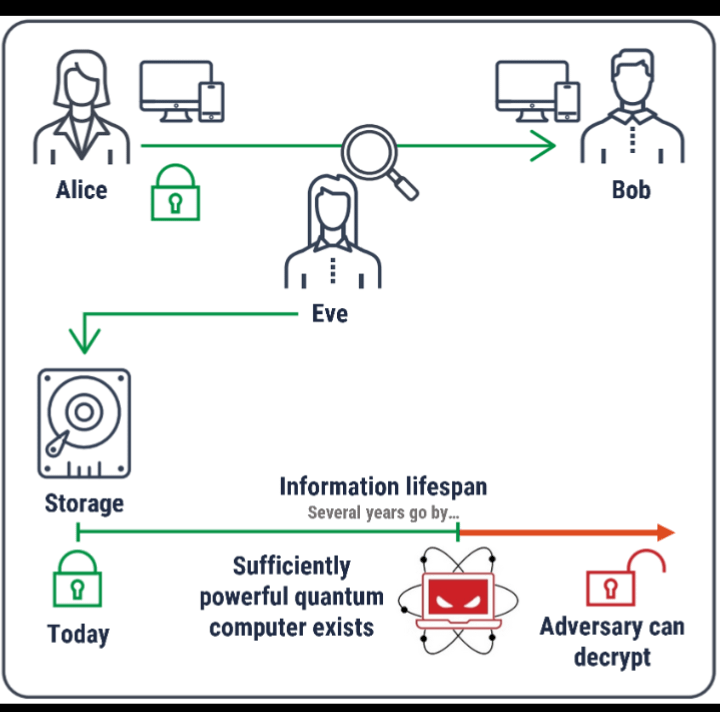
An attacker does not need to hack the blockchain right now. They can collect encrypted data today, wallet signatures, public keys, transactions and simply wait until quantum computers become powerful enough to decode them.
When that happens, the attack is instant. Not because the network failed at that moment,
but because it was never designed for the future.
This is why post-quantum cryptography is becoming one of the most important areas of research in blockchain technology.
Real-World Scenario: National Identity on Blockchain
Imagine a government storing national identity records on a blockchain.
These records must remain secure for decades. If the encryption protecting them becomes obsolete, the consequences could include:
Identity theft at national scale
Exposure of confidential citizen data
Loss of trust in digital infrastructure
Legal and financial chaos
In situations like this, speed is not the priority, Long-term security is.
Some blockchain projects are now experimenting with post-quantum cryptographic algorithms, including standards evaluated by NIST, to make sure the system remains secure even against future computing technology. This is one of the core design ideas behind Cellframe.
Speed Alone Cannot Support Real Infrastructure
Many modern blockchains focus on performance, Higher TPS, Lower fees and Faster confirmations. But real infrastructure requires more than speed.
Imagine a global supply chain running on blockchain. Every shipment, contract, and payment is recorded on-chain. If the network slows down, operations stops. If the encryption breaks, the entire system becomes unsafe.
This is why some developers are exploring true sharding architectures, where multiple chains run in parallel instead of forcing everything through a single chain.
In theory, this allows the network to scale as more nodes join, rather than becoming congested.
For enterprise and government use cases, this kind of design is more important than raw transaction speed.
Blockchain Is Moving Beyond Finance
In the early days, blockchain was mostly about digital money. Today, the industry is slowly shifting toward real-world infrastructure.
Developers are exploring how blockchain can support:
Digital identity systems
Enterprise data platforms
Secure communication networks
Real-world asset tokenization
Decentralized service infrastructure
In these scenarios, reliability and security matter far more than hype cycles.
A meme token can fail without serious consequences, but a National infrastructure system cannot.
Because of this, some networks are being designed as service-oriented blockchains, built to run multiple independent services instead of only handling token transfers.
Cellframe is one of the projects following this direction, focusing on long-term infrastructure rather than short-term trends.
 The Next Question for Blockchain
For years, the industry asked:
Which blockchain is fastest?
Now a new question is starting to matter more:
Which blockchain will still be secure when computing power changes completely?
Quantum computing may not break current encryption tomorrow. But infrastructure built today must survive the technology of tomorrow.
Projects researching post-quantum security, real sharding, and service-oriented architecture are not just building for the next bull run. They are building for the next generation of the internet.
And that shift could define the future of blockchain more than speed ever did.