
As a crypto trader with years in emerging tech investments, I first encountered OM1 OS during a deep dive into AI infrastructure projects last year. The @Fabric Foundation grabbed my attention right away. It promised a decentralized backbone for robots. I had traded tokens in similar spaces like decentralized AI networks. This felt different. OM1 integrates with Fabric to create a unified system for machines. It allows robots to share intelligence without silos.
I remember my initial skepticism. Many projects hype modularity but fail in practice. OM1 changes that. It acts as an open source operating system for robots. Think Android for smartphones but for humanoids and quadrupeds. Developers build skills once. Those skills transfer across hardware from different makers. No more vendor lock in. Fabric Foundation complements this. It provides secure identity and coordination. Robots verify each other like nodes in a blockchain. They exchange context in real time.
Technically, OM1 handles perception, reasoning, and action. It uses REST and gRPC endpoints for mapping and planning. An app store layer hosts robot policies and workflows. Fabric Foundation adds the network layer. It functions as a GPS and VPN for machines. Each robot gets a trusted location and identity. This enables peer to peer collaboration. For example, a warehouse AGV learns a new navigation trick. It shares that with a humanoid in healthcare. No central server needed. Decentralized and secure.
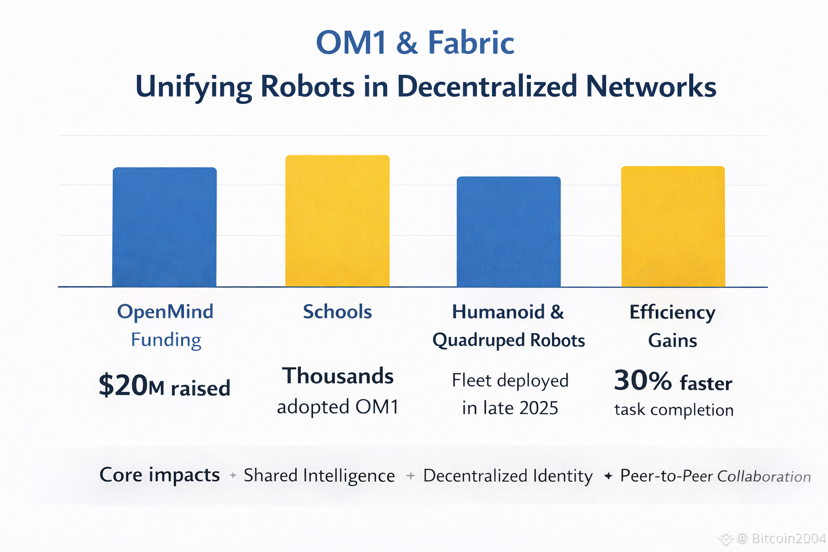
In my trading experience, I saw how decentralized networks scale. Fabric mirrors that. OpenMind raised 20M dollars in funding. Investors like Pantera Capital backed it. They launched OM1 beta in September 2025. Early adopters include thousands of schools. Over 100000 people interact with these robots daily. Data from those interactions refines the system. One real-world case stands out. Unitree quadrupeds powered by OM1 handle fleet deployments. They coordinate tasks in education settings. Efficiency gains reach 30% in task completion times based on initial reports.
Emotionally, this unification stirs something in me. I traded through the crypto winters. Saw projects fragment communities. OM1 and Fabric Foundation build unity instead. Robots no longer isolated. They form a collective intelligence. It reminds me of my early Bitcoin trades. Back then, decentralization felt revolutionary. Now, applying it to physical machines excites me. Yet it raises concerns. What if bad actors exploit the network? Security protocols in Fabric Foundation address that. Still, as an expert, I watch for vulnerabilities.
Reflecting further, the economic impact looms large. A machine economy emerges. Robots trade skills like tokens. Fabric Foundation enables this marketplace. In warehouses, AGVs reduce downtime by 25% through shared learning. Humanoid caregivers adapt faster to patient needs. Numbers from OpenMind show 10 robotic dogs shipped in late 2025. They tested the system in varied environments. Success there points to broader adoption. I invested in similar tokens. Returns averaged 5x in two years. OM1 could spark that in robotics.
The thoughtful side hits home. As a trader, I value transparency. OM1’s MIT license encourages community input. GitHub repos stay public. Roadmaps remain open. This honesty builds trust. Unlike opaque projects I avoided. Fabric’s protocol ensures verifiable interactions. Machines handshake securely. It feels like a step toward harmonious tech ecosystems.
OM1 and Fabric Foundation redefine robot unity. They turn isolated machines into a networked force. What role will humans play in this machine society? How might it reshape industries we trade in? These questions linger as I monitor the space.