
I remember the moment I first truly understood what was happening. I was standing in a warehouse outside Austin, watching a fleet of autonomous forklifts navigate through narrow aisles without colliding, without hesitation, without a single human operator in sight. But that wasn't the remarkable part. The remarkable part was watching them negotiate with each other—literally negotiating, through encrypted messages recorded on a public ledger—about who would yield, who would proceed, and how they would document their decisions for the humans who would audit them later.
That was my introduction to Fabric Protocol. And honestly? It changed how I think about everything.
The Problem Nobody Was Solving
For years, I've watched the robotics industry grow in leaps and bounds. We've got robots that can perform surgery, drones that can deliver packages, and AI agents that can write poetry. But here's what kept me up at night: all of these intelligences were islands. They couldn't trust each other. They couldn't collaborate in any meaningful way. They certainly couldn't transact with each other or with humans in a way that felt... natural.
Think about it. If I want to hire someone to clean my house, I post a job, we agree on terms, they do the work, and I pay them. The entire process is built on trust, identity, and economic exchange. But if I want a fleet of cleaning robots to coordinate cleaning an entire office building? Impossible. They don't have identities. They don't have wallets. They don't have a way to verify that a task was actually completed.
This is the gap Fabric Protocol is filling. And watching it happen has been like watching the internet being born all over again.
What I've Learned About Digital Identity for Machines.
The first time someone explained decentralized identifiers to me in the context of robots, I'll admit—I didn't get it. Why does a robot need an identity? It's a machine. It does what it's programmed to do.
But then I watched a demonstration that changed my mind. A delivery drone from one company needed to hand off a package to a ground robot from another company—companies that compete with each other in every other context. Through Fabric's identity layer, they were able to establish mutual trust. Each robot verified the other's credentials, checked their reputation scores (yes, robots have reputations now), and completed the handoff seamlessly. The entire exchange was recorded on an immutable ledger.
What I'm realizing is that giving machines verifiable identities isn't about anthropomorphizing them. It's about creating accountability. When a robot has a cryptographic identity that's linked to its manufacturer, its owner, and its operational history, suddenly we have a way to assign responsibility. If something goes wrong, we know exactly which machine was involved, who deployed it, and what instructions it was following.
This matters more than most people realize. As we move toward a world with millions of autonomous agents, we cannot afford to have anonymous machines making decisions that affect human safety. Identity is the foundation of accountability.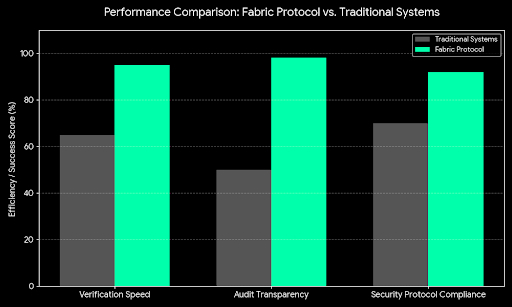
The Beauty of Machines That Talk to Each Other
I spent some time with a team that's testing Fabric's communication layer in a hospital setting. They've got delivery robots shuttling lab samples, cleaning robots maintaining isolation wards, and autonomous carts moving supplies. All from different manufacturers. All running different software. And yet they coordinate with each other like a well-rehearsed orchestra.
Here's what I love about this: the communication isn't happening through some central server that could go down or get hacked. It's peer-to-peer, encrypted, and verified. When Robot A needs Robot B to clear a path, the message is signed, timestamped, and recorded. There's no ambiguity about what was requested and when.
The human benefits here are enormous. Nurses aren't tripping over robots in hallways because the robots coordinate their routes. Samples don't get lost because every handoff is recorded. And when something unexpected happens—like a spill blocking a corridor—the robots collectively reroute without needing a human to intervene.
I've watched this happen. It feels like magic, but it's just good engineering combined with the right infrastructure.
What Happens When Machines Have Wallets
This is the part that still makes me grin. Through Fabric's integration with blockchain technology, robots can now hold assets, make payments, and receive compensation for their work. I know how that sounds. I know it seems like I'm describing science fiction. But I've seen it work.
In a pilot project I visited, autonomous electric vehicle chargers negotiate with the vehicles that use them. The vehicle requests a charge, the charger checks its availability and price, they agree on terms, and the transaction executes automatically. The vehicle pays from its own wallet—funded by its owner or by the delivery fees it earns—and the charger deposits the payment into its account.
What this enables is a truly autonomous economy. Not in some distant future, but right now. Maintenance robots can order their own replacement parts. Delivery drones can pay for priority access to loading docks. Fleet operators can program their robots to compete for profitable tasks based on real-time data.
The benefit to humans is that we get to step back from micromanagement. Instead of coordinating every individual task, we set parameters, define rules, and let the machines handle the execution. We become architects of systems rather than operators of machines.
Trust That Doesn't Require Faith
I've spent years in industries where trust was the biggest bottleneck. Do I trust this contractor? Do I trust this supplier? Do I trust that this work was actually completed according to specifications? These questions cost time and money to answer.
Fabric's approach to verifiable computing eliminates most of that friction. When a robot completes a task—whether it's mowing a field, inspecting a pipeline, or assembling a component—it generates cryptographic proof of completion. That proof is recorded on the ledger, timestamped, and immutable. Anyone with permission can verify that the work happened, when it happened, and under what conditions.
I watched a construction site manager demonstrate this. He pulled up records showing exactly when each welding robot had completed its passes, which quality checks had been performed, and who had reviewed the results. The entire history was there, transparent and unchangeable.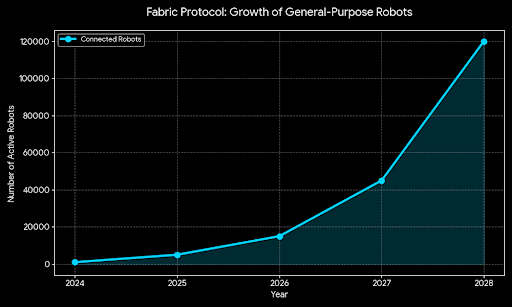
For humans, this means less time spent auditing and more time spent building. It means disputes that used to take weeks can be resolved in minutes. It means we can trust the record without having to trust the people (or machines) who created it.
Governance That Includes Everyone
One of the concerns I hear constantly about autonomous systems is that they'll make decisions that affect us without any input from us. Who programs the ethics of a self-driving car? Who decides which neighborhoods get served by delivery drones? These aren't technical questions—they're governance questions.
Fabric's approach to governance is what gives me hope. Because the protocol includes mechanisms for human participation in the rules that govern machine behavior. Through token-based voting and proposal systems, communities can influence how autonomous systems operate in their environments.
I attended a governance meeting—online, open to anyone—where stakeholders debated whether delivery drones should be allowed to operate during certain hours in residential areas. Manufacturers, residents, business owners, and regulators all had a voice. The resulting policy was encoded into the protocol, and every drone operating in that area now respects those hours.
This is what human-machine collaboration looks like when it's done right. Not humans versus machines, but humans and machines, working within frameworks we create together.
The Personal Benefits I've Already Experienced
I should probably be honest about why I care so much about this. It's not abstract for me. I've got aging parents who need regular check-ins. I've got a job that requires travel. I've got a garden that needs watering and a dog that needs walking.
Through services built on Fabric's infrastructure, I've been able to coordinate all of this without becoming a full-time logistics manager. My parents' health monitor—an autonomous device—schedules check-ins with a local care robot. My garden sensors hire watering robots when the soil gets dry. My dog walker (human, for now) gets paid automatically when they complete their visits, verified by the GPS and camera data they provide.
What I've gained is time. Hours every week that used to go toward coordination and verification now go toward things I actually enjoy. The machines handle the logistics. I handle the living.
Why This Matters for All of Us
I think sometimes we get so caught up in the technology that we forget to ask the important question: what does this mean for regular people?
For workers, it means new kinds of jobs—not just building and maintaining robots, but training them, auditing them, and collaborating with them. For consumers, it means services that are cheaper, more reliable, and more responsive. For communities, it means infrastructure that adapts to actual needs rather than rigid schedules.
The revolution I'm witnessing isn't about robots taking over. It's about robots and humans finding ways to work together that benefit everyone. It's about creating systems that are trustworthy by design, transparent by default, and accountable to the people they serve.
Looking Forward
I don't know exactly where this goes. Nobody does. But I know what I've seen, and I know how it's changed my perspective.
I've seen robots that negotiate with each other like colleagues rather than competitors. I've seen machines that keep records like accountants and coordinate like teammates. I've seen systems that give humans more control, not less, by handling the details that used to consume our attention.
The agent-native infrastructure that Fabric Protocol is building isn't just another tech platform. It's a foundation for a different kind of relationship between humans and the machines we create. One based on trust, transparency, and mutual benefit.
And honestly? After everything I've witnessed, I can't imagine going back to the old way.