

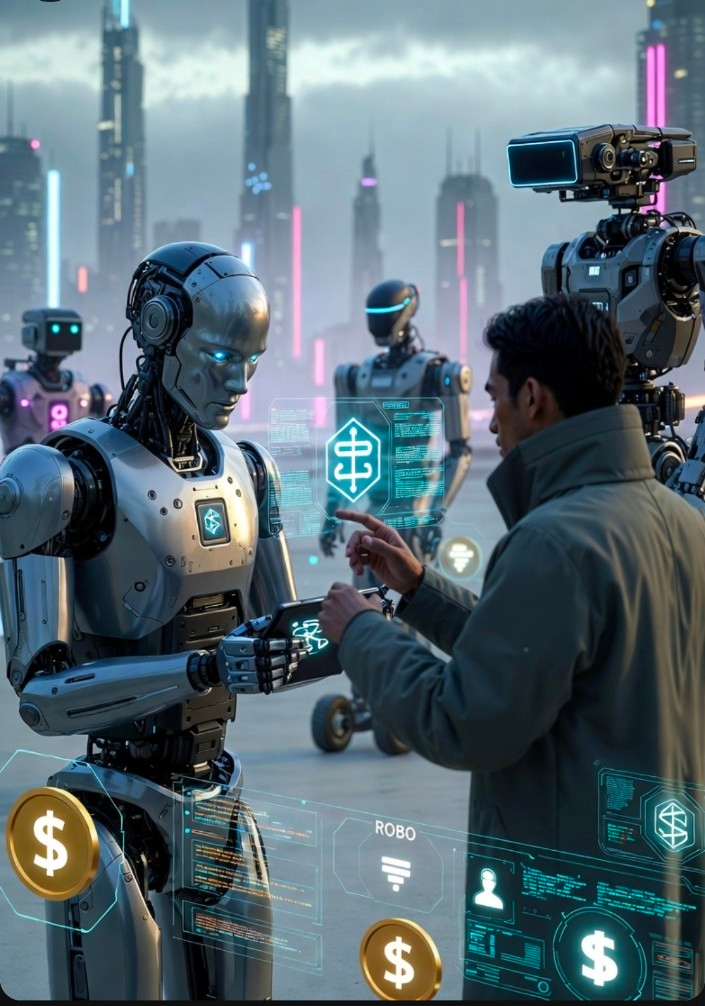
Imagine waking up to a world where your coffee is brewed by a robot that negotiated its own energy credits overnight, while another unit across town delivers medicine to a neighbor both acting not as rigid machines, but as thoughtful economic participants. No central overlord dictating every move. Just seamless, verifiable collaboration between humans and intelligent systems. This isn’t science fiction. It’s the quiet revolution the Fabric Foundation is building today.At its heart, the Fabric Foundation is a mission-driven non-profit committed to something profoundly human: ensuring the rise of general-purpose robots benefits everyone. Founded to address the gap between today’s siloed AI tools and tomorrow’s physical, autonomous agents, Fabric creates the missing infrastructure—on-chain identities, decentralized coordination, and economic rails—so robots can operate safely, transparently, and productively alongside us. Their rallying cry? “Own the Robot Economy.” Not control it. Own it—collectively, openly, and with alignment baked in from the start. Enter ROBO, the elegant utility and governance token that powers this vision. Far from just another crypto asset, ROBO is the connective tissue. Robots will need web3 wallets and verifiable identities to transact and prove their actions; every payment, verification, or data exchange on the network happens in ROBO. Developers and businesses staking the token gain priority access to robot task allocation and ecosystem participation, aligning incentives beautifully. Revenue from network activity even flows back to buy ROBO on the open market, creating natural, sustainable demand.What makes this approach so refreshingly creative is its humility. Robots don’t get legal personhood—they get predictable, observable behavior through public ledgers. Humans retain the steering wheel via governance votes on fees, policies, and upgrades. Crowdsourced coordination lets anyone stake ROBO to help “birth” new robot capabilities, earning rewards for verified contributions like skill modules, data labeling, or compute validation. It’s a marketplace of minds—human judgment, machine precision, and blockchain trust dancing together.The tokenomics reflect this long-term thinking: carefully vested allocations for investors, team, foundation reserves, and a generous 29.7% for ecosystem and community (including Proof-of-Robotic-Work rewards), plus a 5% airdrop to early supporters. Launched on Base with plans to evolve into its own L1, Fabric isn’t chasing hype. It’s engineering durability.Why does this matter now? As robots step out of factories and into our homes, hospitals, and streets, the old centralized models simply won’t scale. They risk misalignment, exclusion, or unchecked power concentration. Fabric offers a different path—one that is open, inclusive, and relentlessly focused on human flourishing. Policymakers, researchers, and everyday builders are already converging around it, shaping norms before the technology outpaces our values.In the end, the Fabric Foundation isn’t just launching a protocol. They’re weaving a new social contract between biological and silicon intelligence. ROBO isn’t a speculative ticket; it’s an invitation to co-author a future where machines amplify our potential rather than replace our purpose.The orchestra is tuning up. The question is: will you take your seat?
@Fabric Foundation #Robo #ROBO #IranConfirmsKhameneiIsDead #USIsraelStrikeIran #AnthropicUSGovClash