
When I first heard about Fabric Protocol, I honestly thought it was just another crypto launch trying to ride the robotics wave. There was a token called ROBO, bold language about decentralization, and big claims about a coming “robot economy.” It sounded ambitious, maybe even a little dramatic. But the more time I spent reading about Fabric Protocol, the more I realized it wasn’t really about hype. It was about a much deeper question: what happens to work, wealth, and fairness when robots don’t just assist us — they start competing with us?
Fabric’s central idea is surprisingly simple but quietly radical. Instead of treating robots as corporate property hidden behind private systems, it imagines giving them blockchain identities and digital wallets. In that world, a robot could earn money for completing tasks, pay for its own maintenance, purchase services, and operate within an open marketplace. Not as a passive tool, but as an economic participant.
At first glance, that sounds futuristic and efficient. Machines that manage themselves. Fleets coordinated transparently. Open access instead of corporate monopolies. But once you sit with the idea for a while, something more personal starts to surface. If robots are earning, who is receiving the income? If they replace workers, where does the displaced wage go?
History tells us that technology always reshapes labour. When machines entered factories during the Industrial Revolution, they didn’t just increase productivity — they changed who held power. Owners of machines gained leverage. Workers often lost bargaining strength. Over time, societies built labour laws, unions, and welfare systems to rebalance things. But that balance was never automatic. It was fought for.
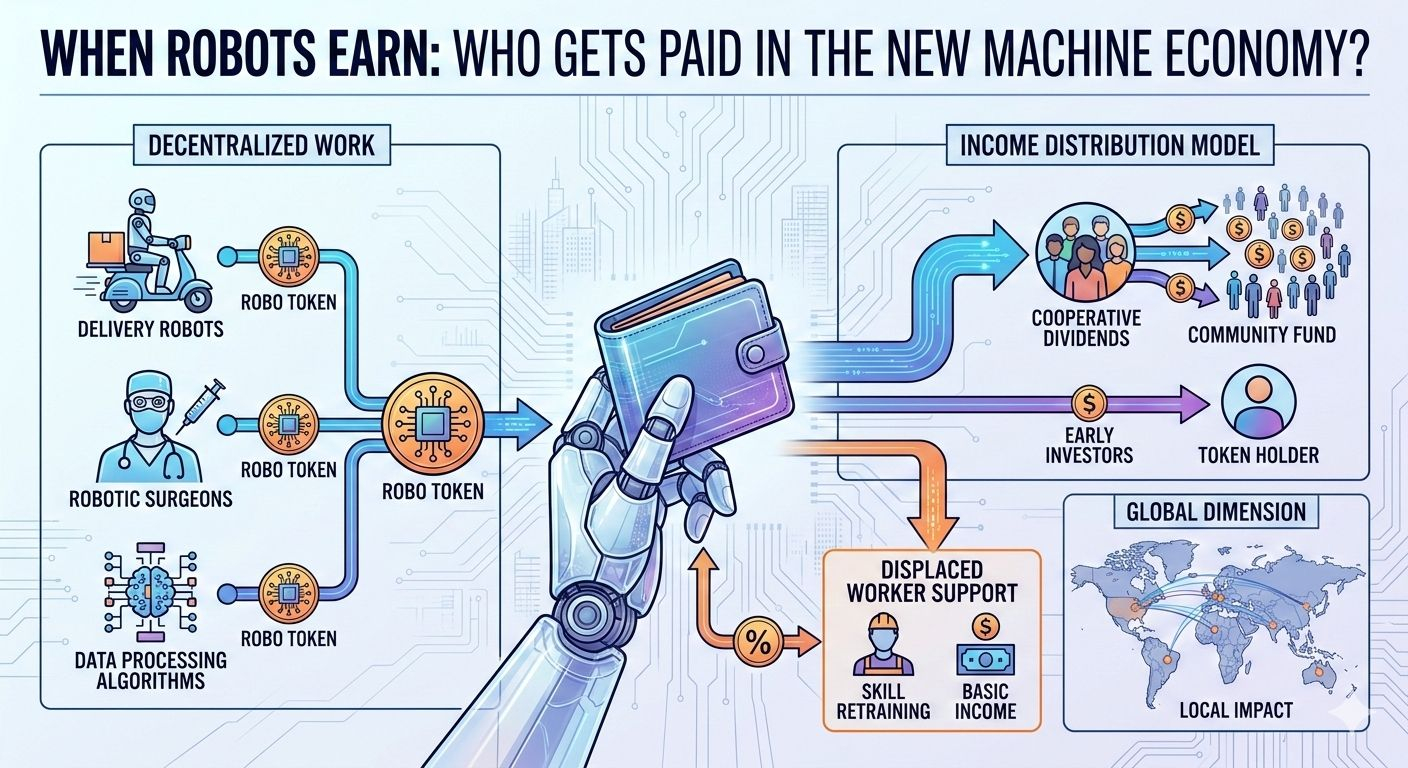
Today’s automation wave feels similar, but faster. Robots and AI systems are not only replacing physical labour; they are replacing cognitive tasks too. Logistics, customer service, data processing, even parts of healthcare and finance are increasingly automated. If Fabric’s vision becomes real, robots won’t just be owned by companies. They could exist as independent economic agents inside decentralized systems. That feels like progress — until you ask where the profits accumulate.
Fabric hints at ideas like communities pooling resources to deploy robot fleets and share earnings. There’s talk of structures where people can collectively benefit from machine productivity, almost like a cooperative dividend funded by robot labour. It’s an attractive thought: if machines take over repetitive tasks, humans could share in the returns and focus on more meaningful work.
But here’s the uncomfortable truth — nothing about technology guarantees fairness. A decentralized network can still concentrate wealth. Tokens can still end up in the hands of early insiders or large investors. Governance can quietly tilt toward those who stake the most capital. Without clear redistribution mechanisms, robot-generated income could simply flow to token holders instead of the communities most affected by automation.
And beyond money, there’s something deeper at stake. Work is not just a paycheck. It’s identity. It’s structure. It’s pride. When someone loses a job to automation, the loss isn’t purely financial. It can feel like displacement from society itself. A token dividend — even if generous — doesn’t automatically replace that sense of purpose.
That’s why the real issue isn’t whether robots should have bank accounts. It’s whether society has a plan for what happens next. If robots can earn, should a portion of those earnings automatically support displaced workers? Should local communities have guaranteed participation in robot-generated revenue? Should governments adapt taxation systems to ensure automation funds social stability?
These are not technical questions. They’re moral ones.
There’s also a global dimension. Robots don’t recognize borders, but labour markets do. If a robotic fleet operates in one country while profits accumulate in another through token markets, inequality could widen internationally. Wealth might become even more detached from geography, while job losses remain painfully local.
Still, I don’t think Fabric’s vision is inherently harmful. In fact, it might open doors. Making robotic transactions transparent on a blockchain could make revenue flows more visible than traditional corporate accounting ever allowed. If designed carefully, such systems could embed automatic contributions to social funds or cooperative structures. The technology itself is neutral; the rules built around it are not.
What fascinates me most is that Fabric isn’t really about robots. It’s about ownership. It’s about who benefits when machines produce value. If robots are going to work alongside — or instead of — humans, the economic architecture must evolve too. Otherwise, we risk repeating a familiar pattern where innovation enriches the few while promising opportunity to the many.
We are standing at a strange intersection. On one side is extraordinary productivity. On the other is potential displacement. Between them lies policy, governance, and design choices that haven’t fully been made yet.
Robots without borders could mean an open, shared economy where communities own part of the infrastructure shaping their future. Or it could mean capital flowing faster and further away from the people whose lives are most disrupted.
The outcome isn’t locked in by code. It will depend on whether we treat this moment as a technical upgrade — or as a chance to rethink how wealth and work are connected in the first place.
