The phrase "decentralized automation" gets used so freely in blockchain marketing that it has nearly lost its meaning. Protocols attach it to products that, under the surface, still rely on a handful of privileged nodes, an upgradeable admin key, or execution infrastructure that can be switched off. None of that is decentralized in any meaningful sense — and for automation specifically, the distinction matters more than in most other protocol categories. When a system is authorized to execute transactions on your behalf, the trust assumptions embedded in that system carry real weight. Understanding how to evaluate those assumptions clearly is one of the most underrated skills in this space.
What ROBO Is — The One-Paragraph Version
$ROBO is the token at the center of an on-chain automation protocol: infrastructure designed to let developers and protocols register conditional tasks that execute automatically when predefined on-chain conditions are met. A network of keepers monitors registered jobs and triggers execution — think of it as a decentralized scheduler that removes human or centralized-bot dependency from time-sensitive on-chain operations. The token handles fee settlement and keeper compensation. That's the premise. The question this article addresses is: what would it actually take for that premise to be genuinely decentralized rather than merely marketed as such?
Why the "Decentralized" Label Needs Scrutiny
There's a pattern in how automation infrastructure gets described versus how it actually operates. A protocol might have 200 registered keepers in its documentation — but if the top five nodes execute 90% of all jobs, the network's practical decentralization is close to zero. Or a protocol's job registry might be upgradeable by an admin multisig, meaning the contracts that define how automation works can be changed without community governance. Or the keeper onboarding process might require whitelisting, which introduces a permissioned choke point regardless of how open the token distribution looks.
None of these are automatically disqualifying. Protocols make pragmatic tradeoffs, especially in early stages. But they are things you need to verify explicitly rather than accept from a one-pager.
#ROBO and any automation protocol that makes decentralization claims should be evaluated against the same framework — not given the benefit of the doubt because the category sounds inherently trustless.
A Layered Checklist: Four Levels Where Decentralization Can Break Down
This framework applies to any automation protocol. Run through each level independently, because a protocol can score well at one layer and fail badly at another.
Layer 1 — Execution decentralization
The question: Is job execution distributed across a meaningful number of independent nodes, or is it effectively centralized in practice?
What to check: Active keeper count. Job completion distribution across nodes. Whether keeper onboarding is permissioned or open. Historical execution during congestion events — was the network's performance concentrated in a few nodes or broadly distributed?
If X then Y: If the top five keepers execute more than 60–70% of all jobs, treat the network as functionally centralized at the execution layer, regardless of how many keepers are technically registered.
Layer 2 — Contract upgradeability
The question: Can the protocol's core contracts be changed unilaterally, and if so, by whom?
What to check: Whether job registry and execution contracts are upgradeable. Who holds upgrade keys — a multisig, a DAO, or a single address. Timelock duration on upgrades, if any.
If X then Y: If a 2-of-3 multisig can upgrade core contracts with no timelock, a user's registered automation jobs are operationally dependent on three people. That's not decentralized execution — it's three-person custody with extra steps.
Layer 3 — Economic sustainability
The question: Are keepers compensated by genuine fee revenue from protocol usage, or primarily by token inflation?
What to check: Fee structure. What percentage of keeper rewards come from execution fees vs. newly minted tokens. Whether fee volume is growing relative to inflation rate.
If X then Y: If keeper rewards are predominantly inflationary, participation is incentivized artificially — and if token price declines, keepers have rational incentive to exit, which degrades the network's reliability precisely when users may need it most.
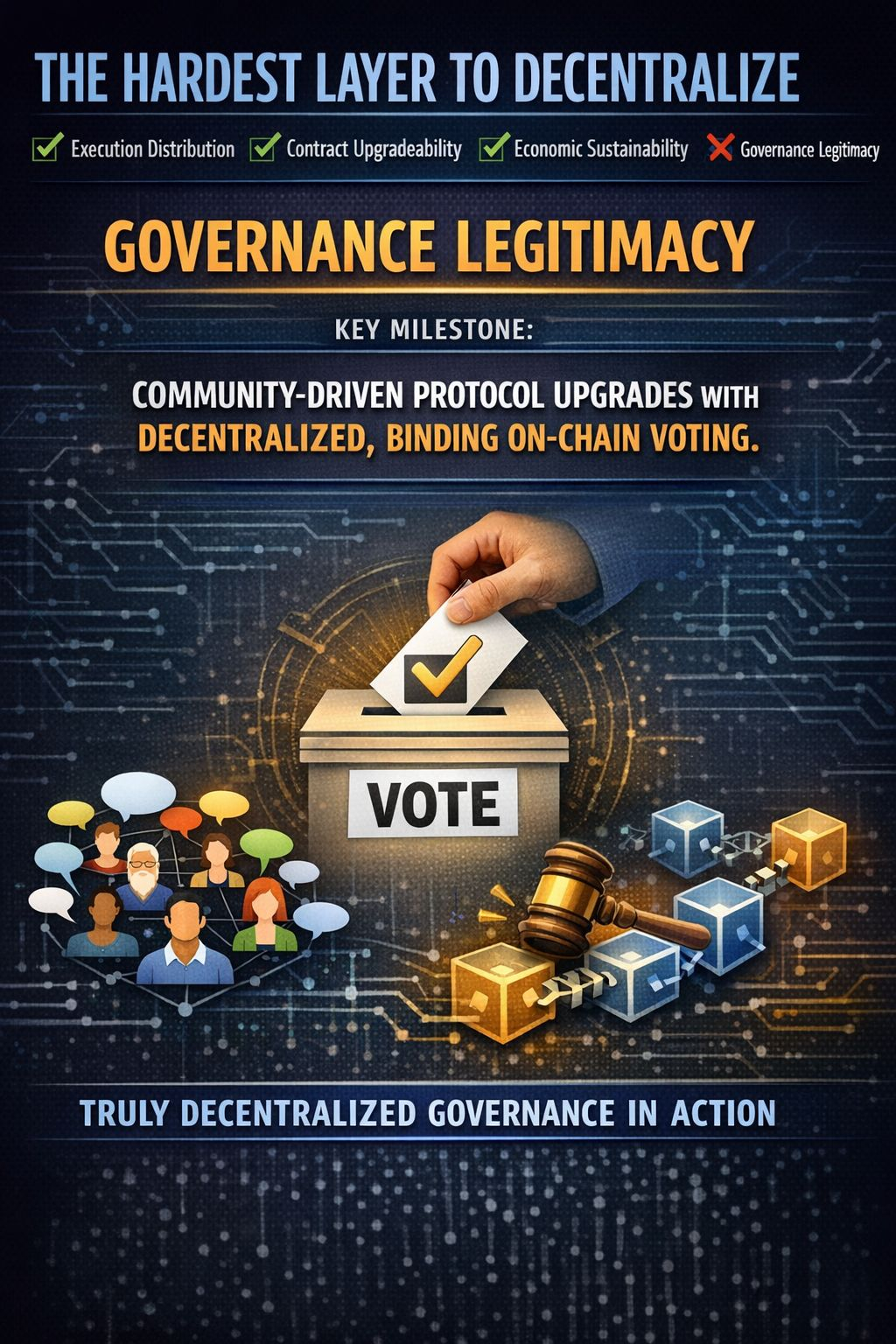
Layer 4 — Governance legitimacy
The question: Do token holders actually make meaningful decisions, or is governance cosmetic while core parameters remain under team control?
What to check: What decisions have passed through on-chain governance vs. been implemented directly by the team. Voter participation rates. Whether governance votes have ever overruled a team proposal.
If X then Y: If every governance vote in the protocol's history has passed with the team's preferred outcome and minimal opposition, that's evidence that governance is decorative rather than functional — or that token distribution is too concentrated for independent governance to operate.
The Nuanced View: Why This Doesn't Mean "Avoid Everything Early-Stage"
It's worth being direct about what this framework is and isn't saying. Early-stage automation protocols legitimately need centralized components to function — fully decentralized keeper networks with no whitelisting, no upgradeable contracts, and no team-controlled parameters are almost impossible to bootstrap. The honest version of most protocols' early architecture is "progressively decentralizing," and that's a defensible position. The problem isn't centralization per se; it's undisclosed centralization, or marketing that implies trustlessness the protocol hasn't yet achieved.
@Fabric Foundation like any protocol in this category, should be evaluated on the trajectory, not just the current state. Is keeper participation growing? Is the upgrade key governance moving toward a DAO timelock? Is fee revenue as a proportion of keeper compensation increasing over time? A protocol that's genuinely on the right trajectory deserves more credit than one that hit decentralization theater metrics on day one and then stopped moving. But trajectory claims need evidence — roadmap items and blog posts are not evidence; on-chain data and contract changes are.
Risks & What to Watch
Keeper concentration creeping upward: Even a well-distributed network can become concentrated over time if smaller keepers find economics unsustainable. Watch active keeper counts and job distribution, not just total registered keepers.
Upgrade key risk going unnoticed: Contract upgradeability disclosures are often buried in technical documentation. A protocol can change materially without any announcement — set a personal alert to track admin key activity on-chain if you're using the protocol actively.
Governance participation collapse: Low voter turnout in on-chain governance creates de facto centralization even where formal decentralization exists. A quorum of 2–3% token supply is functionally captured by whoever holds the largest wallets.
Execution failure during stress events: Automated jobs that work fine under normal conditions may queue, delay, or drop during high-congestion periods. If your use case is time-sensitive (liquidation protection, rebalancing), stress-test assumptions about execution reliability are not optional.
Fee revenue vs. inflation ratio deteriorating: Track this ratio across quarters. Declining fee revenue relative to keeper rewards signals that the network's participation is becoming structurally dependent on token price rather than actual demand for automation services.
Practical Takeaways
Run the four-layer checklist before integrating any automation protocol — especially at the contract upgradeability layer, which is the most underread risk in this category and the one with the most immediate consequences for users who register long-running jobs.
Distinguish between "decentralized by design" and "decentralized in current practice." The former is a whitepaper claim; the latter is an on-chain observable fact. Build your analysis on the latter.
Trajectory matters more than current state for early-stage protocols — but trajectory needs to be measured in verifiable contract changes, keeper participation data, and governance history, not team communications or roadmap timelines.
One Discussion Question
Of the four layers in the checklist — execution distribution, contract upgradeability, economic sustainability, and governance legitimacy — which one do you think is the hardest for an automation protocol to genuinely decentralize, and what specific milestone would convince you that a protocol had actually crossed that threshold?