
The crypto industry has a habit of discovering a real world trend and then turning it into a financial narrative long before the infrastructure exists. The “robot economy” is the latest version of that pattern. Trillion dollar projections are repeated until they begin to sound inevitable. The logic becomes simple: robots will be everywhere, therefore any token connected to robots must be valuable.
That line of thinking is comfortable. It is also incomplete.
When I looked at Fabric Protocol and the ROBO token, I tried to ignore the size of the projected market and focus instead on the structural problem underneath the story. Strip away the token, the campaigns, the trading volume. What remains?
A real gap.
As AI systems move from generating text to controlling physical machines, we enter a different category of risk. A robot delivering medical supplies, managing warehouse logistics, or assisting in hospitals cannot just exist as a device. It needs identity. It needs to prove who it is. It needs to log what it does. It may need to transact without waiting for a human to approve every action.
Today, banks do not open accounts for autonomous machines. Legal systems were not designed for software agents making independent decisions. Hardware ecosystems are typically centralized under a single manufacturer, which makes accountability difficult when something fails.
Fabric’s core idea is to use a ledger to anchor machine identity, payments, and activity logs in a system that is transparent and verifiable. Whether implemented perfectly or not, this direction addresses a legitimate infrastructure problem. As robots enter public spaces and critical systems, identity and accountability cannot remain informal.
That is the serious part of the thesis.
The more complicated part begins when we examine the ROBO token.
The token model includes holding requirements for access, ecosystem incentives, buyback mechanisms funded by protocol revenue, and reward distributions designed to stimulate activity. On paper, this structure aligns participants. Builders must hold tokens. Users must hold tokens. Value flows back into the system.
In practice, the question is simpler: is usage driven by necessity or by incentives?
Reward campaigns and listing events often create sharp increases in trading volume and community activity. High 24 hour volume looks like validation. But incentives blur the signal. When participants are paid to engage, it becomes difficult to measure genuine demand. Activity under subsidy is not the same as activity under necessity.
The real stress test begins when rewards decline.
If robots continue registering identities on the ledger without token incentives, that suggests real integration. If developers build tooling without short term reward campaigns, that suggests belief in long term utility. If partnerships result in deployed systems rather than announcements, that signals traction.
If activity collapses when incentives disappear, then the system was never infrastructure. It was a temporary marketplace for rewards.
Fabric’s organizational structure deserves attention. Operating as a non profit foundation with detailed governance documentation and explicit risk disclosures is not common in crypto. Many projects use whitepapers as marketing documents. A technically detailed and risk aware paper suggests internal discipline.
But discipline is a starting condition, not a guarantee of success.
The risk for Fabric is social, not technical. Any project connected to a large future narrative attracts two audiences. One wants to solve real problems in robotics and machine coordination. The other wants exposure to a compelling story that might appreciate in price.
The market price will reflect the louder group. The long term value, if it exists, will depend on the quieter one.
The idea of machine verifiable identity and autonomous economic participation is not science fiction. It is a foreseeable requirement if robotics continues advancing. The missing infrastructure is real. The institutional and legal gaps are real.
What is not yet real is proof of sustained, incentive independent adoption.
The meaningful question is not whether ROBO trades actively or trends during campaigns. It is whether robots, developers, and institutions will rely on the network when there is no reward to do so.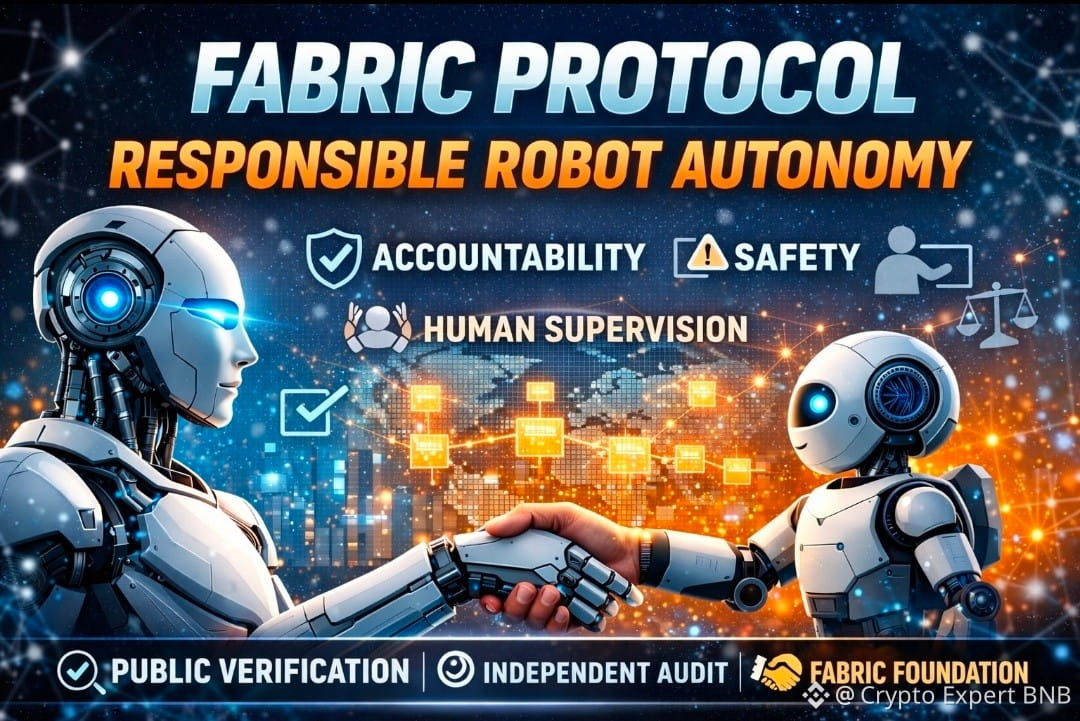
In crypto, narratives are abundant. Durable systems are rare.
Fabric Protocol sits between those two outcomes.
Time, not trading volume, will decide which side it belongs to.