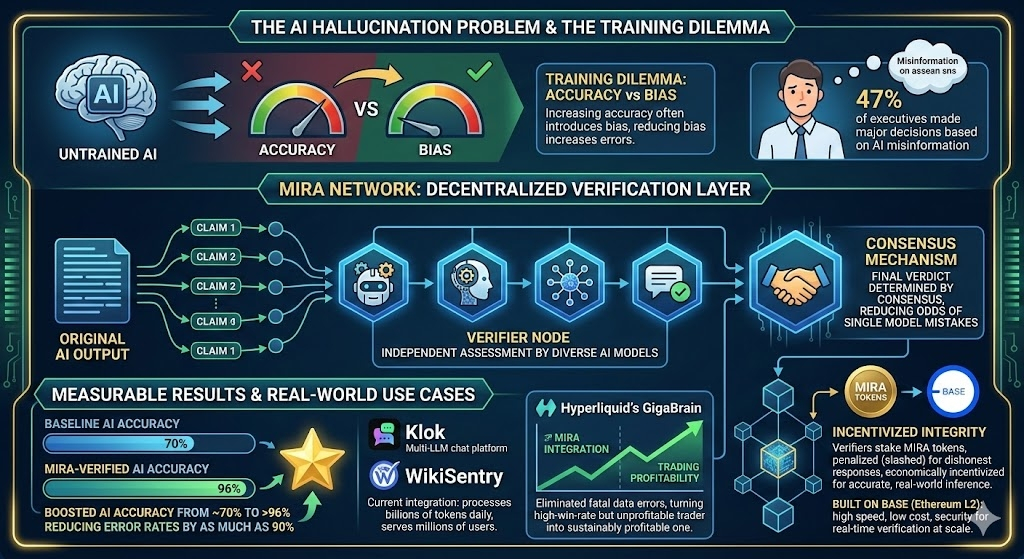
Artificial intelligence holds immense promise, but its widespread adoption is hindered by a critical flaw: hallucination. As AI models become more sophisticated, they also become more convincingly wrong, leading to a "training dilemma" where increasing accuracy often introduces bias, and reducing bias can increase errors . This poses a significant risk, with Mira Network's research indicating that 47% of executives have made major decisions based on AI misinformation .
Mira Network is addressing this challenge by building a decentralized verification layer for AI, rather than creating yet another large language model . The protocol acts as a "trust layer," functioning like a decentralized audit system for AI outputs . Here’s how it works: when an AI generates a response, the network breaks it down into smaller, verifiable factual claims . These individual claims are then sent to a distributed network of verifier nodes, each running diverse and specialized AI models . These models independently assess the claims, and a consensus mechanism determines the final verdict—a process that significantly reduces the odds of a single model's mistake or bias slipping through .
This innovative approach delivers measurable results. By using a consensus of multiple models, Mira Network has reportedly boosted AI accuracy from a baseline of around 70% to over 96%, reducing error rates by as much as 90% . The network is not just theoretical; it currently processes billions of tokens daily and serves millions of users through integrated applications like the multi-LLM chat platform Klok and the Wikipedia fact-checker WikiSentry . A compelling real-world use case is its integration with Hyperliquid"s autonomous trading agent, GigaBrain, where Mira"s verification helped eliminate fatal data errors, turning a high-win-rate but unprofitable trader into a sustainably profitable one .
To ensure the integrity of this verification process, Mira Network combines principles from both AI and blockchain. It utilizes a hybrid of Proof-of-Work (PoW) and Proof-of-Stake (PoS) mechanisms . Verifiers must stake MIRA tokens to participate and are penalized (slashed) for dishonest or random responses, ensuring they are economically incentivized to perform accurate, real-world inference . The network"s native token, MIRA, fuels this economy: it is used for staking to secure the network and is also consumed as payment for API usage by developers, creating a potential deflationary pressure as demand for verification grows .
By choosing to build its core infrastructure on Base, an Ethereum Layer-2 solution, Mira Network gains the high speed, low cost, and security necessary for real-time verification at scale . This focus on solving a tangible performance problem has attracted a customer base primarily from traditional Web2 enterprises, distinguishing Mira from many ideologically-driven Web3 projects . Ultimately, Mira Network posits that the future of AI depends not on creating "smarter" models, but on building a robust, verifiable foundation for the intelligence we already have . @Mira - Trust Layer of AI #mira $MIRA