
Iran is moving to close the — a decision that would immediately disrupt over 20% of the world’s oil supply. $ALICE
Most people still don’t understand what this really means.
This isn’t just an oil story.
This is a global markets shock.
Stocks.
Metals.
Crypto.
If you’re holding any asset right now, there’s a risk you may not be pricing in.
Here’s why this is unprecedented:
The Strait of Hormuz has never been fully closed in modern history.
This isn’t symbolic pressure — this is a chokepoint.
The narrow passage between and is the gateway connecting the to global markets.
Nearly one-fifth of global oil consumption flows through it every single day.$DENT
Following U.S. strikes on Iran, ships moving through the strait are receiving warnings, and vessels have been advised to avoid the area altogether.
That alone tells you how serious this is.
has already labeled a Hormuz shutdown as their worst-case scenario in an .
Because if Hormuz shuts down, oil doesn’t rise slowly.
It spikes.
Estimates suggest crude could surge to $120–$130 per barrel almost immediately.
Now follow the chain reaction:
→ Oil spikes → inflation returns fast
→ Inflation returns → rate-cut hopes vanish
→ Rate cuts vanish → bond yields rise
→ Yields rise → liquidity tightens
And when liquidity tightens, markets don’t stay orderly.
Energy feeds directly into inflation. Every $10 move in oil can materially push CPI higher — and oil is already climbing before any full disruption.
And here’s what most people miss:
Saudi Arabia alone accounts for roughly 38% of crude flows through Hormuz — about 5.5 million barrels per day.
Add Kuwait.
Qatar.
Bahrain.
Large portions of Saudi production.
They have no alternative sea route.
Pipelines can reroute some supply — but nowhere near enough to offset a full shutdown.
There is no quick workaround.
Shipping costs are already jumping.
Tanker routes are diverting.
Vessels are being warned to keep distance from military assets.
This is not hypothetical anymore.
This is active risk repricing.
If Hormuz is fully or even partially disrupted, this stops being a short-term shock and becomes a structural supply event.
And structural supply shocks don’t resolve in a single trading session.
There are only three possible outcomes:
1️⃣ Temporary threat
Tensions cool, oil pulls back.
2️⃣ Sustained tension
Ongoing disruptions, oil grinds higher.
3️⃣ Full disruption
Shipping halts, oil explodes upward, and the macro regime shifts.
Scenario three changes everything.
Because once oil spikes hard enough, markets stop pricing fear —
they start pricing duration.
And duration is where real damage happens.
This isn’t just about oil.
It’s about inflation.
It’s about interest rates.
It’s about liquidity.
When liquidity tightens, investors don’t sell what they hate.
They sell what they can.
Risk assets are hit first: • High-multiple tech
• Speculative growth
• Small caps
• And yes — crypto
doesn’t fall because the network fails.
It falls because it trades like a high-beta liquidity asset.
When leverage unwinds and crowded trades clear, volatility accelerates.
That’s how dominoes fall.
The next 24 hours are critical.
This won’t be “just another headline.”
It could be a macro turning point.
By the time it’s obvious, most participants will already be too late.
I’ve been calling major market tops and bottoms for over a decade.
When I make my next move, I’ll share it here first.
If you’re not paying attention yet — you probably should be.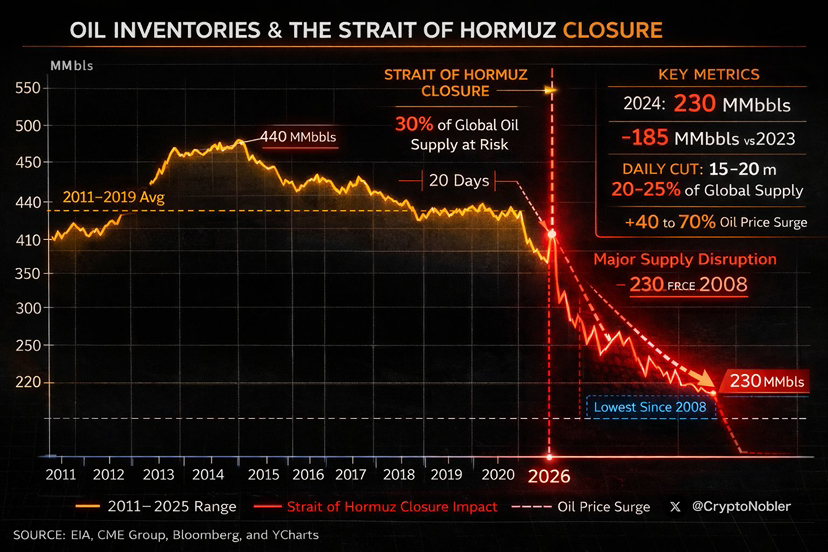
#IranConfirmsKhameneiIsDead #USIsraelStrikeIran #IranAttackIsrael