
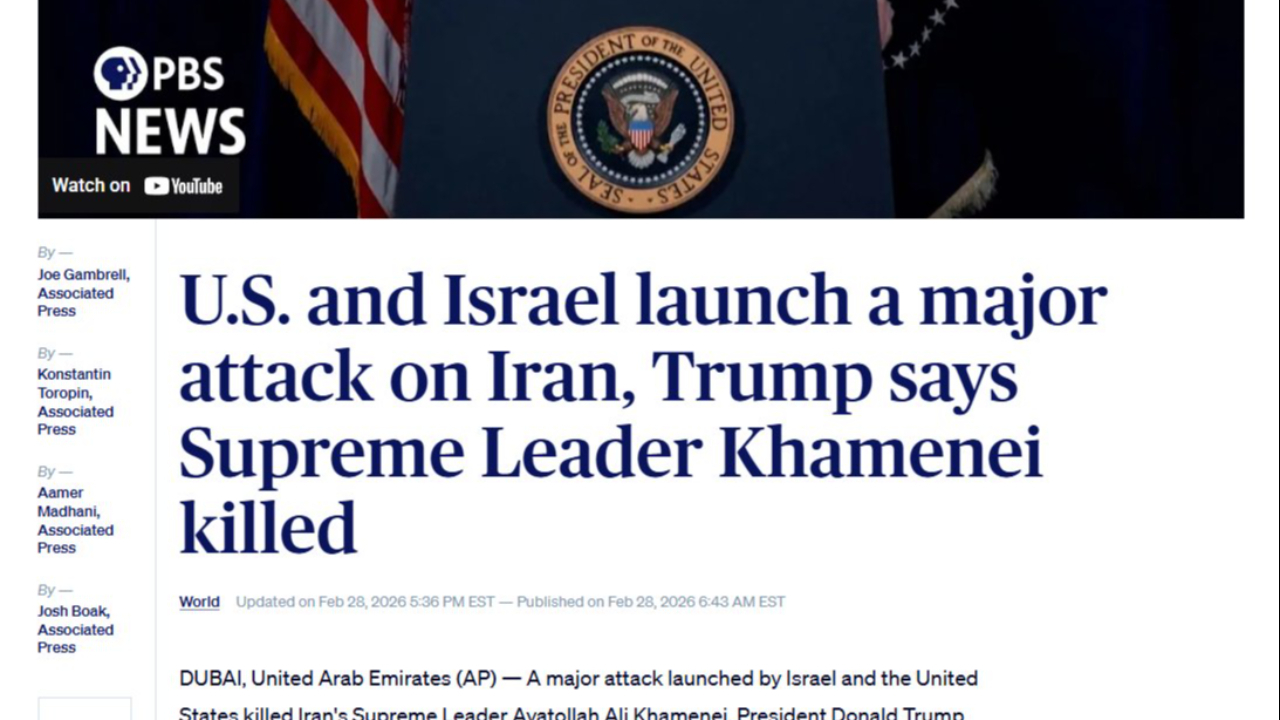
📊 Looking at the numbers in Iran as of 01/03/2026, I don’t just see 500 targets hit or 150–300 missiles fired in response.
I see a state of Controlled Escalation — escalation that’s deliberate, calibrated, but large enough to force markets to reprice regional risk.
24 out of 31 provinces affected isn’t symbolic.
This isn’t a one-off warning strike. It’s structural.
It signals the ability to penetrate defense layers and command chains — not just send a message.
🔍 The scale matters.
Roughly 200 Israeli fighter jets involved, alongside the presence of US carrier groups and submarines, suggests the US–Israel axis isn’t just targeting tactically. They’re testing Iran’s response threshold.
Iran, with nearly 960,000 personnel and the IRGC at the core, retaliates with missiles, drones, and air defense systems — even with reported S-300 damage.
This is no longer proxy-level friction. It’s a collision between two modern military structures recalibrating deterrence power.
⚠️ The key isn’t just casualty numbers.
When damage stretches across Tehran, Isfahan, Qom, and Minab — including serious civilian losses — internal political pressure rises.
History shows once civilian casualties cross psychological thresholds, retaliation pressure shifts from military logic to national honor logic.
And once honor enters the equation, control bandwidth narrows.
Iran targeting US bases in Qatar, Kuwait, UAE, Bahrain, Jordan, and Iraq signals what I’d call Horizontal Signaling — extending deterrence messaging across the entire logistical network.
Even if US casualties remain at zero and damage is limited, the fact that bases are within strike range changes the definition of “safe zone.”
Once logistics chains are threatened, the cost of maintaining presence increases — even before material losses scale.
💡 Core insight: both sides are trying to keep this under the “Total War” threshold.
But every exchange compresses the margin of control.
I call this Escalation Bandwidth Compression — where each successive move becomes harder to keep symbolic. The range for calibrated response gets tighter.
When claims about Khamenei’s death surfaced and were later denied, the information battlefield became a second front.
In that environment, truth is secondary to velocity.
If a narrative spreads fast enough, it can trigger reactions before verification catches up.
📉 Hundreds of flight cancellations and thousands stranded aren’t side effects.
They’re signals that risk has spilled beyond military zones into civilian infrastructure.
Airspace disruption raises insurance costs, slows trade flows, and forces energy and financial markets to price in additional war premium.
Compared to 2025 — when Iran lost over 600 people and key nuclear facilities were pushed back years — today’s escalation is more sophisticated, but not less dangerous.
High intensity.
Below full-scale war.
But closer to the threshold than markets may be comfortable with.
The real question isn’t who hit more targets.
The question is:
Does the current deterrence structure still have enough bandwidth to absorb another shock without tipping beyond control?
When conflict remains elevated without fully detonating, the world enters prolonged instability — where each military decision doesn’t just shape the battlefield.
It reshapes how global markets price the future.
If war premium is now an embedded variable in risk pricing,
have you adjusted your portfolio structure accordingly?
#IranConfirmsKhameneiIsDead #USIsraelStrikeIran $PAXG
