
There is often a wide gap between “this solves a real problem” and “this solution is demonstrably working.” That gap tends to be obscured by trading volume, rapid community growth, and incentive-driven content ecosystems that naturally reinforce positive sentiment.
Fabric Foundation presents an interesting case study in that dynamic.
Not because it is obviously destined for success or failure — but because it represents a broader test for the crypto industry:
Can this space build durable, long-term infrastructure?
Or is it structurally optimized to monetize the narrative of building it?
---
The Problem Is Real
The issue Fabric is targeting is not hypothetical.
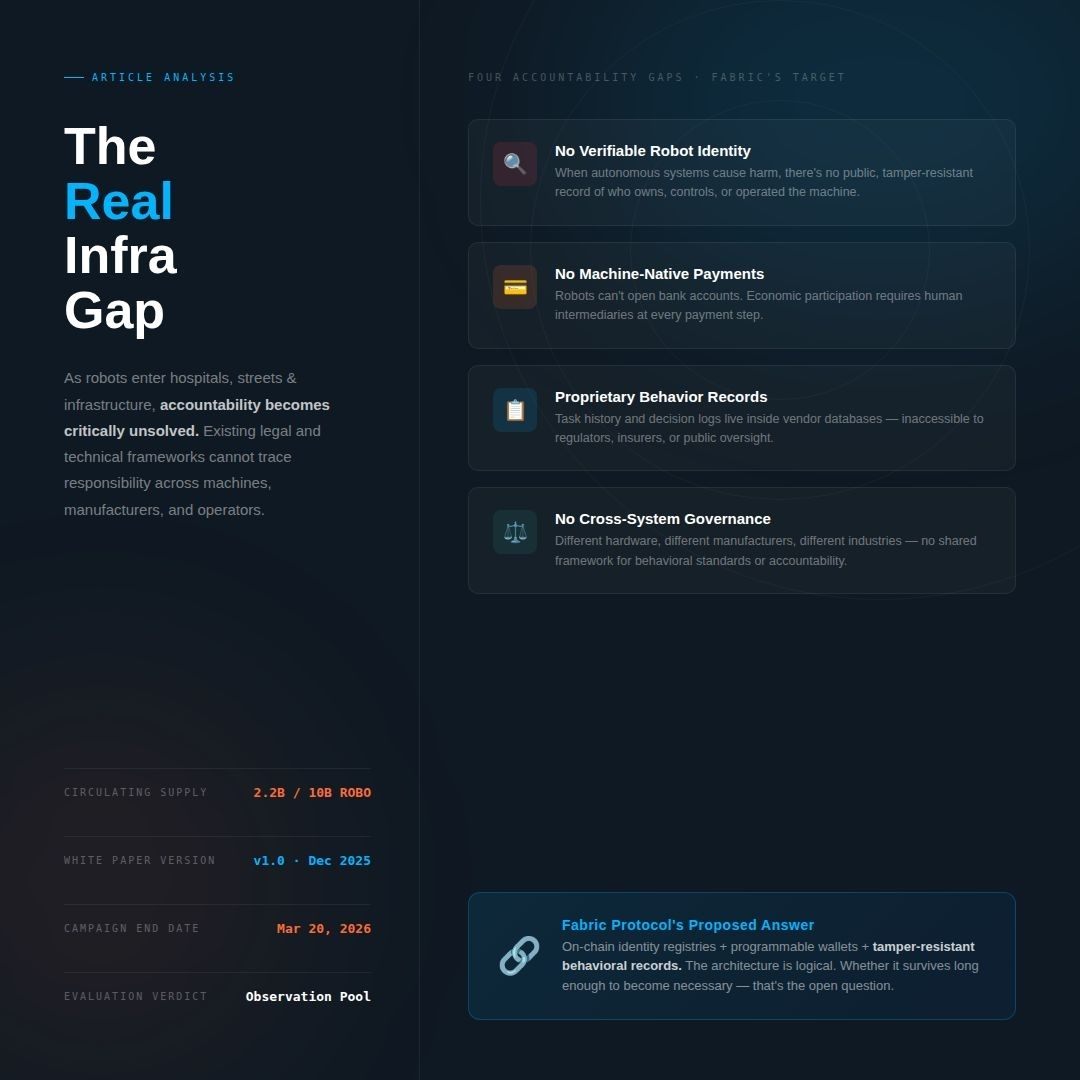
As physical robotics systems move beyond controlled environments and into public, commercial, and industrial spaces, accountability becomes a genuine structural gap. When:
An autonomous delivery unit damages property
A robotic arm injures a worker
A self-directed machine makes a high-impact operational error
Existing legal and technical frameworks struggle to assign clear responsibility.
On-chain identity registries, programmable wallets, and tamper-resistant behavioral records are logically aligned with this problem. The architecture Fabric outlines — robots with persistent on-chain identities, task histories anchored to public ledgers, and governance structures enabling distributed oversight — maps coherently onto the accountability challenges the robotics industry will inevitably face.
The problem is legitimate.
What remains uncertain is the timeline.
---
Where Precision Matters
Crypto markets have a documented tendency to price future possibility into present valuation. When a compelling infrastructure thesis appears, markets rarely wait for it to materialize. They price in:
1. The assumption it will be built
2. Optimism around adoption
3. Speculative expansion beyond realistic timelines
Fabric currently has approximately 2.2 billion tokens in circulation against a maximum supply of 10 billion. That ratio should anchor any serious conversation about long-term value.
Every unlock — team allocations, ecosystem incentives, future emissions — introduces additional supply. The key question becomes whether genuine, non-speculative demand will emerge to absorb it.
In Fabric’s model, durable demand would look like:
Companies paying ROBO to register robot fleets because accountability infrastructure provides legal or operational value
Developers staking $ROBO to deploy applications that require capabilities unavailable elsewhere
Insurers or regulators interfacing with behavioral records to reduce verification costs
These use cases create structural demand independent of token cycles. Without them, valuation remains narrative-driven.
---
Incentives vs. Signals
The CreatorPad structure — content rewards, trading thresholds, community participation incentives — is tactically understandable. Public goods infrastructure projects often struggle with early traction. Without visibility and liquidity, even strong technical foundations can fail before proving value.
The campaign is performing its function.
The risk lies in conflating incentive-driven metrics with product-market fit.
The real evaluation window opens after incentive structures wind down. If developer activity, on-chain behavioral data, and meaningful governance participation persist without financial rewards sustaining them, that becomes the first credible signal of organic gravity.
Until that data exists, confident bullish or bearish claims remain speculative.
---
What Real Traction Would Look Like
In the months following incentive expiration, the most meaningful indicators would include:
Independent developers publishing tools or standards referencing Fabric’s protocol without compensation
Robotics or hardware deployment companies acknowledging or integrating the registry infrastructure in operational contexts
Governance proposals addressing substantive network decisions rather than symbolic engagement
These signals rarely trend on social media. They do not produce immediate price momentum. But they are the markers that separate infrastructure that matters for five years from infrastructure that mattered for five weeks.
---
The Open Question
If a large-scale robot economy emerges, some form of open accountability layer will be necessary. That is not controversial.
What remains uncertain is whether this specific project — at this stage, with its current token structure and community composition — becomes that layer.
There is not yet enough data to answer that question.
Anyone presenting certainty is likely selling a position rather than offering analysis.