
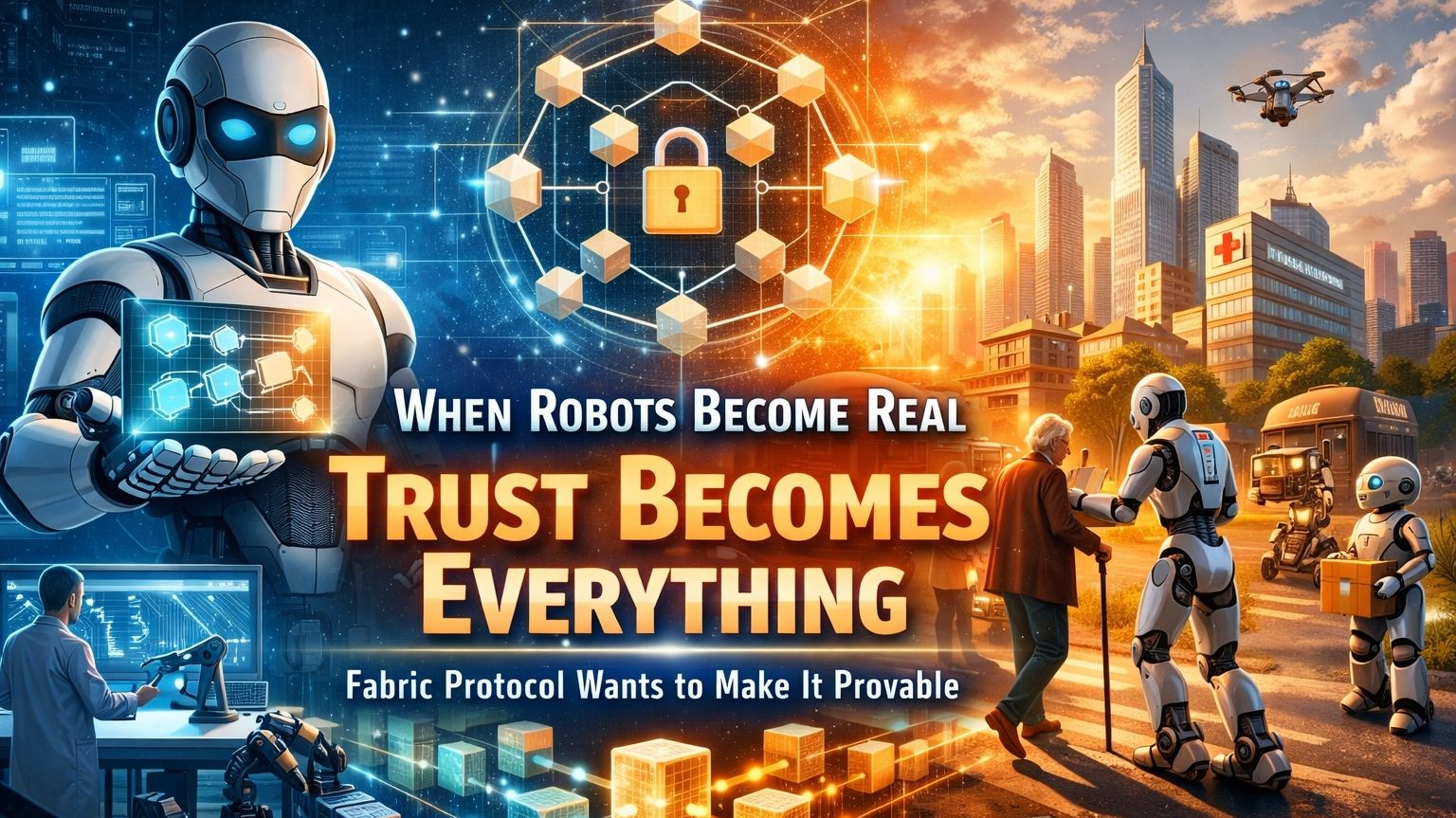
Robots are stepping out of controlled rooms and into places that feel like life itself homes hospitals streets warehouses classrooms and small businesses. That moment is thrilling but it is also heavy because a robot is not a screen that can be ignored. A robot is a body that can lift move carry drive cut clean deliver and enter spaces where people feel vulnerable. When a chatbot is wrong you feel annoyed. When a robot is wrong you feel fear because the cost can be physical financial and emotional. Fabric Protocol begins inside that feeling and builds outward. It does not start with a promise that everything will be safe. It starts with the idea that safety and trust must be engineered into the system the same way we engineer brakes into cars and standards into bridges. I’m looking at Fabric as an attempt to turn robotics from a closed product story into a public accountability story where actions can be tracked verified challenged and improved over time.
Fabric Protocol is presented as a global open network supported by the non profit Fabric Foundation with a mission to enable the construction governance and collaborative evolution of general purpose robots using verifiable computing and agent native infrastructure. In plain terms it wants to be the coordination layer where robots can be built and operated by many parties without everyone having to trust everyone else. The protocol aims to coordinate data computation and oversight through a ledger based system and modular components so humans and machines can collaborate with clearer accountability. They’re not only building a robot idea. They are trying to build the rails that let many robots and many contributors exist together without the whole system collapsing into chaos or private capture.
The emotional heart of Fabric is this one truth. Robots need identity memory and consequences. Identity means the world can know which machine acted. Memory means we can see performance history instead of judging from marketing or a single demo. Consequences means good behavior earns and bad behavior loses. Without those three things robots remain impressive but untrustworthy because nobody can answer the questions that matter after something goes wrong. What exactly happened. Which policy was active. Which model version ran. Who operated the machine. What evidence exists. Who is responsible. Fabric tries to move those questions from arguments into verifiable records. That is why the ledger matters. Not for hype. For receipts.
The system can be understood as a loop that repeats again and again as the network grows. A robot operator registers a robot identity and participates under network rules. Work happens in the real world and produces signals logs and outcomes. Evidence about availability and performance is posted or referenced in a way the network can evaluate. Validators or watchers can check claims and challenge dishonesty. Rewards flow to contributors who deliver real value and penalties can hit parties who fail reliability requirements or behave fraudulently. Then the robot and its skills evolve through modular upgrades so improvement is continuous rather than locked behind one company release cycle. When you see it as a loop you understand why Fabric talks about open collaboration. The goal is not just to ship one machine. The goal is to create a living ecosystem where robots can improve in public while staying accountable.
One of the most important design choices is modular evolution. Real world robotics is too complex for one model or one team to solve forever. Hardware changes. Sensors change. Environments change. Rules change. So Fabric leans toward a structure where capabilities can be added refined swapped and retired more like skill modules than a single sealed brain. That matters because it reduces the blast radius of change. If a particular capability behaves poorly it can be isolated and replaced. If a safer method exists it can be adopted without tearing down everything. If it becomes normal for robots to operate across industries then modularity becomes survival because no single stack will fit every environment for long. We’re seeing the logic of the internet applied to robotics where open standards and composable layers beat isolated towers over time.
Another core piece is verifiable computing and enforceable participation. In open networks the enemy is not only failure. The enemy is exploitation. People will try to fake identities inflate capacity submit low quality work harvest rewards and disappear. Fabric tries to counter that with economics and verification. The idea of bonding is central. Participants can be required to commit value as a bond that represents skin in the game. A bond changes behavior because it makes dishonesty expensive. It also makes reliability measurable because you can tie rewards and penalties to performance signals like uptime and quality. A network that cannot punish bad behavior becomes a charity. A network that can punish and reward based on measurable outcomes becomes infrastructure.
This is where the token story becomes more than a price story. In coordination systems the token can function like fuel and enforcement at the same time. Fees can pay for settlement and validation. Bonds can protect the network from spam and Sybil behavior. Rewards can attract builders operators and watchdogs. Governance can set thresholds policies and upgrade paths. If you only see the token as speculation you miss the deeper point. The system is trying to build consequences that operate automatically and predictably so participants do not need to trust a centralized referee. That is a hard problem but it is also the kind of problem that becomes unavoidable as robotics scales.
To judge whether Fabric is becoming real you look for metrics that cannot be faked for long. One signal is bonded participation and secured capacity because it shows how many participants are willing to lock value to operate. Another signal is availability because uptime is the most honest truth in robotics. Reliability in the field is what separates toys from workers. Another signal is quality behavior over time because systems degrade before they collapse and a resilient network should show recovery and improvement not only growth. Another signal is dispute behavior because verification only works if challenges happen and are resolved with real consequences. And finally you look at adoption shape across different settings because a general purpose vision must prove it can survive different environments not just one curated use case.
No deep analysis is honest without the risks because robots do not forgive theory. One risk is governance capture where decision power concentrates and the network drifts away from broad alignment. Another risk is measurement failure where verification signals can be gamed and the incentives start rewarding the wrong behavior. Another risk is operational reality because robots require maintenance power logistics parts and support and networks cannot magically remove hardware constraints. Another risk is regulatory pressure because when robots become autonomous participants in work and finance the rules around liability data safety and accountability get sharper. If the project cannot adapt to that pressure the growth story breaks. If it adapts well the same design choices that feel heavy today become the baseline for public acceptance tomorrow.
What matters is how Fabric tries to absorb pressure rather than pretend pressure will not arrive. Bonding is one defense because it creates a cost to dishonesty. Availability checks are another defense because they make silent failure visible. Quality thresholds are another defense because they push the network toward real outcomes not only participation. Challenge mechanisms are another defense because they reward people who prove wrongdoing instead of relying on social outrage. Modular upgrades are another defense because they allow the system to evolve without constantly risking catastrophic regressions. None of this guarantees safety. But it creates a framework where safety can be contested measured improved and enforced rather than left to hope.
The far future Fabric is pointing toward is bigger than a protocol. It is a new shape of the robot economy. In one future robots are controlled by a few private silos where the world gets convenience but not transparency and people must accept decisions they cannot inspect. In another future robots operate through shared rails where identity settlement oversight and improvement are more open and verifiable and where economic upside can be distributed to the broader ecosystem that builds and maintains the machines. Fabric is clearly reaching for the second future. That future is not utopia. Mistakes will still happen. Conflicts will still happen. But the difference is that the system is designed so society can ask hard questions and get provable answers.
I’m not asking you to believe in a perfect robot world. I’m asking you to notice what Fabric is really attempting. They’re trying to make trust something you can audit not something you have to accept. If it becomes normal for robots to do real work beside us then trust will be the most valuable feature of all because capability without accountability turns into fear. We’re seeing the world move toward autonomous agents and embodied machines at the same time and that convergence will force a decision. Either robotics becomes a closed power structure or it becomes a shared accountable infrastructure. Fabric is an attempt to build the second path early.
And here is the part that stays with you. A safe future is not one where robots never fail. A safe future is one where failure is visible accountable and correctable so people do not feel helpless. When trust is engineered into the rails people can accept progress without surrendering control. That is why Fabric matters as an idea even before it becomes massive. It is trying to turn the scariest part of robotics into the most measurable part. And if it succeeds then the day robots become normal will not feel like a loss of human agency. It will feel like a new partnership where technology finally earns the right to be in our world.
#Robo $ROBO @Fabric Foundation
