
 Most networks fail because they rely on trust.
Mira Network takes a different approach — it relies on mathematics.
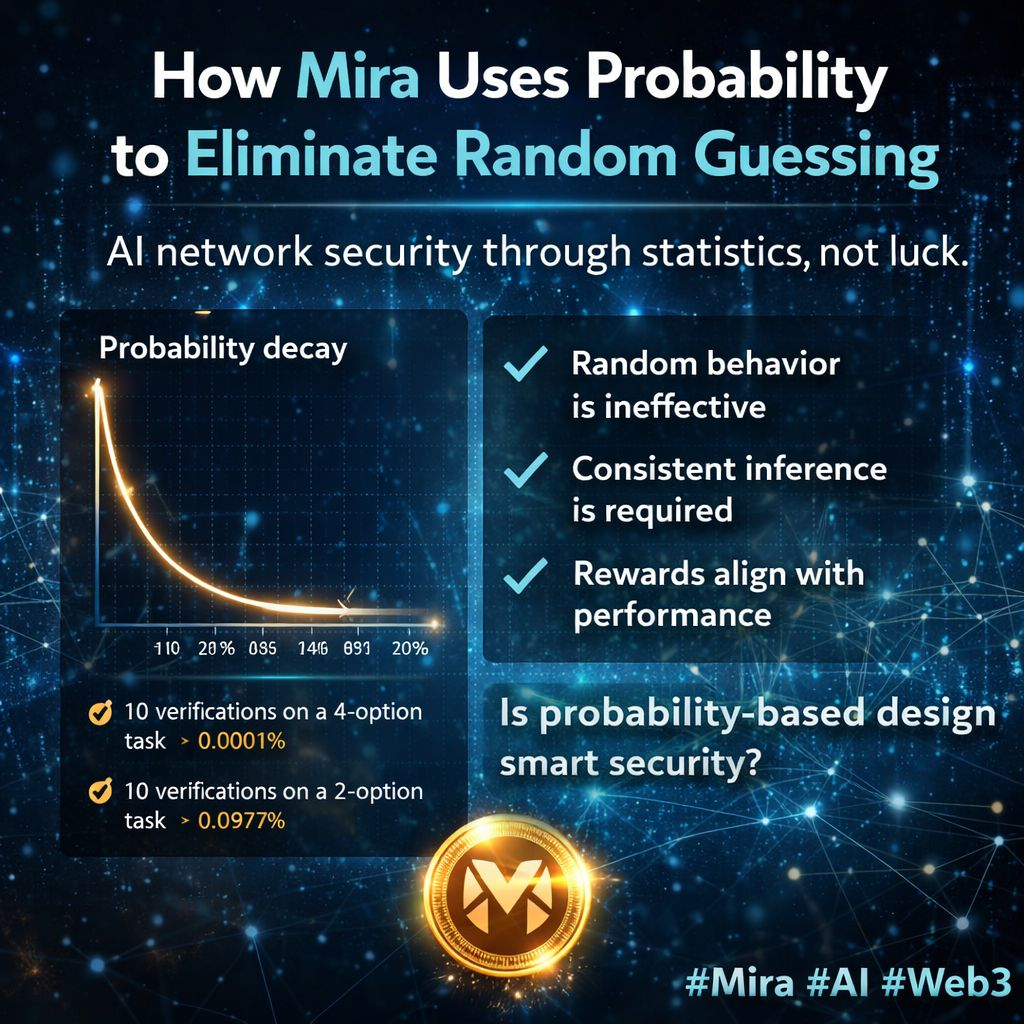
Instead of assuming honest behavior, Mira designs its verification system so that random guessing becomes statistically unsustainable. When a task has multiple answer options, a single guess might seem reasonable. But as verification rounds increase, the probability of consistent success drops exponentially.
For example, with repeated verifications, the chance of continuously guessing correctly becomes extremely small. This probability decay ensures that rewards are earned through actual computational work — not luck.
This design creates a powerful security mechanism: • Random behavior becomes ineffective
• Consistent inference is required
• Economic rewards align with real performance
The key insight is simple: when probabilities decrease rapidly, dishonest strategies lose viability. By integrating statistical constraints directly into its verification model, Mira strengthens system reliability without relying on blind trust.
In a space where transparency matters, backing security claims with mathematical structure builds confidence.