I didn’t approach Fabric Protocol with excitement. I approached it with skepticism.
Over the past few days, I went through its documentation slowly — not just scanning headlines, but actually trying to understand what problem it believes exists. Robotics and blockchain have both been overused narratives. When they appear together, I usually expect abstraction layered on abstraction. I’m not looking for another layer of complexity; I’m looking for a reason to trust the infrastructure we’re already building.
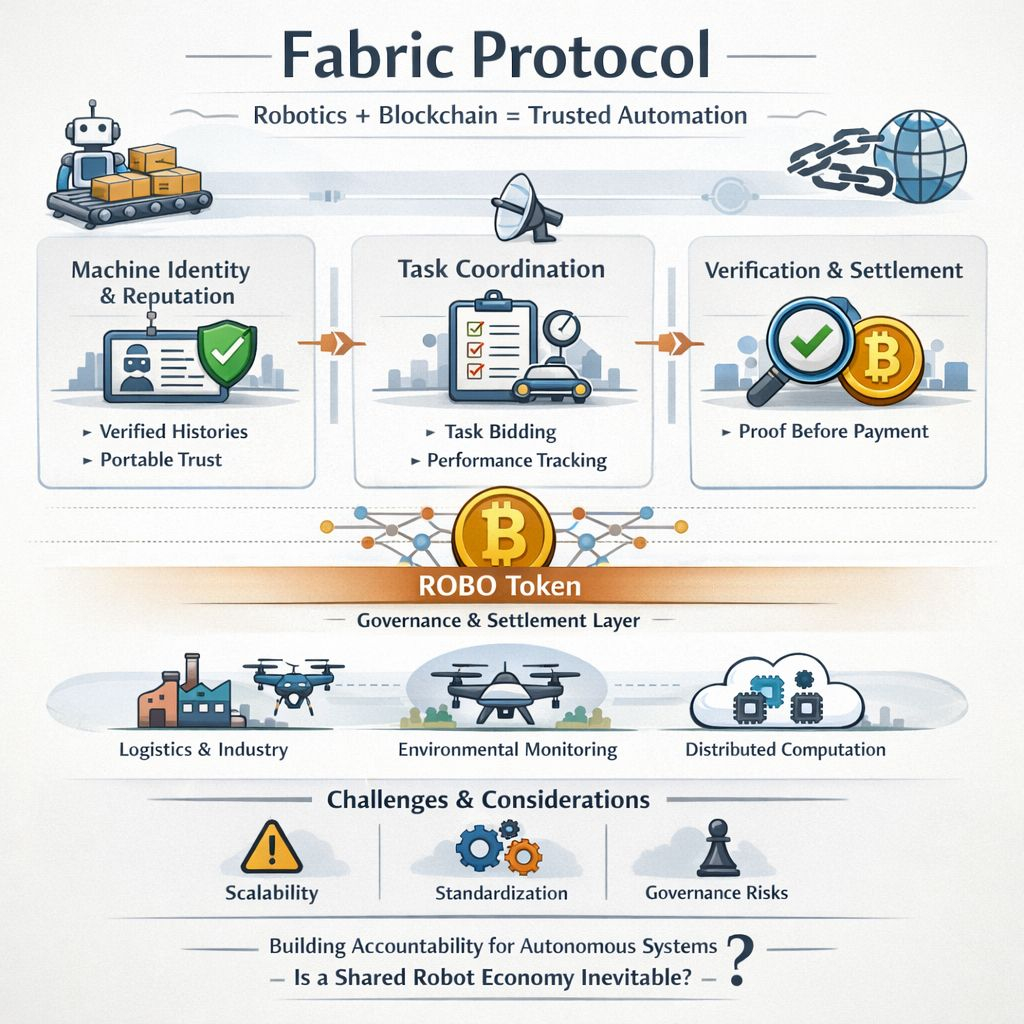
At its core, Fabric Protocol is attempting to solve a problem that most people don’t notice yet: machines are beginning to operate like economic actors, but our infrastructure still treats them like tools. A robot can move goods across a warehouse, collect environmental data, or perform repetitive industrial tasks. It can even make autonomous decisions. But it cannot hold a verifiable identity outside its operator’s system. It cannot independently settle payments. It cannot build a portable record of trust.
That gap matters more than it seems.
The protocol, supported by the Fabric Foundation, is structured as open infrastructure rather than a private platform. That design choice signals something important. If robots from different manufacturers, jurisdictions, and industries are going to collaborate, the coordination layer cannot belong to one company. It needs to be neutral.
Fabric proposes a public ledger where machines register verifiable identities. These identities accumulate track records — completed tasks, validated outputs, and performance history. Over time, that record becomes a kind of reputation layer. Not based on marketing claims. Based on proof.
I’ve seen how fragile centralized automation systems can be. In one logistics environment I observed years ago, robots performed efficiently inside their own network but became effectively “unknown entities” once introduced elsewhere. No transferable history. No portable trust. Everything had to be revalidated from scratch. It slowed expansion and increased risk.
Fabric seems to be addressing that inefficiency directly.
The protocol separates identity, task coordination, verification, and settlement into distinct layers. That might sound technical, but it reflects something practical: mature financial systems separate responsibilities for a reason. Identity checks are distinct from clearing mechanisms. Governance is separate from settlement. When everything is fused together, fragility increases. When it is modular, adaptation becomes possible.
Tasks within Fabric are published, accepted, executed, and then verified before compensation is released. Payment follows proof. Not promises. That sequencing feels less like innovation and more like basic economic hygiene.
The introduction of the native asset, ROBO, formalized the settlement mechanism. The total supply has been defined, allocations structured, and vesting schedules outlined. I’ve seen enough tokens launched as solutions looking for a problem. With Fabric, the problem is already here; the question is whether the solution is robust enough.
The token functions as a coordination instrument inside the network — used for task settlement, governance participation, and identity-related operations. It is presented less as a speculative instrument and more as an operational layer. Whether that framing holds over time will depend on execution, not narrative.
Recent milestones show incremental development rather than dramatic announcements. Governance mechanisms are being shaped so participants can influence protocol parameters. Identity standards are being clarified. Economic incentives are being refined. These are not flashy updates. But infrastructure rarely is.
Still, I have reservations.
Scaling verification across thousands or millions of robotic interactions is not trivial. Standardizing identity across diverse hardware manufacturers will require cooperation beyond code. Governance, even with good intentions, can drift toward concentration. I’m less interested in what the protocol promises to do and more concerned with how it handles the friction of the real world.
That friction is where most ambitious systems struggle.
What I find most compelling is not the idea of a “robot economy.” That phrase can feel abstract. What resonates with me is the recognition that automation is quietly becoming infrastructure. If machines are going to perform meaningful labor — in logistics, data collection, environmental monitoring, or distributed computation — then their work needs verifiable accounting. Otherwise, we are building scale without accountability.
And this isn’t about making robots smarter; it’s about making them accountable. Accountability is usually boring — which is exactly why I’m starting to take it seriously.
After spending time with the project, my conclusion is measured. Fabric Protocol is not trying to romanticize robotics. It is attempting to build economic rails for systems that are already operating at scale. Whether it succeeds will depend less on vision statements and more on whether its identity, verification, and settlement layers prove reliable under pressure.
I’m genuinely curious — as automation continues to expand, do you think a shared economic framework for robots is inevitable, or are we still too early to define it properly?