
For most of history, machines were silent partners in the economy. They lifted, cut, welded, calculated. They made factories faster and supply chains smoother. But they didn’t “participate.” They didn’t compete. They didn’t earn. They were tools — expensive, powerful tools — but still tools.
Now there’s a quiet shift happening. Some builders are asking a question that feels small at first but is actually enormous: what if machines weren’t just inside markets, but part of them?
That’s the deeper idea behind Fabric Protocol and its token, ROBO. It’s not just about robotics and it’s not just about crypto. It’s about giving autonomous machines a way to hold value, take on tasks, prove they completed them, and get paid — all without constant human supervision.
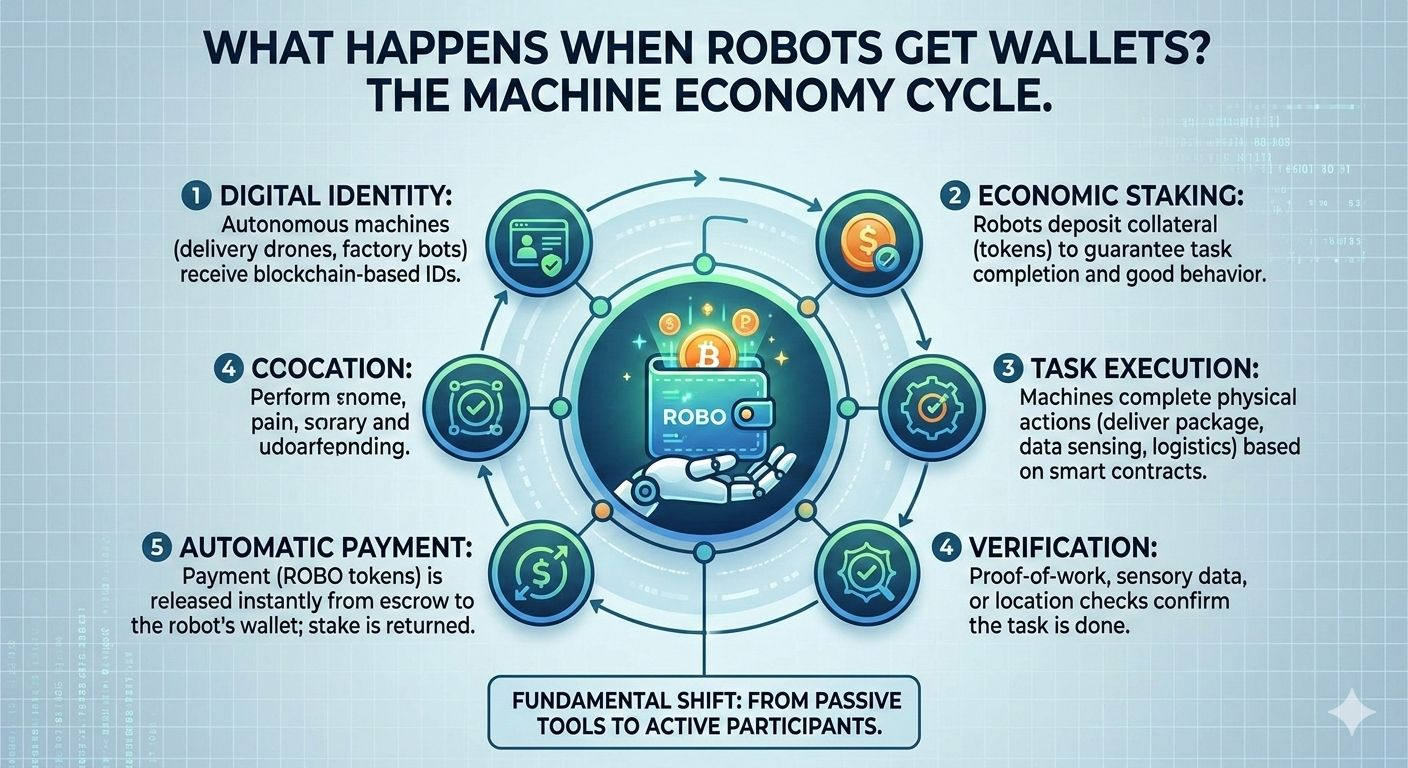
If that sounds abstract, imagine something simple. A delivery robot receives a task posted in a digital marketplace. It agrees to deliver a package. Before starting, it stakes a small amount of value as a guarantee. It completes the job. The delivery is verified through data and confirmation. The payment is released automatically. No manager pushing buttons. No accountant issuing invoices. The machine participates directly in an economic exchange.
That’s the world Fabric is trying to prepare for.
The idea of a “machine economy” isn’t new. For years, technologists have imagined devices paying each other for services. Smart cars paying toll booths. Drones paying for charging time. Sensors selling data. But those visions always hit the same wall. Machines could communicate, but they couldn’t carry economic responsibility. They had no identity in financial systems. No stake. No consequence.
Markets depend on trust and enforceability. If you fail to deliver, there must be a penalty. If you succeed, there must be reward. Humans understand this instinctively. Machines needed infrastructure to operate under the same logic.
Fabric’s approach is to create that infrastructure. It gives machines a kind of economic wrapper — an identity that can hold tokens, stake collateral, build reputation, and be penalized if something goes wrong. Instead of mining meaningless computations, the system ties rewards to real-world tasks. The value comes from what a robot actually does, not just what it calculates.
But here’s where things become complicated.
In digital systems, verification is clean. A block is valid or it isn’t. A signature matches or it doesn’t. In the physical world, proof is messy. GPS signals can be spoofed. Sensors can fail. Cameras can be tampered with. When a robot claims it completed a delivery or inspected a bridge, how do you know?
Fabric leans on layered verification and economic incentives. Machines stake value before accepting tasks. If they cheat or fail, they lose that stake. If they succeed and provide acceptable proof, they earn. The hope is that financial incentives will push behavior toward reliability.
But reality isn’t a spreadsheet. Physical environments are unpredictable. Disputes will happen. And when they do, the system needs governance — people or mechanisms deciding what counts as proof, what counts as failure, and how penalties are applied.
That’s where ROBO becomes more than just a payment token. It represents influence over how the protocol evolves. Token holders shape decisions about verification standards, dispute resolution, and system upgrades. This introduces another tension. The same token that aligns incentives can concentrate power. Large holders may shape rules in ways that benefit fleet owners over smaller operators.
There’s also a deeper social layer to all of this.
We’ve grown used to algorithms matching drivers to passengers, buyers to sellers, and freelancers to clients. But in those systems, humans are still the economic actors. Now imagine a marketplace where a human courier and a delivery robot are bidding for the same task in real time. The machine isn’t just assisting — it’s competing.
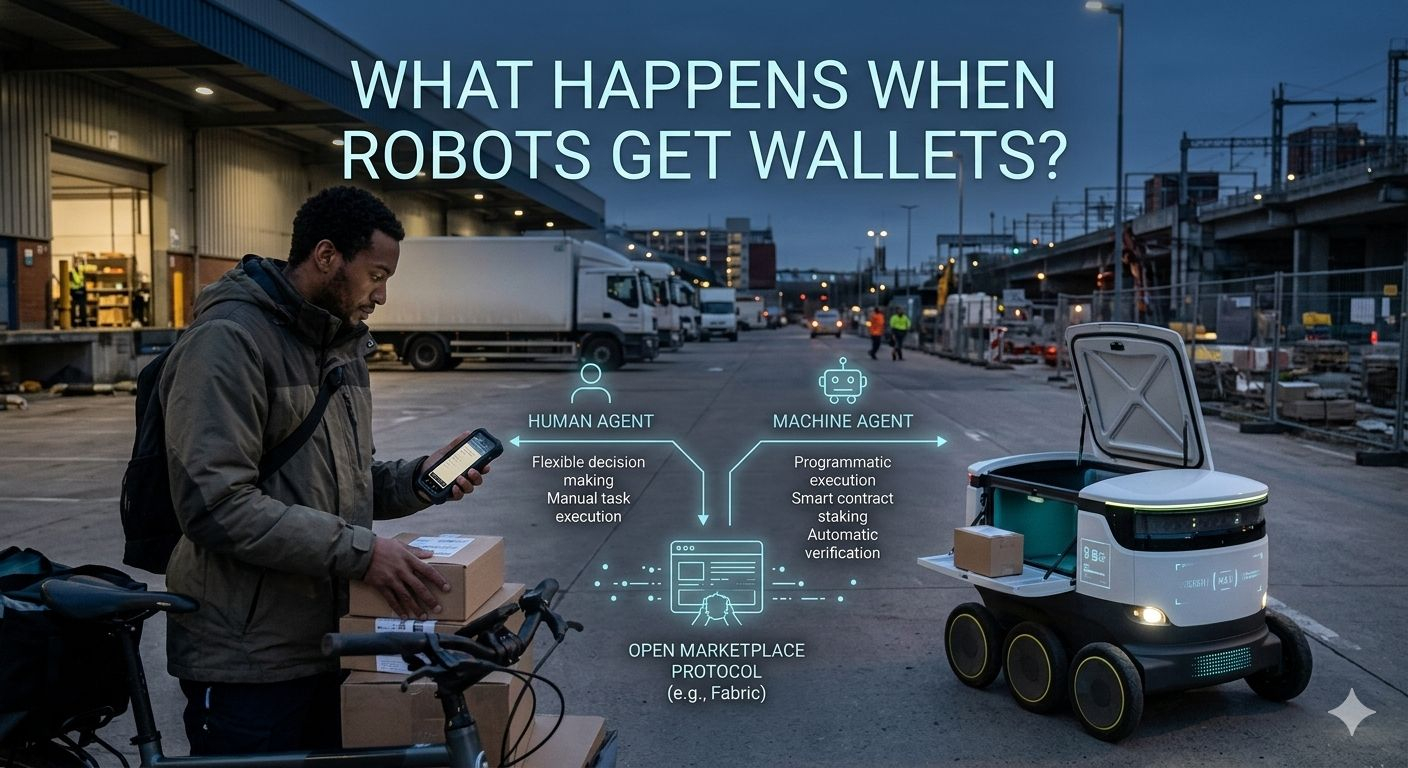
That changes the emotional landscape. Machines stop feeling like infrastructure and start feeling like participants.
And participation raises uncomfortable questions. If a robot damages property, does slashing its stake solve the problem? Or does liability still rest entirely on the human owner? Legal systems don’t yet recognize machines as independent entities. The protocol can impose financial penalties, but courts may still look to manufacturers and operators.
There’s also the issue of speed. Machine-to-machine markets would operate at a tempo far beyond human negotiation. Prices could adjust instantly. Tasks could fragment into tiny pieces optimized for efficiency. That sounds powerful, but high-speed markets can also amplify instability. Small errors can cascade quickly.
The first real tests of this idea probably won’t happen on public streets. They’ll happen in controlled spaces — factories, warehouses, private campuses — where verification is easier and legal exposure is limited. If it works there, expansion becomes plausible. If it fails, the failure will teach hard lessons about incentives and governance.
At its core, Fabric is trying to do something ambitious: design economic rails before the traffic fully arrives. Autonomous systems are improving every year. If fleets of robots and AI agents become common, they will need coordination mechanisms. Fabric is betting that open, tokenized infrastructure can handle that coordination better than closed corporate systems.
But whether that vision becomes empowering or extractive depends on details. Who controls governance? How transparent is verification? Who bears risk when something breaks? Those questions matter more than the elegance of the code.
There’s something fascinating about this moment. We are watching the boundary between tool and actor blur. Corporations were once a legal invention that allowed groups of people to act as one economic entity. Now protocols are experimenting with giving machines a limited form of economic agency — not legal personhood, but operational autonomy within markets.
It’s early. It’s uncertain. It’s risky.
But the experiment reveals something important about where technology is heading. We are no longer just building smarter machines. We are building systems where those machines might negotiate, compete, and earn alongside us.
Whether that future feels empowering or unsettling depends on how carefully these foundations are laid.
Fabric and ROBO are trying to lay them before the market fully exists.
