

The robotics industry likes to present autonomy as an engineering race. Faster perception. Smarter planning. More adaptable hardware. The narrative is technological acceleration.
But beneath that surface sits a quieter, more structural problem: coordination risk.
As machines begin operating across shared environments—logistics hubs, industrial corridors, cross-border supply chains—the issue is no longer just whether a robot can execute a task. It’s whether multiple independent stakeholders can rely on that execution without surrendering control to a single private stack.
Fabric Protocol enters precisely at that pressure point.
Rather than positioning itself as a robotics manufacturer or an AI enhancement layer, Fabric introduces a protocol framework designed to structure how autonomous systems interact economically and procedurally. It does not compete on hardware. It competes on rule definition.
That is a materially different thesis.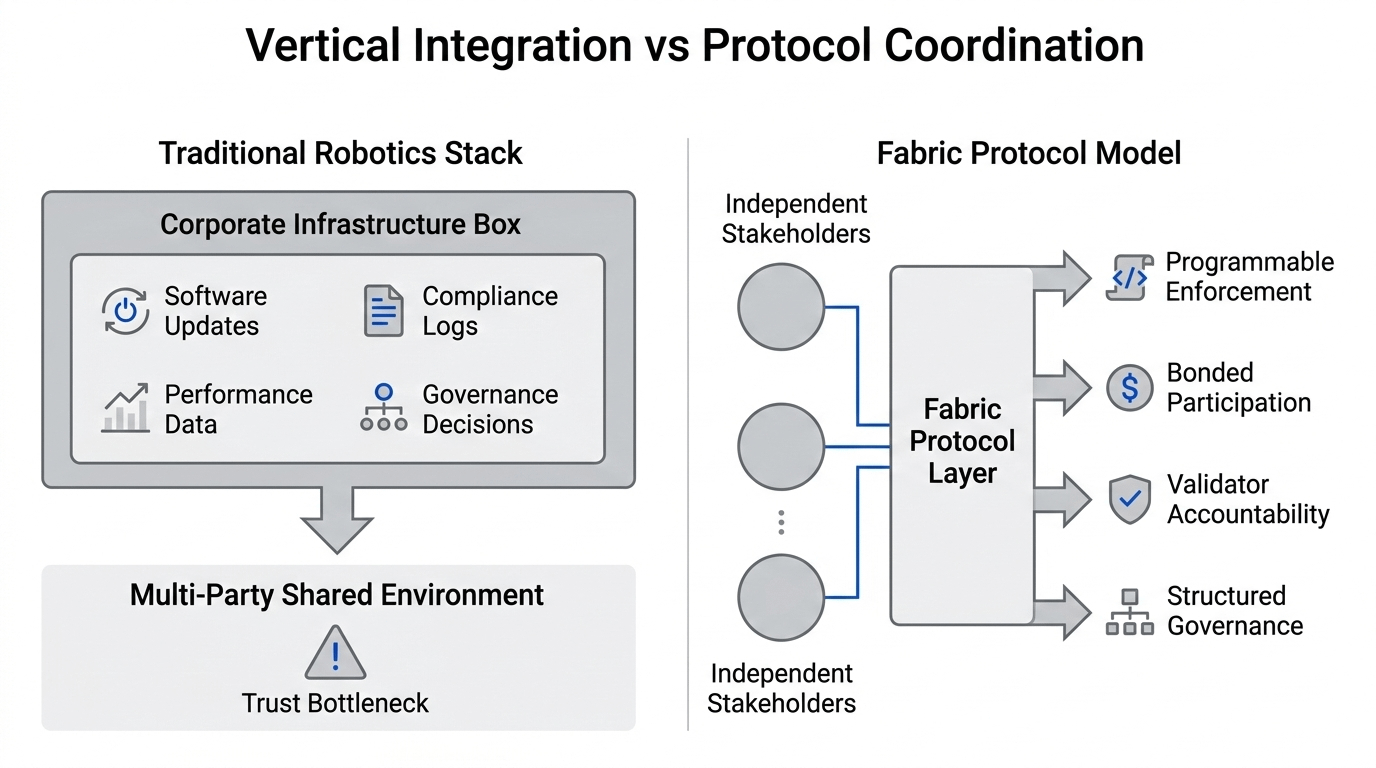
Most robotic ecosystems today are vertically integrated. Software updates, compliance standards, performance logs, and governance decisions sit inside corporate infrastructure. Trust is contractual and brand-based. That model scales until machines begin operating in environments where multiple parties depend on shared guarantees.
At that stage, private governance becomes a bottleneck.
Fabric’s architecture proposes an alternative: externalize coordination to a cryptographic protocol layer. Participation is structured. Enforcement is programmable. Governance evolves through defined economic incentives rather than unilateral updates.
This is where the role of $ROBO becomes relevant—not as a speculative instrument, but as operating capital for enforcement. Bonded participation creates consequence. Validators anchor accountability. Governance mechanisms introduce structured evolution rather than opaque iteration.
The significance here is not tokenization. It is economic alignment.
When autonomous systems perform tasks that influence capital flows or operational throughput, incentive design cannot remain informal. If operators can participate without meaningful exposure, reliability degrades. If enforcement lacks cost, compliance becomes negotiable. If governance has no economic weight, decision-making centralizes by default.
Fabric’s approach recognizes that machine networks are not purely technical systems; they are economic ecosystems.
And economic ecosystems require boundaries.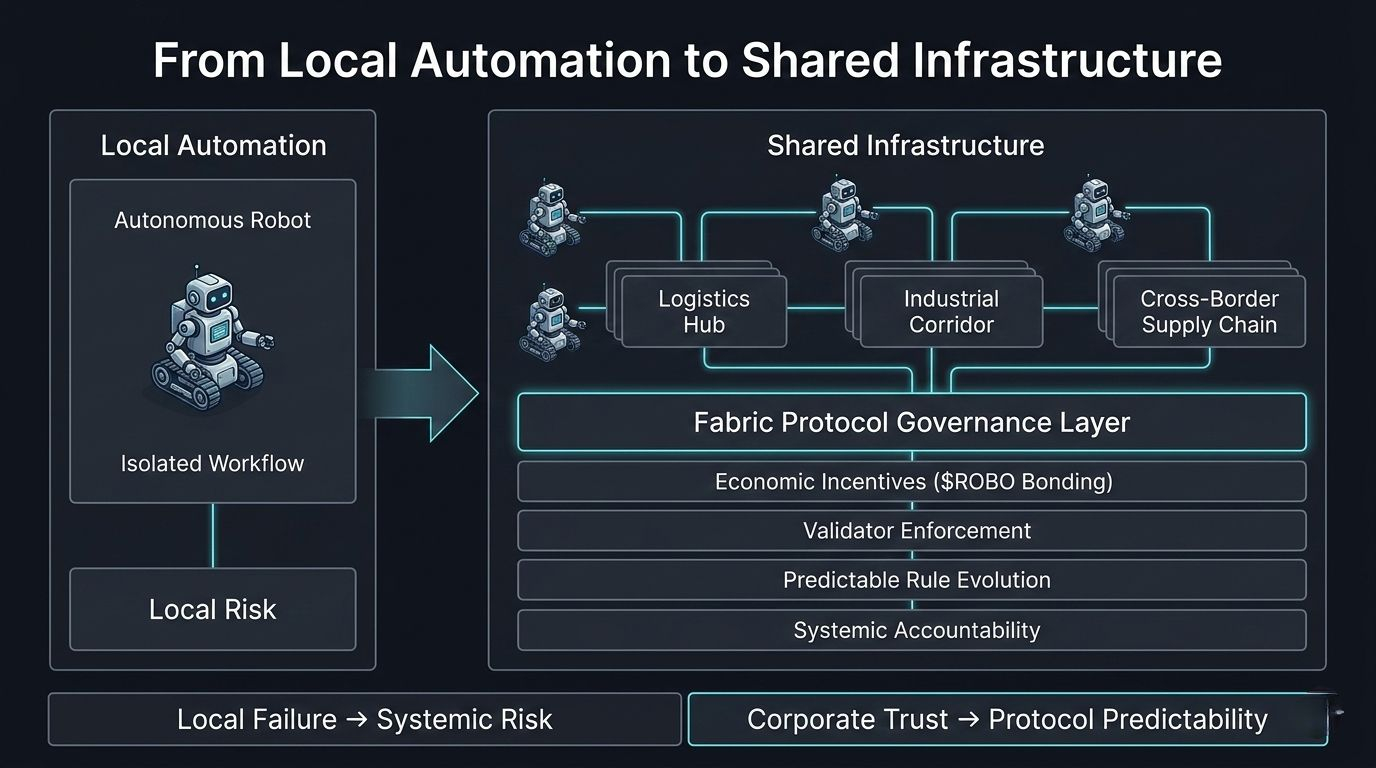
The deeper strategic implication is this: robotics is moving toward shared infrastructure status. Once machines become embedded in production workflows across independent actors, coordination failures become systemic rather than local. At that scale, trust cannot rely solely on corporate assurances.
It requires protocol-level predictability.
This is not without risk. Crypto-native systems are accustomed to iteration under volatility. Robotics environments demand stability under liability. Bridging those expectations requires disciplined governance design and credible enforcement mechanisms.
Fabric’s long-term relevance will depend on whether it can maintain predictable participation standards under growth, not whether it can generate narrative excitement.
If the protocol succeeds, it will not be because it built better robots.
It will be because it formalized how autonomous systems interact under shared accountability.
The robotics sector may continue marketing autonomy as an engineering milestone.
Fabric is betting that autonomy’s real constraint will be governance.
And governance, unlike hardware, cannot be retrofitted once scale arrives.