

The first time I tried to “stress test” Fabric as more than a chart, I did what I always do with new infra narratives. I looked for the spot where incentives end and habits begin. Price was moving, timelines were loud, listings were stacking up, and I still couldn’t shake the simplest risk: if one small group can steer the rules, everyone else eventually stops building, and then usage turns into a temporary event instead of a sticky behavior loop. That’s the retention problem in crypto dressed up in robotics clothing. And it’s why I keep coming back to the unsexy part of the story: neutral stewardship from the Fabric Foundation. Let me be blunt about the risk up front. If Fabric governance gets captured, you don’t just get “bad vibes.” You get parameter risk. Fees can be tuned to favor insiders, access can get gated in ways that quietly punish small operators, and standards can drift toward whatever makes the treasury look good this quarter. The whitepaper basically admits the shape of the danger in plain language, governance can evolve, early decision making can be concentrated, and outcomes may not match what participants expect. That line matters more to me than any token utility diagram because it’s the kind of disclaimer that becomes a prophecy if stewardship isn’t deliberately neutral. Now zoom into what makes Fabric different from the usual governance theater. The structure is not just “token holders vote.” The whitepaper lays out an entity stack where Fabric Protocol Ltd. is the issuer and is wholly owned by the Fabric Foundation. It also draws a bright line around early contributors operating “arms-length” with no ownership or control over token issuance. That’s not just legal hygiene. It’s an attempt to make the protocol legible to outsiders who might otherwise assume every roadmap decision is a disguised balance-sheet decision. In other words, neutrality is not a moral stance here, it’s a product requirement. 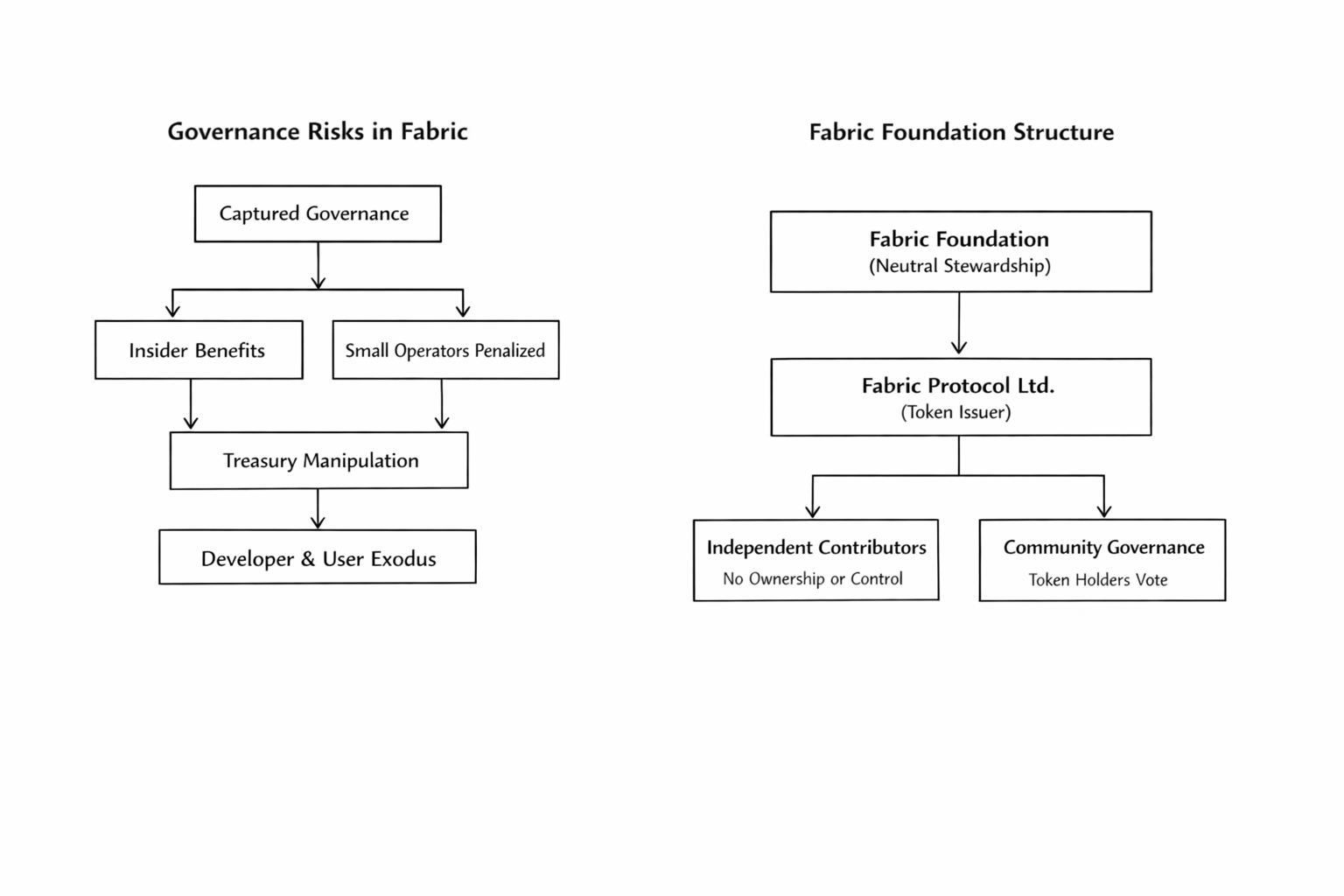 Here’s the trader lens I can’t unsee. When a token gets listed fast and liquidity shows up before real usage, the market starts pricing governance optionality like it’s a feature. But builders price governance as operational risk. If you’re a team thinking about shipping on Fabric, you’re not asking “will ROBO pump,” you’re asking “will the rules I build against still be the rules in six months.” If the answer feels political, they either delay, or they ship somewhere else. That churn is retention death, not just for users, for the entire developer surface area that would have created repeatable demand. So neutral stewardship becomes the cheapest retention lever the ecosystem can buy, because it reduces the fear tax on long-term effort. I’ll give you a concrete example of why I watch this so tightly. On Ethereum, the ROBO contract is public, and you can see the holder count building, Etherscan showed about 7,081 holders around the Feb 28, 2026 snapshot. That’s decent for a fresh asset, but it’s not the number that convinces me. What convinces me is whether those holders turn into participants who lock, vote, run things, build things, and stick around when the first excitement fades. If governance feels neutral and predictable, you can get that conversion. If governance feels like a backstage room, you get passive holding and eventual boredom. The tradeoff is real, though, and this is where I’m a little uneasy. Neutral stewardship usually means slower moves, more process, more “boring” decisions, and sometimes missed momentum. A foundation that is truly neutral can’t always act like a growth team. That friction is annoying when the market is moving and competitors are shipping. But I’d rather eat that frustration than watch Fabric optimize for short-term narrative at the cost of long-term credibility. Because once builders believe governance is for show, the rebuild is brutal. Trust is slower to mint than tokens. The other thing I’m watching is how governance power actually accrues. A lot of ecosystems say “community,” then quietly rely on a small cluster of large holders and early aligned entities. Fabric’s public positioning leans into long-horizon coordination, governance, and stewardship as the foundation’s job. The site literally says it’s structured to serve as a neutral, mission-driven institution for decades. That’s a strong claim, and it’s testable in behavior: transparent processes, clear conflicts policies, predictable parameter changes, and credible resistance to capture when the first really controversial vote hits. So if you’re trading this, don’t just stare at volume and listings. Track retention signals that are downstream of stewardship. Are governance proposals readable and consistent, or chaotic and reactive. Do changes feel like they protect the protocol’s long-run neutrality, or like they’re quietly optimizing for a stakeholder bloc. Do builders talk about Fabric like a stable base layer, or like a political arena. If neutral stewardship holds, I’m more willing to treat dips as structure and not just noise. If I see capture dynamics, I’m out, because the market eventually punishes ecosystems that can’t keep contributors engaged without constant stimulus. If you’re eyeing ROBO, do one thing this week that actually gives you an edge: stop outsourcing your conviction to timelines and memes and start auditing stewardship. Read the foundation’s stated role, read the whitepaper’s governance risk language, watch how decisions get made when nobody’s cheering. Trade the credibility, not the vibe.
@Fabric Foundation #ROBO $ROBO
