When I look at Fabric Foundation ($ROBO), I don’t immediately question whether robots can transact.
I question whether they can be trusted.
Because autonomy without verification is not innovation. It is risk.
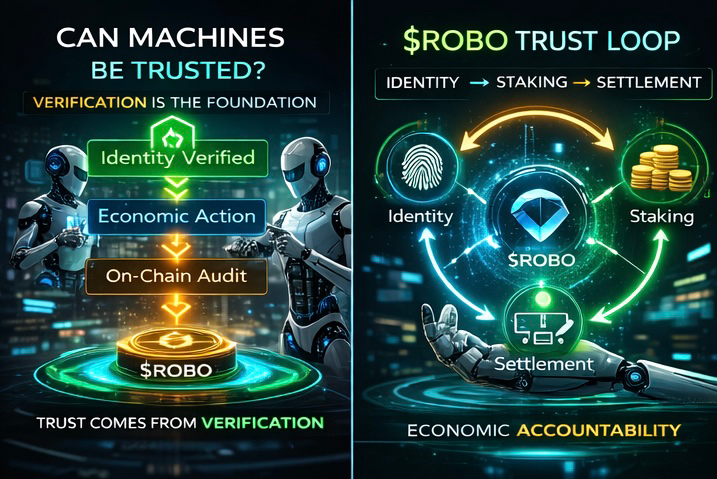
The uncomfortable truth is this: as machines become capable of making economic decisions routing deliveries, executing trades, allocating compute we introduce non-human actors into financial systems. And financial systems are built on verification.
Humans rely on legal identity, credit history, regulatory oversight.
Machines have none of that.
Fabric’s answer is not blind automation. It is verifiable infrastructure.
The mental model is simple:
Autonomous action
→ Recorded on chain
→ Publicly auditable
→ Economically staked
$ROBO sits at the center of this structure. Identity verification, transaction settlement, coordination staking each layer creates friction against malicious behavior.
But there is tension here.
Verification increases cost.
Transparency reduces speed.
Governance slows pure automation.
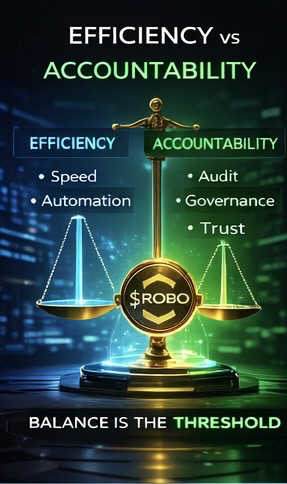
So the system must balance two forces:
Efficiency
and
Accountability.
My opinion:
If Fabric leans too far toward efficiency, trust weakens.
If it leans too far toward control, autonomy weakens.
Success would not mean robots operating freely.
It would mean robots operating verifiably where every economic action is traceable, economically bonded, and open to oversight.
Trust is not a marketing claim.
It is a systems property.
If Fabric can make machine behavior economically accountable, then autonomy becomes sustainable rather than speculative.
That is the real threshold.