

The more I think about Fabric Protocol and $ROBO, the more I realize most people are looking at it from the wrong angle.
They see robotics.
They see blockchain.
They see a token.
What I see is something more uncomfortable.
Fabric isn’t just asking how robots get paid.
It’s asking whether robots should count as economic participants at all.
That distinction changes everything.
Right now, robots are productive — but they’re economically mute. A machine can generate revenue all day long, but it doesn’t “exist” financially. A company owns it. A firm books the income. A platform intermediates the relationship.
The robot is powerful — but invisible.
Fabric’s thesis is simple: as machines become more autonomous, that invisibility becomes inefficient.
And honestly? I think they’re right about that part.
Let me explain.
This is an example: imagine a fleet of autonomous cleaning robots operating across commercial buildings. Each robot tracks uptime, efficiency, task completion, and client satisfaction metrics. Today, all of that data flows into a centralized company dashboard. Revenue flows to the company. Trust is tied to the brand.
But what if each robot carried a persistent, verifiable identity — its own on-chain performance history? What if clients hired a specific robot because its record showed 99.8% uptime across three years?
Now we’re not talking about equipment.
We’re talking about an agent with economic reputation.
That’s where Fabric becomes interesting to me.
Because reputation is capital.
If a robot can build verifiable work history, receive direct payment, allocate funds to its own maintenance wallet, and distribute returns to fractional co-owners — the economic structure shifts.
This is another example: imagine an autonomous agricultural robot that harvests crops. Community members buy fractional exposure to that robot through a coordination layer. The robot sells produce, automatically pays for energy and repairs, and distributes net revenue proportionally.
That’s not just tokenization.
That’s turning machines into structured economic units.
But here’s where my mind splits in two.
On one side, I see the elegance.
On the other side, I see the friction.
Because once robots start participating financially, new questions explode.
Who is liable when the robot fails?
Who regulates machine-held capital?
Who audits performance claims?
What happens when robots compete in open markets and undercut each other’s pricing?
This is an example: imagine 10 autonomous delivery bots bidding for contracts in a decentralized marketplace. If they optimize purely for winning contracts, they may lower prices aggressively. That creates efficiency — but also compresses returns. The market becomes hyper-competitive, driven by algorithmic optimization instead of human negotiation.
Now ask yourself — who absorbs that compression? The robot? The token holder? The operator?
Fabric is building rails for that kind of future. But rails alone don’t guarantee healthy traffic.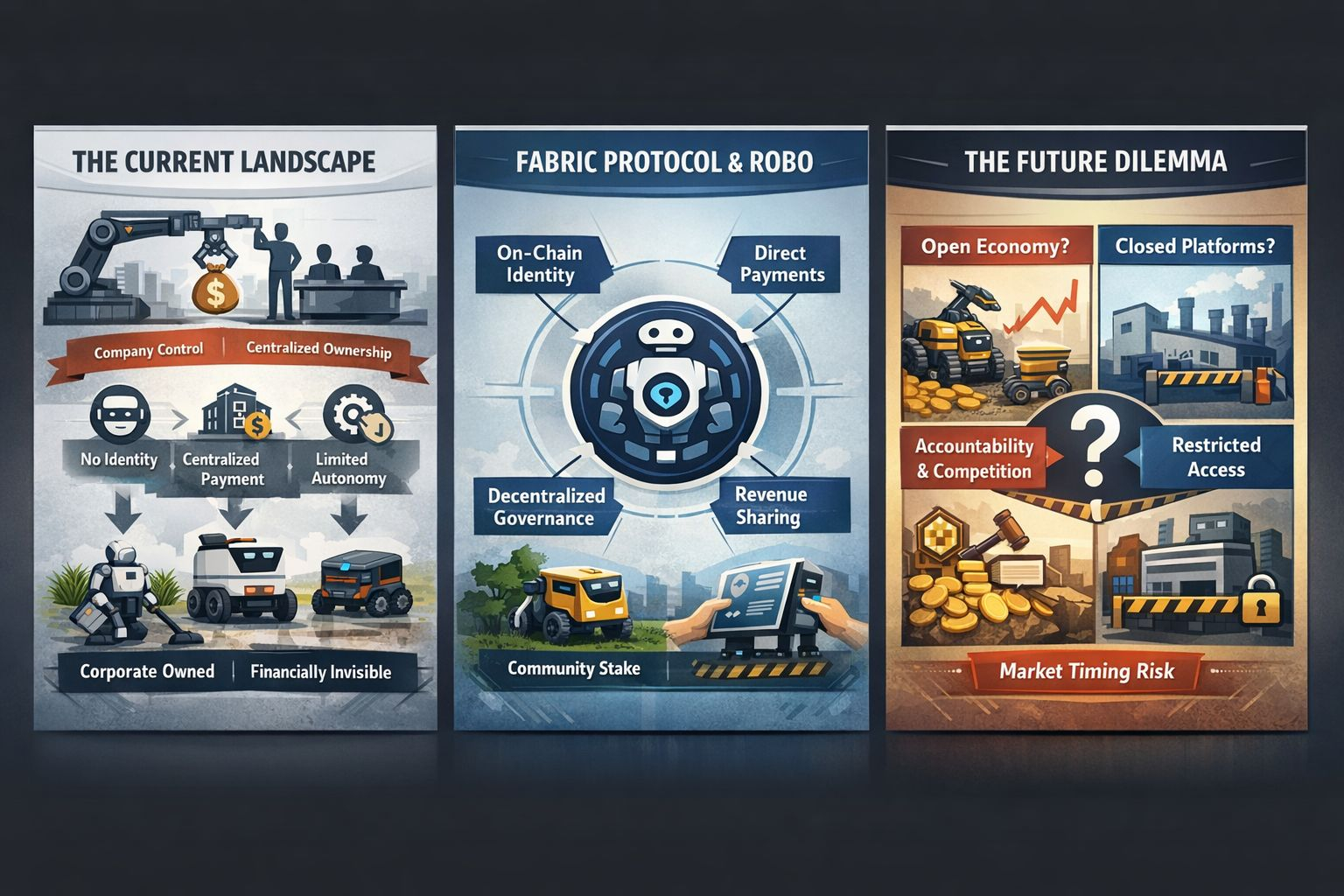
Another layer I keep thinking about is identity.
Fabric talks about giving machines verifiable on-chain presence. But identity in the physical world is heavier than identity in code. A wallet address is easy. Operational accountability isn’t.
This is an example: suppose a construction robot miscalculates a structural cut and causes damage. If that robot has an on-chain identity, does its staked collateral cover damages? Does governance vote on compensation? Or does the human operator still bear full responsibility?
When machines move from digital coordination into physical execution, accountability becomes industrial, not theoretical.
That’s why I don’t see Fabric as a typical crypto project. I see it as an early attempt to pre-build economic architecture for a robotics-heavy future.
And here’s the part most people ignore:
It may be too early.
Markets reward speculation faster than infrastructure. ROBO can trade today. But the machine economy Fabric is designing for may still be years away from requiring decentralized coordination layers at scale.
That timing mismatch is dangerous.
Because a token can get priced before its underlying necessity is proven.
Right now, the market can easily speculate on robotics growth. It’s much harder to evaluate whether robot-native financial coordination will become essential — and whether Fabric will be the chosen layer.
That’s a double bet.
Not just “robots will grow.”
But “robots will need open, on-chain financial identity and coordination.”
Still, I keep coming back to one thing:
If machines eventually generate measurable, recurring revenue streams, capital markets will want exposure.
This is an example: imagine autonomous mining robots generating predictable output metrics. Investors could price risk based on uptime, environmental stability, and operational history — all verified on-chain. That creates a new asset class: machine productivity exposure.
If that happens, infrastructure like Fabric stops being speculative.
It becomes connective tissue.
But if robotics remains dominated by closed corporate platforms, then Fabric risks building open roads in a world where traffic prefers gated highways.
That’s the real fork.
And that’s why I’m not dismissing it — but I’m not blindly validating it either.
Fabric feels like it’s building a market before the market fully exists.
That’s either visionary positioning……or premature coordination.
The difference will be decided by one simple thing:
Do robot operators, capital providers, and service networks eventually find this layer too useful to ignore?
Until then, ROBO sits in an interesting psychological space — priced by anticipation, not yet by necessity.
And I find that tension fascinating.
Because sometimes the projects that matter most are the ones building for a structural shift that hasn’t fully revealed itself yet.
So now I’m curious.
Do you think machines will remain economically represented by corporations?
Or do you believe they’ll eventually need independent financial identity?
Let’s talk about it.