STONfi unlocks BTC & ETH liquidity on TON
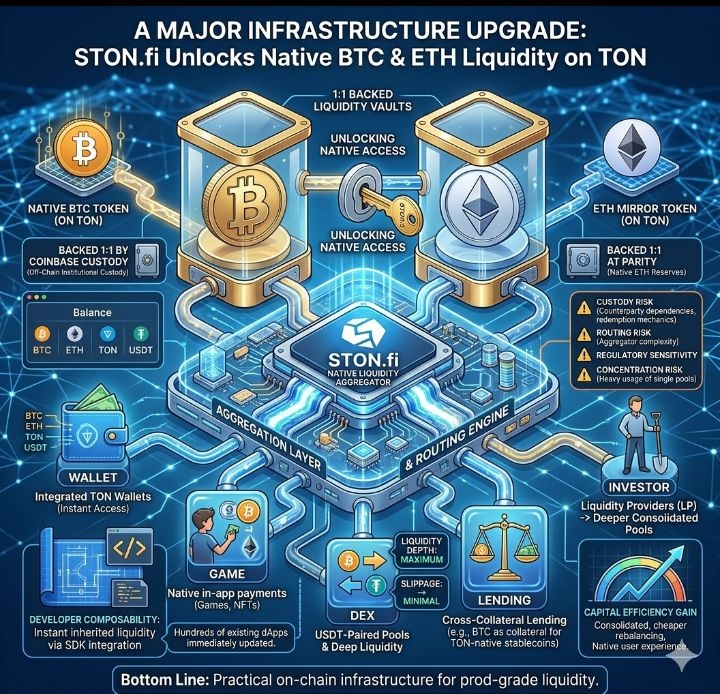
A major infrastructure upgrade just landed: TON now has native, 1:1-backed Bitcoin and Ether liquidity available inside its ecosystem — not as synthetic IOUs or wrapped derivatives of uncertain provenance, but as tokens backed by real, custodial reserves and routed through a single aggregation layer. This is the kind of change that shifts how capital flows, how dApps compose, and how users think about cross-chain access inside the network.
What changed (the facts, briefly)
Two primary assets are now available inside the network in a fully supported, on-chain form: a Coinbase-backed BTC token and a 1:1 Ether mirror. That means users can access BTC and ETH exposure from inside TON without leaving the network, and without relying on synthetic or purely protocol-issued representations.
The Bitcoin token is backed by institutional custody from a major exchange, so each on-chain unit corresponds to an equivalent amount held in custody off-chain. The Ether mirror likewise represents native ETH at parity. These arrangements remove a class of counterparty risk common to ad-hoc bridged or synthetic assets — though they do introduce the usual reliance on custodial and redemption mechanics.
Finally, an aggregation layer — a routing engine already embedded in many apps across the ecosystem — will route swaps into these assets and across pools (notably USD₮ pairs), so users and apps get best-price execution and deeper liquidity without extra integrations.
Why this matters (clear, practical implications)
Lower friction for on-chain BTC/ETH use
Before this, TON users who wanted BTC or ETH exposure had to rely on external bridges, cross-chain swaps, or synthetic constructions — each adding latency, user steps, and often higher fees. With these 1:1 instruments accessible inside the network, typical user flows (swaps, LP provision, leveraged strategies, in-app payments) become native experiences.Deeper, consolidated liquidity
By placing the tokens into USD₮-paired pools and exposing them via a best-rate router, the ecosystem gains consolidated liquidity depth. Deep pools plus intelligent routing reduce slippage on larger trades and make automated market makers more useful for institutional-sized liquidity as well as retail traders.Composability for developers
Hundreds of apps already integrated to the aggregation layer immediately inherit access to BTC/ETH liquidity. That means wallet providers, games, NFT marketplaces, and DeFi primitives can add BTC/ETH functionality without additional contract changes — accelerating product timelines and increasing the number of user touchpoints for the tokens.Capital efficiency across the stack
When major base assets become available on a single network, rebalancing, collateralization, and yield strategies can be executed more cheaply and faster — users and strategies keep funds on-chain in the network where they operate, instead of routing back and forth between multiple chains.
Risks and caveats (don’t gloss over these)
Custody and redemption mechanics. Even though the BTC token is backed 1:1 by an institutional custodian, that introduces counterparty dependencies (redemption windows, custody policy, regulatory/operational risk). Users should understand how redemption works and what guarantees exist.
Protocol and routing risk. Aggregation layers improve execution but add complexity. Smart-contract bugs, mis-routing, or unexpected interactions between liquidity sources can create execution edge cases. Review audit status and on-chain metrics before routing very large trades.
Regulatory sensitivity. Custodial wrapped assets sometimes draw regulatory attention. That’s a factor for platforms and institutions that must keep compliance front of mind.
Concentration risk. Heavy usage of a single liquidity provider / pool can create centralization vectors. The health of the overall network still depends on diversified liquidity contributors and resilient on-chain infrastructure.
Strategic outlook — what this unlocks next
Faster onboarding of institutional flows. Institutional desks prefer deep liquidity and clear custody arrangements. Having a marketplace inside the network that can offer both lowers the barrier for institutional participants to interact with native on-chain products inside the environment.
New product primitives. Expect an acceleration in products that combine native BTC/ETH exposure with TON-native assets: yield aggregators, cross-collateralized lending, on-chain hedging, and tokenized derivative layers that use the new liquidity as settlement rails.
Composability-driven growth. Because many apps already use the aggregation layer, the marginal cost to extend functionality to BTC/ETH is near zero. That can cause a rapid multiplication effect: more places to use BTC/ETH → more users staying on-network → more liquidity → more sophisticated financial products.
Practical guidance (for users and builders)
If you’re a user: start small. Try a test swap, check slippage, and read the token’s custodial and redemption docs. Understand how to redeem to the native asset if that matters to you.
If you’re a builder: evaluate integrating the aggregation SDK (if you haven’t already) so your app can inherit deeper liquidity and best-rate routing. Check the docs and audit reports for the aggregator and the token bridges, and plan for monitoring and fallback routes.
If you’re an LP or market maker: run simulations for expected impermanent loss under new BTC/ETH pair dynamics and test how the aggregator routes between your pools and other sources.
Bottom line
This isn’t merely a token listing — it’s a structural upgrade to on-network liquidity and execution. By introducing institutionally backed Bitcoin exposure and a first-class Ether mirror together with an aggregation/routing layer, the network’s DeFi stack gains both asset integrity and capital-efficient rails. That combination is precisely what turns experimental markets into production-grade infrastructure.
As always: do your own research, understand custody and smart-contract risk, and treat on-chain capital management as both opportunity and responsibility.
Read and explore more about STONfi here: linktr.ee/ston.fi