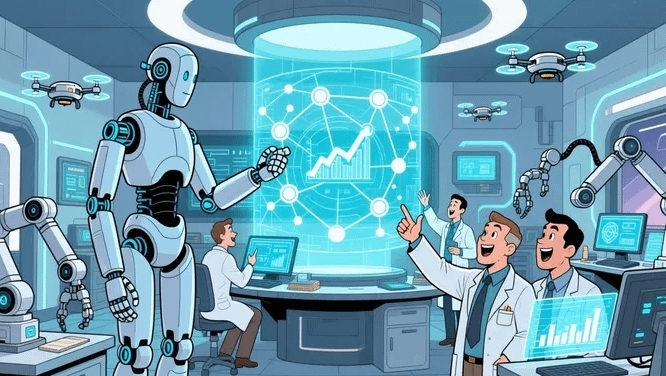
In a world increasingly shaped by automation, algorithms, and autonomous systems, it’s easy to forget that technology begins with a human intention. Behind every line of code, every smart contract, and every protocol upgrade, there is a simple question: how do we make systems that work for people, not just around them? That’s where Robo Fabric Foundation begins its story.
Robo Fabric Foundation is not just another blockchain initiative or AI-driven experiment. At its core, it feels more like a movement built around trust in automation. The word “fabric” is meaningful. A fabric connects threads into something stronger than each strand alone. In the same way, Robo Fabric connects AI agents, decentralized infrastructure, and economic incentives into a unified ecosystem designed to support autonomous finance and intelligent coordination.
What makes Robo Fabric Foundation stand out is its human-centered philosophy. While much of the industry races toward speed, scale, and speculation, Robo Fabric focuses on responsibility. It asks a deeper question: if machines are going to act on our behalf, who ensures they act correctly? Instead of blindly celebrating automation, the foundation emphasizes structured accountability. Systems are designed not only to execute tasks but to validate, verify, and align with transparent rules.
The foundation’s approach to autonomous agents reflects this mindset. Rather than viewing bots as cold, detached executors of code, Robo Fabric treats them as participants in a digital economy. These agents negotiate, validate information, interact with smart contracts, and coordinate with other agents. But crucially, they operate within a framework that rewards accuracy and penalizes misuse. This economic structure mirrors human systems of trust — where credibility is earned, and responsibility carries weight.
There is also a strong sense of long-term thinking embedded in Robo Fabric’s design. Many projects chase trends. Robo Fabric builds infrastructure. Infrastructure is rarely flashy, but it is what supports everything else. Roads, bridges, and power grids don’t make daily headlines, yet they are the backbone of modern life. In a similar way, Robo Fabric aims to become foundational infrastructure for autonomous systems in decentralized finance and beyond.
Another human element of the Robo Fabric Foundation is its emphasis on collaboration. No single AI model, validator, or participant dominates the ecosystem. Instead, distributed consensus and shared incentives create a balanced environment. This distributed model reflects a belief that intelligence — whether human or artificial — becomes more reliable when diverse perspectives contribute. It is less about control and more about coordination.
Security and verifiability are treated not as technical add-ons but as ethical commitments. In a time when AI hallucinations and automated errors can have real financial consequences, Robo Fabric promotes mechanisms that reduce blind trust. Validation layers, transparent logic, and cryptographic assurances form the backbone of its architecture. The message is clear: automation should be powerful, but it must also be accountable.
What truly humanizes Robo Fabric Foundation, however, is its quiet ambition. It does not position itself as replacing humans. Instead, it seeks to augment human capability. Autonomous agents can process vast amounts of data, execute strategies instantly, and interact across decentralized networks without fatigue. Yet humans remain the architects, governors, and beneficiaries of the system. The goal is not to remove people from the equation but to empower them with tools that expand what is possible.
As autonomous finance evolves, the lines between AI, blockchain, and economic coordination will continue to blur. The projects that endure will be those that understand technology is ultimately about trust. Robo Fabric Foundation appears to recognize this deeply. It is building not just for efficiency, but for resilience. Not just for innovation, but for integrity.
In many ways, Robo Fabric Foundation represents a shift in perspective. Instead of asking how far automation can go, it asks how responsibly it can grow. Instead of focusing solely on speed, it values structure. Instead of hype, it prioritizes foundation.
And perhaps that is the most human thing about it — the understanding that sustainable progress is woven carefully, thread by thread, into something strong enough to last. @Fabric Foundation