
I have been in crypto long enough to watch Bitcoin dominate headlines, survive crashes, and prove its resilience again and again. I have also watched something else happen quietly in the background. While Bitcoin remained the strongest store of value in the space, most of the innovation in decentralized finance was happening somewhere else. That disconnect stayed in my mind for a long time.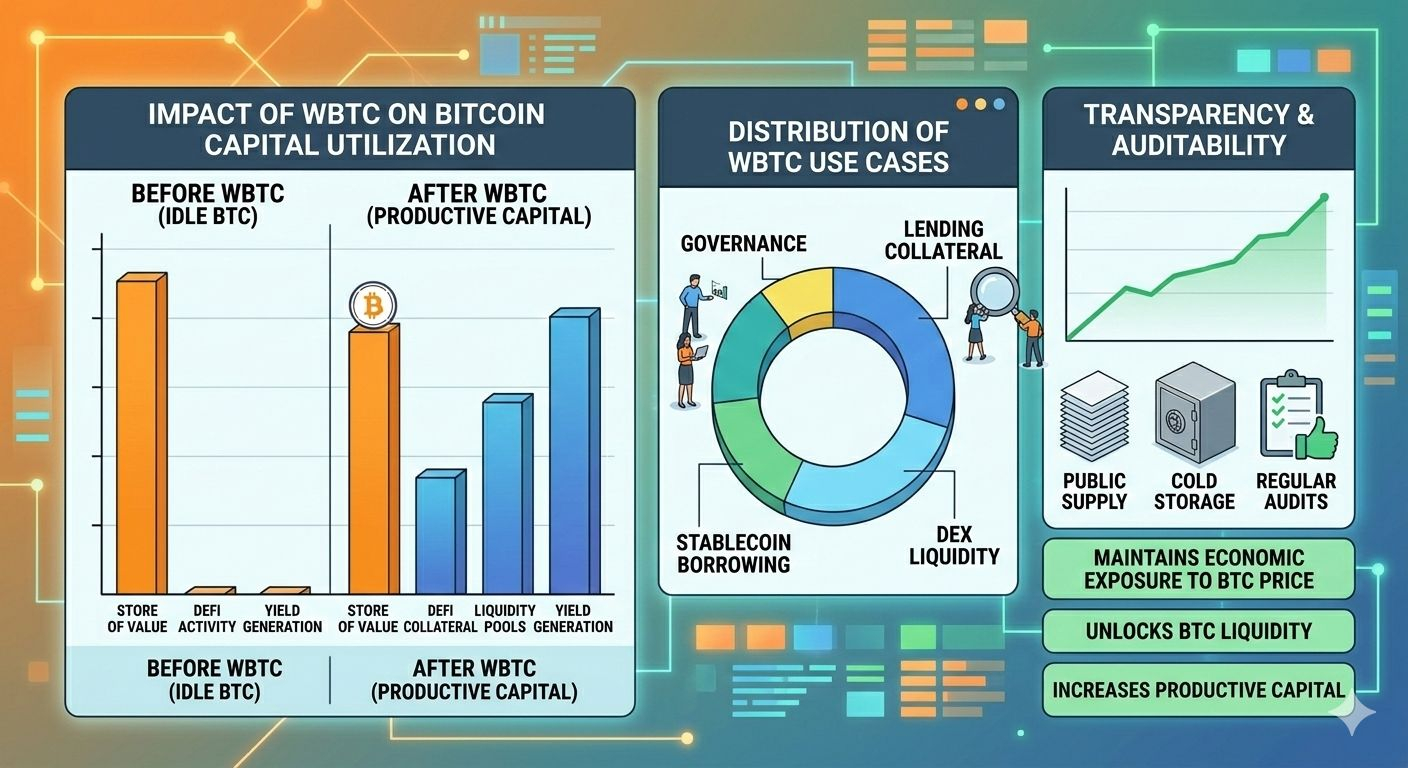
I spent months researching how Bitcoin holders were interacting with the fast-growing DeFi ecosystem. What I kept noticing was simple but important: people either held BTC long term, or they sold it when they wanted to participate in opportunities on other chains. There was rarely a middle ground. If you wanted to lend, borrow, earn yield, or provide liquidity on smart contract networks, you often had to give up your Bitcoin exposure to do it.
That is when I started looking closely at Wrapped Bitcoin, better known as WBTC.
At first, I was skeptical. The idea of a “wrapped” version of Bitcoin sounded unnecessary. Why not just use Bitcoin itself? But the more I studied how blockchains are designed, the clearer it became. Bitcoin’s blockchain was built for security, decentralization, and sound monetary policy. It was not built to run complex smart contracts or decentralized applications at scale. Meanwhile, networks like Ethereum, BNB Chain, Solana, TRON, and Base were rapidly becoming financial playgrounds where lending protocols, decentralized exchanges, and yield platforms were thriving.
I have been watching capital flow into those ecosystems, and one thing became obvious. Bitcoin liquidity was massive, but it was mostly inactive in those environments. Wrapped Bitcoin was designed to solve exactly that problem.
WBTC is essentially a token that represents real Bitcoin on other blockchains. For every WBTC token in circulation, there is one actual BTC held in reserve by custodians. It maintains a one-to-one backing. That means when someone holds WBTC on Ethereum or another supported chain, they are still economically exposed to Bitcoin’s price. The difference is that now their Bitcoin can interact with smart contracts.
The process itself fascinated me. When someone wants WBTC, they send Bitcoin through an authorized merchant. The custodian verifies the transaction on the Bitcoin network and mints the equivalent amount of WBTC on the target blockchain. When someone wants to convert back, the WBTC is burned, and the real BTC is released from storage. It is a bridge between two very different blockchain philosophies.
I have spent time digging into the security side because that is where most doubts naturally arise. The Bitcoin backing WBTC is typically stored offline in cold storage. Multi-signature wallets are used so no single party can move the funds alone. Audits are performed, and the total supply is publicly visible. Transparency is part of the design. Still, it is impossible to ignore that this model introduces trust. Unlike holding Bitcoin in your own wallet, WBTC relies on custodians doing their job responsibly.
That trade-off is important. I have learned that crypto is full of these trade-offs. Pure decentralization often limits flexibility. Increased functionality sometimes requires structured trust systems. Wrapped Bitcoin sits right at that intersection.
What really changed my perspective was watching how people use it. Instead of selling BTC to enter DeFi, holders can wrap it and use it as collateral. They can borrow stablecoins against it. They can deposit it into liquidity pools and earn fees. They can participate in governance systems. Their Bitcoin stops being passive and starts becoming productive capital.
I have been observing how this affects behavior. Long-term believers no longer feel forced to liquidate just to access opportunity. Traders can maintain Bitcoin exposure while exploring new strategies. Liquidity that would otherwise sit idle becomes active across multiple ecosystems.
There are, of course, costs involved. Wrapping and unwrapping may include fees from merchants or custodians, along with blockchain transaction costs like gas fees. During network congestion, those costs can rise. Timing matters. Planning matters. It is not always instant. But for many users, the flexibility outweighs the friction.
After all the research I have done and all the market cycles I have watched, I see Wrapped Bitcoin as more than just a token. It is a bridge connecting the most established cryptocurrency with the most experimental corners of decentralized finance. It allows Bitcoin to extend beyond its native chain without losing its price identity.
I used to see Bitcoin and DeFi as two separate worlds. Now I see them as interconnected layers of a broader financial system that is still being built in real time. Wrapped Bitcoin does not replace Bitcoin, and it does not change what Bitcoin stands for. It simply gives it a new environment to operate in.
And from everything I have been watching, that bridge between security and flexibility may become one of the most important developments in crypto’s ongoing evolution.