
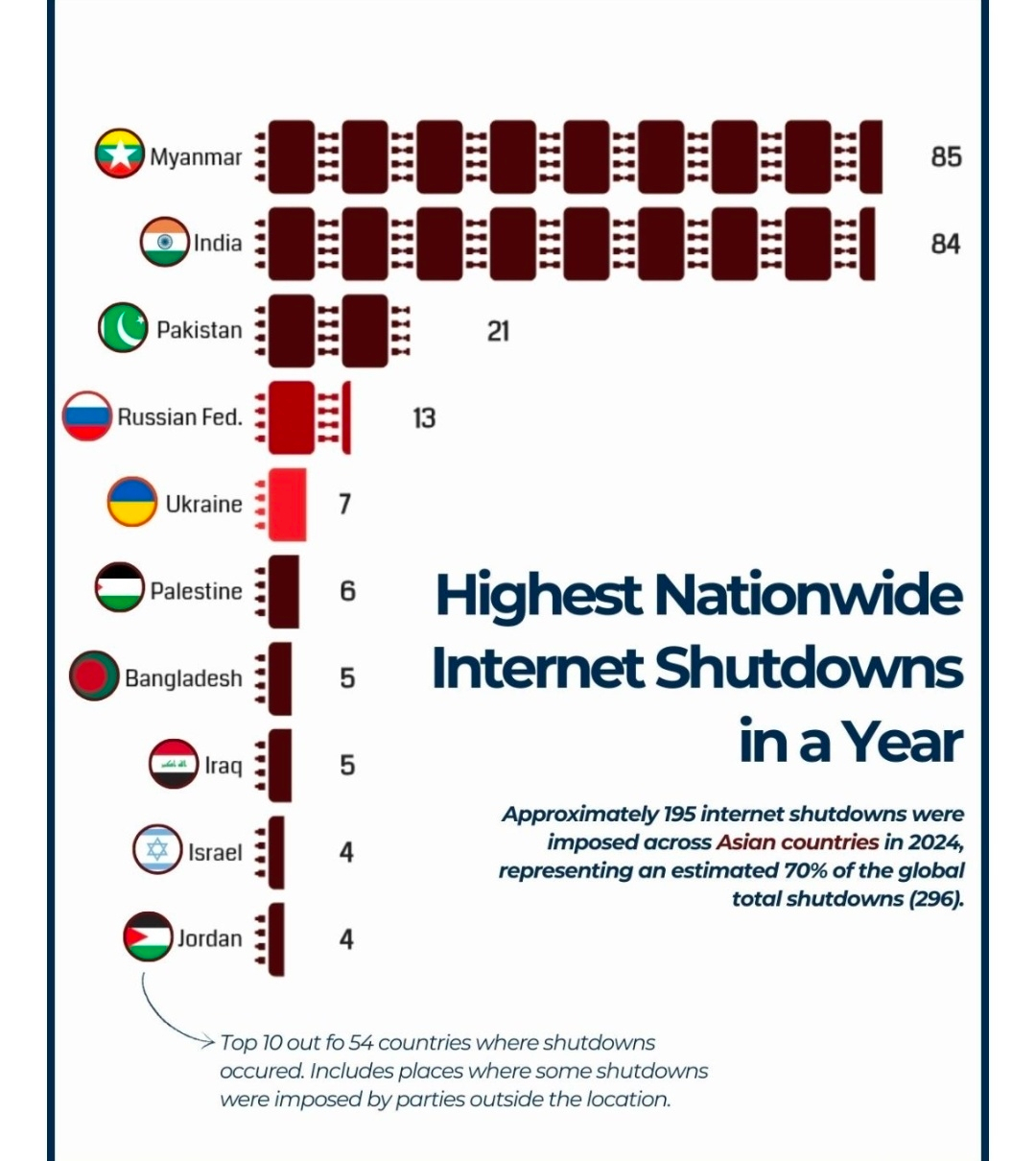
 Approximately 195 internet shutdowns were imposed across South Asian countries in 2024, representing an estimated 70% of the global total.
The countries that contributed to these were Myanmar (85), India (84), Pakistan (21), and Bangladesh (5). Their governments, at that year, suppressed internet access far more than the rest of the world combined.
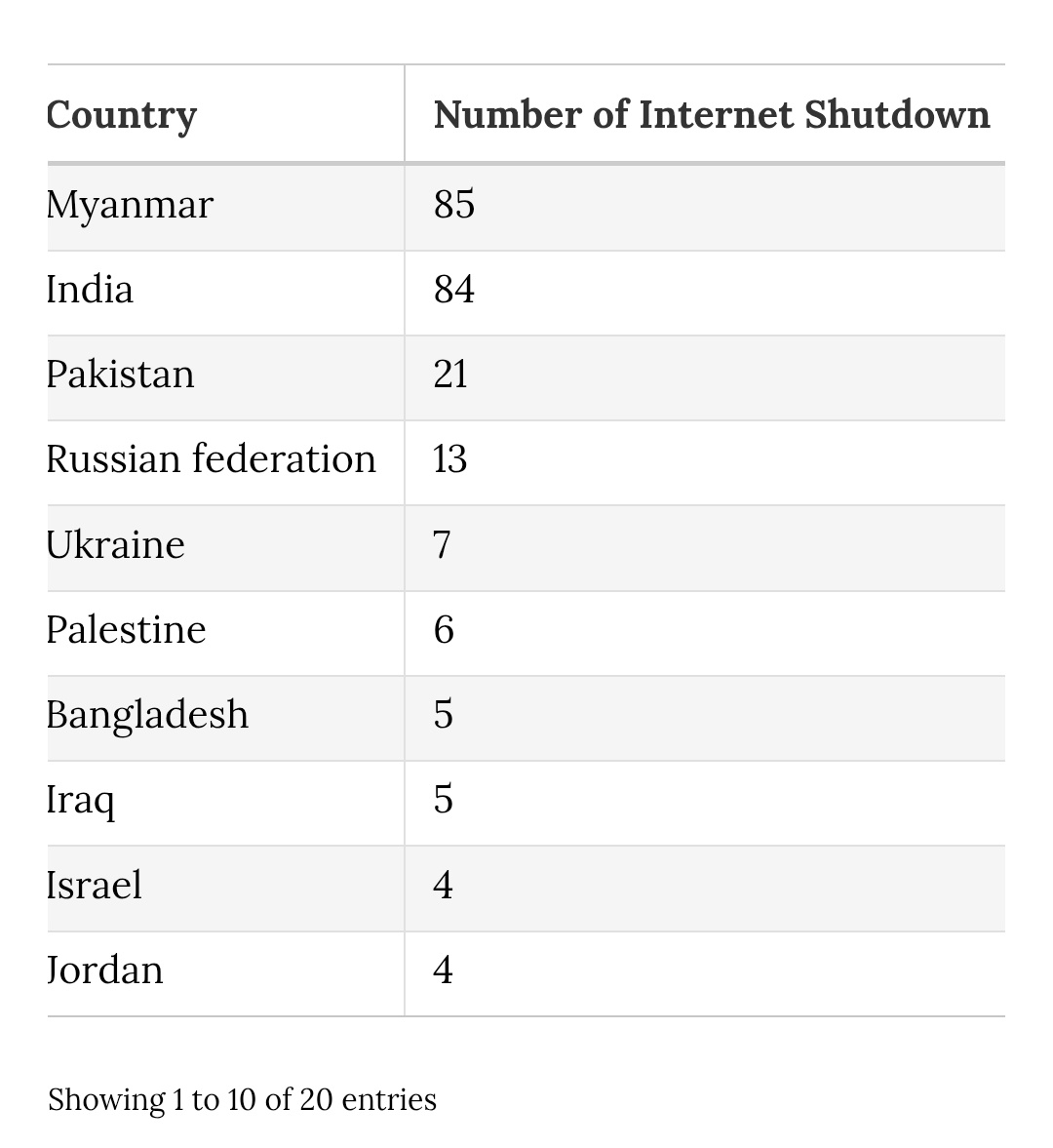
In the graphics above, we show the countries with the highest rates of nationwide internet shutdowns. It’s based on data from AccessNow’s shutdown tracker as of 2024, the most recent available period.
The regional concentration reveals Myanmar’s military junta and India’s democracy employing nearly identical shutdown frequencies despite vastly different political systems.
TL;DR
In 2024, Myanmar experienced the most internet shutdowns of any country, with about 85 documented blackouts,
Most internet shutdowns coincided with tensed electoral periods.
Top 20 Countries of Shutdown
India’s Democratic Paradox
In 2024, India recorded 84 internet shutdowns, more than any other democracy.
Also, more than Russia, Iran, and China combined, second only globally to Myanmar’s 85 shutdowns.
Most of these blackouts occurred in tension-prone regions such as Manipur, Haryana, and Jammu & Kashmir, where authorities cut connectivity during protests or communal violence.
The result is a stark contradiction as the world’s largest democracy is also a global leader in intentional internet blackouts.
This drops the principles of free expression and access to information, even though it promotes democratic ideals on the world stage.
Myanmar’s Civil War Shutdowns
In 2024, Myanmar experienced the most internet shutdowns of any country, with about 85 documented blackouts, which were fueled by its ongoing civil conflict and military junta control.
The majority of these shutdowns were imposed by the military government as part of tactics to control information amid fighting with ethnic armed groups and pro-democracy forces.
The pattern shows deep fragmentation in control across the country.
For context, about 33.4 million individuals use the internet in Myanmar at the start of 2025. Myanmar also had 19.6 million social media user identities in January 2025 (35.9% of the total population).
Areas contested by the junta and various insurgent groups often see repeated outages, with shutdowns coinciding with military operations.
The South Asian Domination
South Asia stands out sharply in the 2024 internet shutdown data.
Several factors help explain this pattern.
First is persistent political instability, then ongoing conflicts, and contested territories.
For example, shutdowns in Kashmir are tied to security operations, repeated blackouts in Myanmar are linked to its civil war and junta control, and protest-related disruptions in Pakistan and Bangladesh.
High-stakes election periods and communal tensions also trigger authorities to cut connectivity in an attempt to control information flow or blunt mobilization.
China’s Suspicious Absence
China’s internet is tightly regulated by the Great Firewall, where access to platforms like Google, Facebook, and Twitter is permanently censored.
That type of ongoing content blocking is not a “shutdown” under Access Now’s methodology, which tracks temporary, intentional disruptions to connectivity.
This indicates an important limitation.
Meaning, ongoing censorship and throttling aren’t classified as shutdowns, so countries like China, where information is tightly controlled, may appear low on shutdown statistics even though large portions of the population effectively lack open internet access.
Election Year Shutdown Pattern
Across 2024, several internet shutdowns aligned with election-related tensions.
Bangladesh logged 5 shutdowns amid its January general election
Senegal saw 3 shutdowns linked to controversy over delayed polls.
Pakistan’s 21 shutdowns happened alongside political unrest tied to Imran Khan and electoral disputes
Indonesia also recorded 1 shutdown during its election cycle.
This pattern tells of a disturbing trend.
For example, governments increasingly use internet blackouts to silence dissent, limit criticism, or disrupt mobilization during key vote periods.
ELI5
India alone had about 84 internet shutdowns, making it one of the biggest users of internet blackouts globally in 2024. This happened during protests, unrest, or sensitive political moments.
Looking ahead, South Asia accounts for roughly 65–70% of all internet shutdowns globally. That means a region is responsible for the majority of intentional internet disruptions worldwide, linked to elections, political instability, or security concerns.