Artificial intelligence is evolving at breakneck speed. Models can write reports, generate code, analyze markets, and simulate complex decisions in seconds. But beneath this impressive capability lies a critical weakness: reliability.
AI systems are probabilistic by design. They predict what seems correct based on patterns in data — not what is definitively true. In casual applications, occasional hallucinations may be harmless. In decentralized finance, governance, infrastructure, or autonomous systems, they become systemic risks.
Now consider the structural tension emerging in Web3.
Blockchains are deterministic. They execute code exactly as written. They settle transactions transparently. They enforce consensus without trust. But they cannot determine whether off-chain information — including AI-generated outputs — is accurate. A smart contract can function flawlessly while acting on flawed intelligence.
That’s where Mira Network steps in.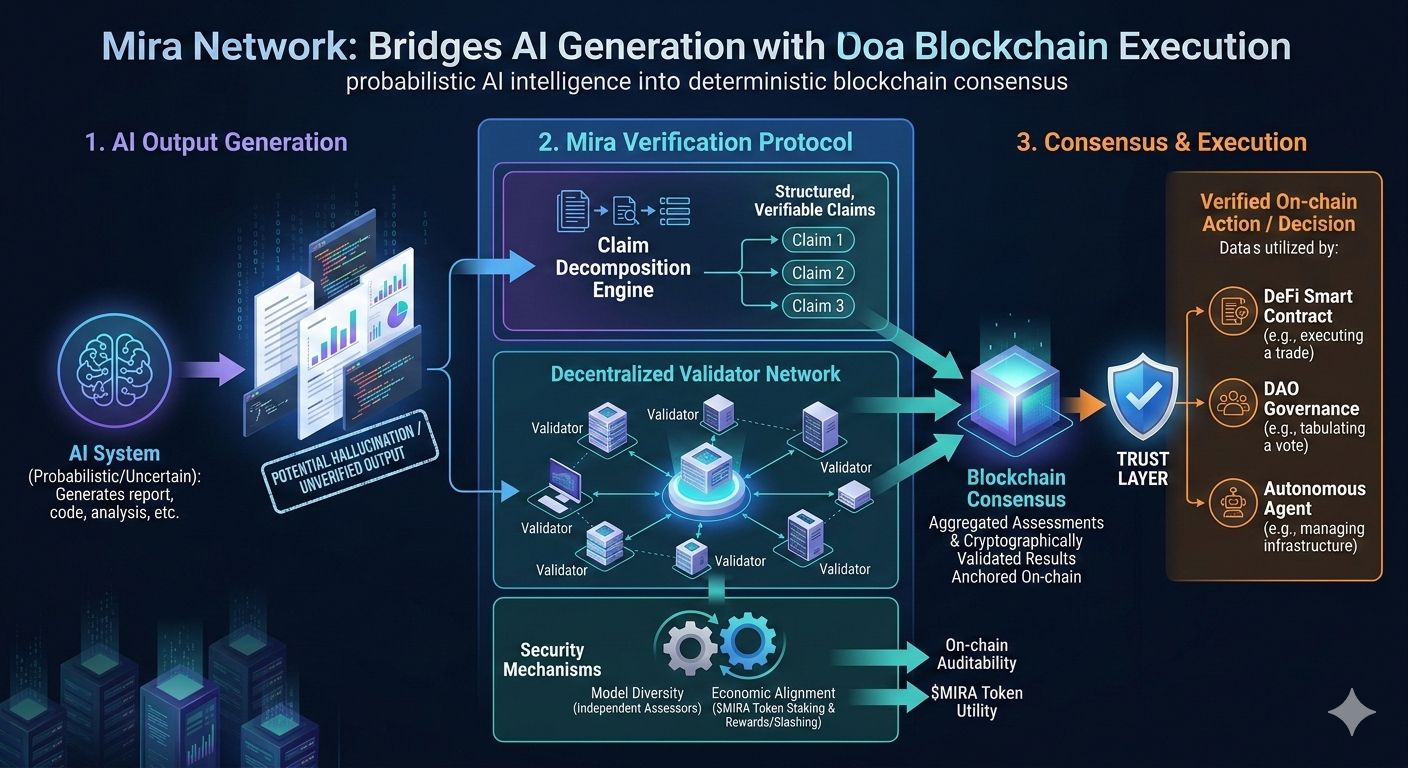
Bridging AI and Blockchain with Verification
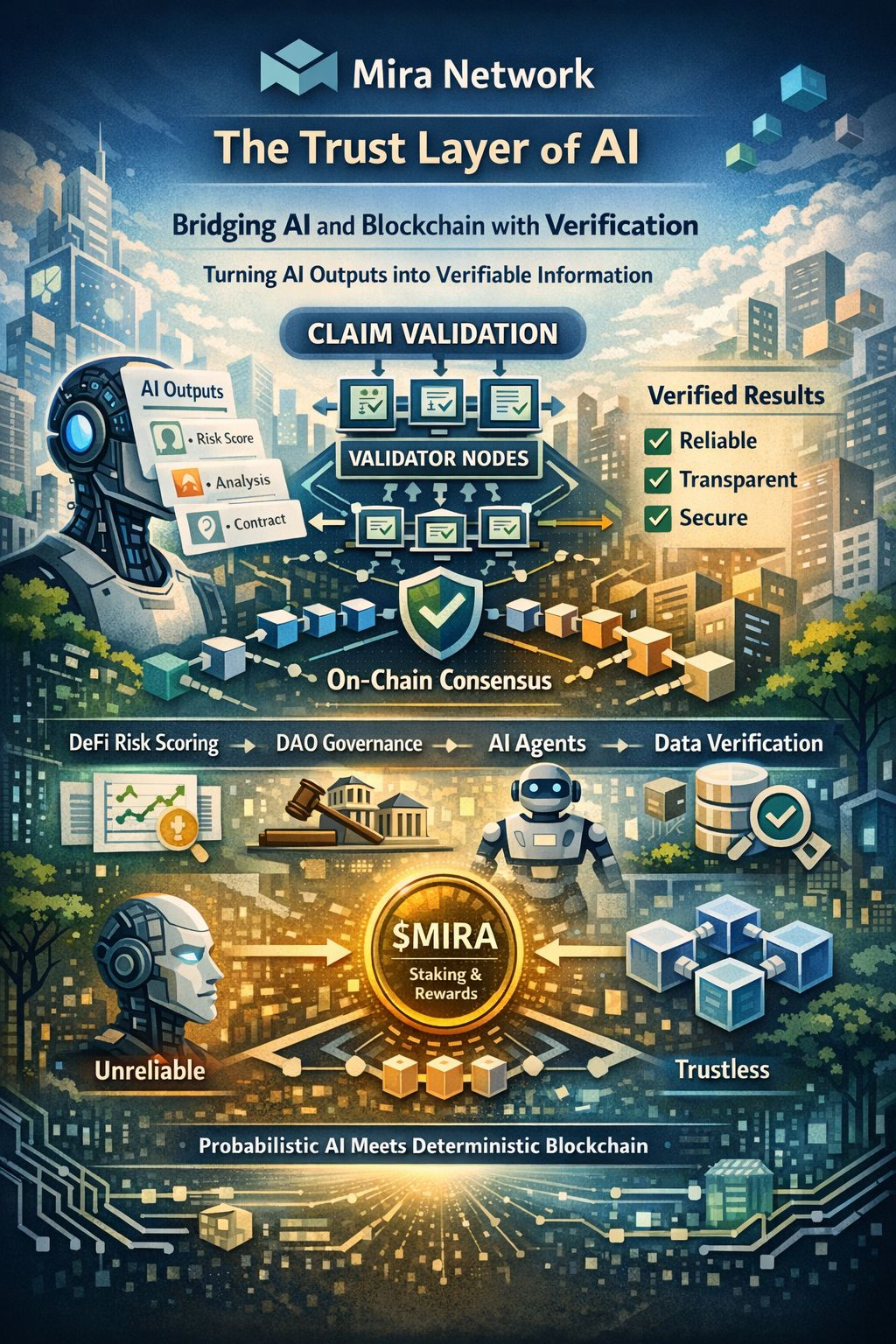
@Mira - Trust Layer of AI is a decentralized verification protocol built to transform AI outputs into cryptographically validated information. Instead of trusting a single model or centralized reviewer, Mira distributes verification across independent validator systems coordinated through blockchain consensus and economic incentives.
Here’s how it works:
When an AI generates content — whether it’s a risk score, research insight, governance analysis, or decision trigger — Mira decomposes that output into structured, verifiable claims. These claims are sent to independent validator models across the network. Their assessments are aggregated and anchored on-chain through a consensus mechanism.
Trust is no longer assumed. It is economically enforced.
Why This Matters
In DeFi, an incorrect AI-driven risk model could misallocate capital or trigger unnecessary liquidations. In decentralized insurance, flawed claim validation could drain reserves. In governance platforms, biased AI policy analysis could influence voting outcomes.
Without distributed verification, intelligent automation introduces fragility into systems designed for trust minimization.
Mira introduces a reliability layer between AI generation and blockchain execution — acting as a decentralized filter before automation becomes action.
Security Through Incentives and Diversity
Mira’s architecture combines off-chain scalability with on-chain transparency. Verification happens off-chain for efficiency, but results are recorded on-chain to ensure auditability.
Security emerges from two forces:
Model Diversity: Independent validator systems reduce correlated bias and single-point failure.
Economic Alignment: Validators stake tokens to participate. Accurate validation earns rewards. Malicious or negligent behavior risks financial penalties.
Over time, this creates a marketplace for truth — governed not by authority, but by aligned incentives.
Built for Scale
Rather than validating entire outputs as single units, Mira processes discrete claims in parallel. This granular approach allows horizontal scalability as validator participation grows. More validators mean more throughput and stronger consensus.
Expanding Use Cases
The applications are vast:
AI-verified risk scoring in DeFi
Fairness validation in gaming ecosystems
Policy verification in DAO governance
Reliable research validation in data marketplaces
Secure deployment of autonomous on-chain agents
As intelligent agents begin managing capital and infrastructure, verification shifts from optional to essential.
The Role of $MIRA
The native token coordinates the ecosystem. Validators stake to participate in verification. Honest validation earns rewards. Governance mechanisms allow token holders to influence consensus thresholds and incentive structures.
The token functions as both a security layer and a coordination mechanism — but long-term sustainability depends on real adoption, not speculation.
The Bigger Picture
AI is powerful but uncertain. Blockchains are certain but blind.
Mira Network attempts to bridge that gap — linking probabilistic intelligence with deterministic consensus. If Web3’s next evolution is intelligent automation, then verification infrastructure may become as foundational as consensus itself.
In the decentralized era, intelligence alone is not enough.
It must be verifiable.