
U.S. messenger app WhatsApp, owned by Meta Platforms, has been completely blocked in Russia for failing to comply with local law, the Kremlin said last week Thursday, suggesting Russians turn to a state-backed “national messenger” instead.
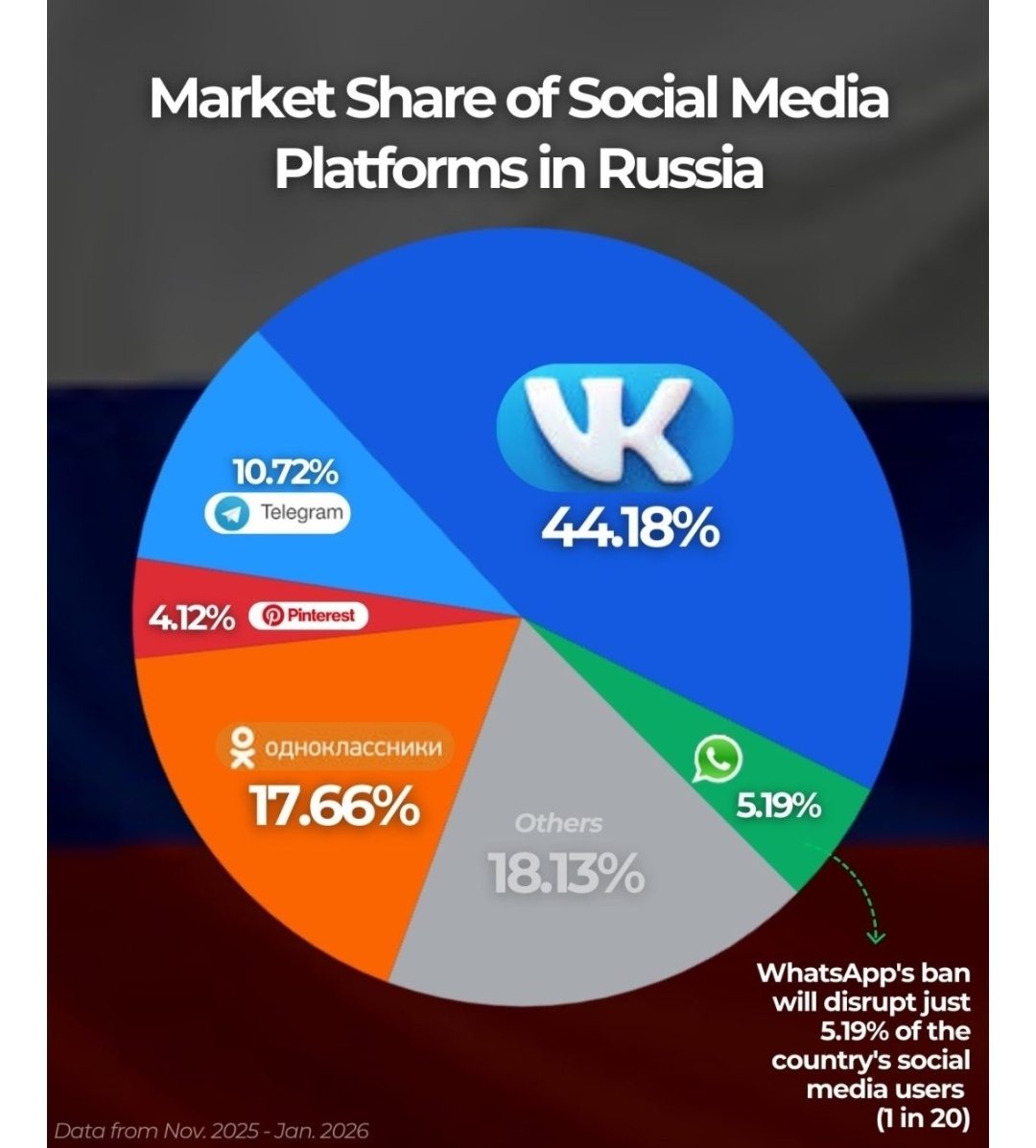
Surprisingly, WhatsApp’s ban in Russia will disrupt just 5.19% of the country’s social media users.
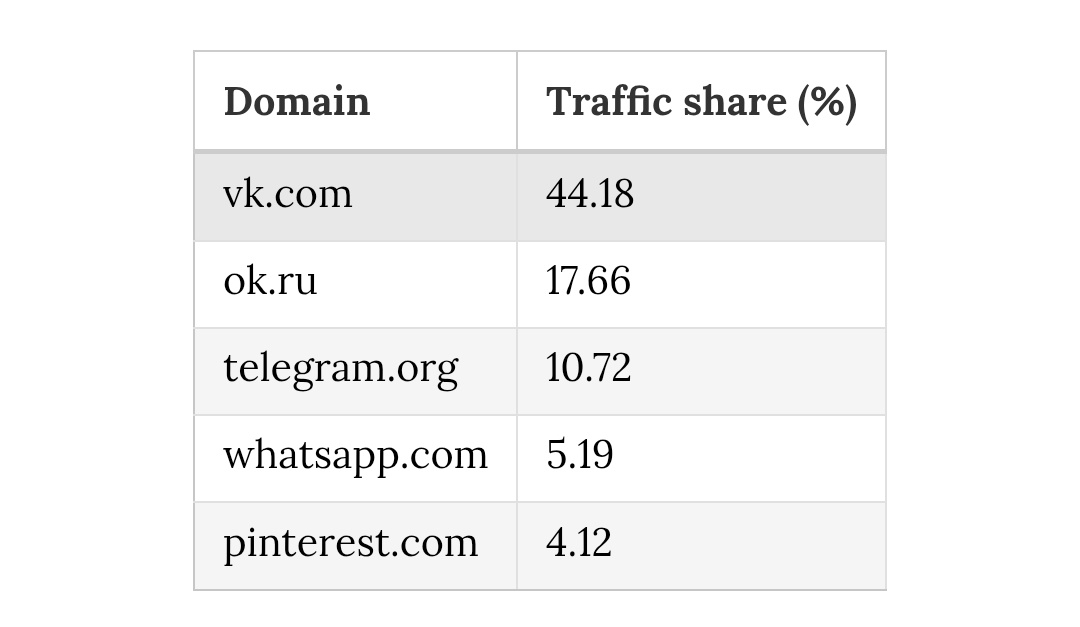
Today’s visuals show the market share of social media platforms in Russia, measured by the percentage of total social media users (1,898 domains tracked).
The data represents which platforms Russians actually use.
TL;DR
WhatsApp was blocked in Russia, even though it has only 5.19% of social media users.
VK and Ok.ru have significant state influence, dominating Russia’s social media with 61.84% of user traffic.
Russia is pushing users to MAX, a government-backed messaging app with virtually no adoption, making switching impractical and unreliable.
The data for this explainer was sourced from SimilarWeb.
Leading social media networks in Russia and their market share.
Russian officials have accused WhatsApp of failing to comply with local laws requiring data to be stored domestically, prompting the ban and a push toward the state-backed MAX app.
The situation looks contradictory.
Telegram was itself targeted with a nationwide ban from 2018 to 2020 after its founder, Pavel Durov, refused to hand over encryption keys to Russian authorities. This move forced him to relocate abroad.
That ban proved unenforceable and was lifted, and Telegram remains widely used despite ongoing throttling and legal pressure.
Domestic Dominance
While WhatsApp and Telegram account for only a small fraction of Russia’s social media traffic, domestic platforms VK and Odnoklassniki (OK) together hold 61.84%, nearly two‑thirds of all usage.
VK, Russia’s largest social network, offers messaging, media sharing, streaming, and financial services, while OK remains popular, particularly among older users.
Both platforms have strong ties to the state, giving authorities easier access to user data, content moderation, and monitoring compared with encrypted foreign apps.
This concentration creates a “digital walled garden,” similar to China’s Great Firewall, in which domestic platforms dominate behind regulatory barriers.
By favoring VK and OK, Russia ensures tighter control over data, content, and political messaging, reinforcing a form of internet sovereignty that limits foreign influence and global connectivity.
The “Max” Problem
MAX, a state-backed platform with relatively zero adoption, when compared with the top 5 platforms.
This means that almost no Russian users actively use MAX, making it an impractical replacement for a widely popular service.
Meanwhile, Telegram, with a 10.72% market share, continues to operate freely, serving the same messaging purpose as WhatsApp.
The situation highlights a puzzling double standard: while authorities cite legal breaches to justify blocking WhatsApp, Telegram has faced similar scrutiny in the past but remains available, leaving citizens caught between limited options and government mandates.
The scenario is comparable to banning Uber and requiring riders to use a government taxi app, even though Lyft already serves the same function more efficiently.
MAX, despite state backing, struggles with adoption, user trust, and functionality, leaving users with a largely untested, unproven service.