
The robotics industry is standing at an important turning point. For many years, most robotic systems have been built inside closed environments where the hardware and software are tightly connected and hidden from the outside world. Everything works inside a “black box,” but very little is transparent. This approach has slowed down innovation and made safety, trust, and regulation more complicated than they need to be.
Fabric Protocol is trying to change that. Instead of keeping robotics development locked behind closed systems, it introduces a decentralized and open platform where collaboration becomes possible. The idea is to create shared infrastructure that connects different robotic systems, developers, and data in a secure and verifiable way. If successful, Fabric Protocol could act as the connective layer that helps robotics evolve faster, safer, and more transparently in the years ahead.
At its heart, Fabric Protocol is designed as a global, open network supported by the Fabric Foundation. Instead of manufacturing robots directly, it focuses on creating the digital and governance framework that robots rely on. Think of it as the underlying system that allows robots to operate independently while still following shared rules and global standards.
Through agent-native infrastructure, each robot (or “agent”) can act on its own, make decisions, and perform tasks — but it stays connected to a broader network that ensures coordination, accountability, and consistency.
Solving the Black Box Problem with Verifiable Computing
One of the biggest concerns in AI-driven robotics is transparency. When a robot makes a decision, it’s often difficult to understand how or why it reached that conclusion — this is known as the “black box” problem.
Fabric addresses this with verifiable computing. Every action a robot takes — movements, communications, or decisions — can be recorded and verified on a public ledger. This creates a clear “proof of execution,” meaning actions are traceable and cannot be secretly altered.
This matters because it supports:
Safety audits: If something goes wrong, there is a clear record to review.
Regulatory compliance: Robots can be monitored to ensure they follow laws and ethical standards in real time.
Data integrity: The data used to train and operate robots can be verified as secure and untampered.
Modular Design and Shared Innovation
Fabric also encourages a modular approach to robotics. Developers and researchers can contribute specific components — such as a computer vision system or an advanced movement algorithm — without needing to build an entire robot from scratch.
This structure promotes collaborative evolution. When one robot or developer improves a system, that advancement can benefit the entire network. Instead of isolated innovation, progress becomes shared and cumulative, accelerating development across the ecosystem.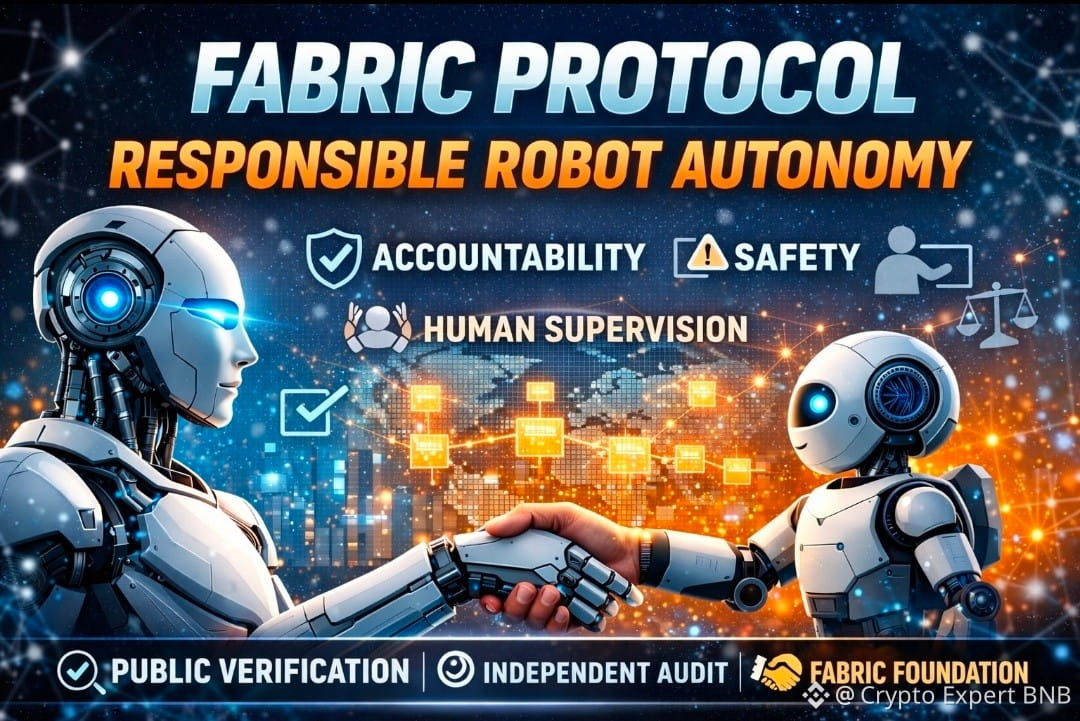
Creating Trust Between Humans and Machines
Ultimately, Fabric Protocol aims to make collaboration between humans and machines safer and more transparent. By providing a trusted public infrastructure for robotic governance and computation, it reduces uncertainty around autonomous systems.
Rather than operating as mysterious, standalone machines, robots become verifiable and accountable participants within a shared framework — trusted partners rather than unpredictable tools.
With the growing interest around $ROBO and the broader #ROBO ecosystem, the vision is clear: build not just smarter robots, but a smarter, more trustworthy system for how they exist and evolve.