
The robotics industry is entering a defining moment. For years, innovation has been trapped inside closed systems where hardware and software are fused together in isolated “black boxes.” This structure slowed progress, limited collaboration, and created serious safety and regulatory blind spots.
Fabric Protocol is emerging as a radical alternative — not just another robotics project, but a decentralized, open foundation that could become the connective infrastructure for general-purpose robotics worldwide.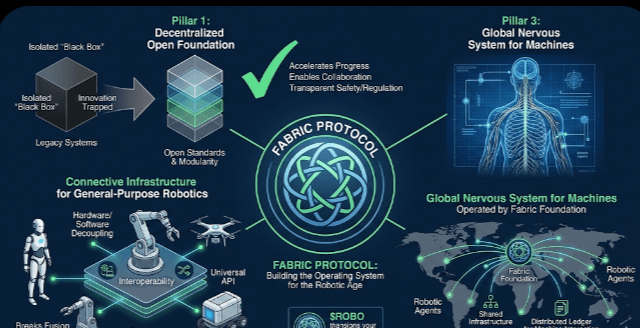
A Global Nervous System for Machines
Fabric Protocol operates as a global open network supported by the Fabric Foundation. Instead of building individual robots, it builds the shared infrastructure that robots rely on.
Think of it as a decentralized nervous system.
Each robot functions as an autonomous agent, capable of making decisions independently while remaining aligned with global standards. Through agent-native infrastructure, robots can coordinate, evolve, and operate within a transparent and governed framework rather than in isolation.
Solving the Black Box Proble
One of the biggest challenges in AI robotics is trust. When a robot makes a decision, how do we know why it made that decision?
Fabric addresses this through verifiable computing. Every action, interaction, and computational step can be recorded and validated on a public ledger. This creates a proof-of-execution system that transforms opaque machine behavior into transparent, traceable activity.
This foundation strengthens:
Safety audits — clear, trackable logs in case of malfunction.
Regulatory compliance — real-time alignment with local laws and ethical standards.
Data integrity — assurance that training data and operational inputs remain uncompromised.
Trust is no longer assumed. It becomes mathematically verifiable.
Modular Infrastructure and Collective Progress
Fabric introduces modular architecture, allowing developers to contribute specialized components — whether that is advanced vision systems, locomotion algorithms, or decision-making models.
Instead of every robotics team building from scratch, contributors can build interoperable modules that plug into a shared ecosystem.
If one system discovers a more efficient navigation method or a safer manipulation protocol, that improvement can be validated and shared securely across the network.
This transforms robotics development from isolated competition into collaborative evolution.
Human and Machine Alignment
At its core, Fabric Protocol is not only about machines — it is about trust between humans and autonomous systems.
By anchoring governance, computation, and regulation to a transparent public framework, Fabric reduces uncertainty around machine autonomy. Robots are no longer mysterious black boxes. They become accountable, auditable, and aligned participants in a shared ecosystem.
The result is a future where robots are not isolated tools owned by corporations, but verifiable partners operating within a secure and open global standard.
Fabric Protocol is not simply building robots.
It is building the infrastructure that defines how robots will exist, cooperate, and earn trust in the world ahead.
