
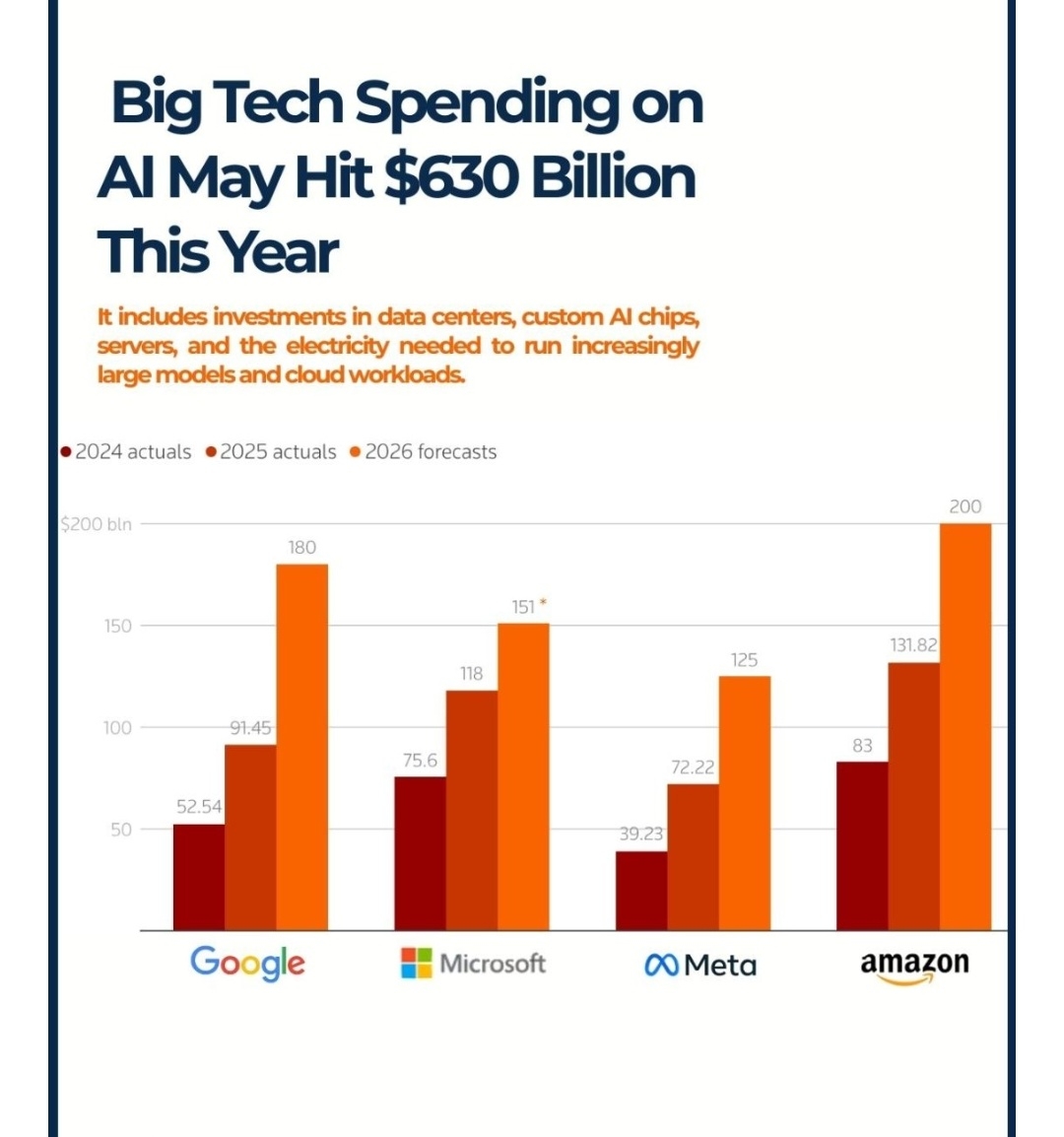
U.S. tech giants have predicted that their spending will surge this year as they intensify their investment in artificial intelligence.
Economists are calling it the “Great AI Arms Race.”
It even heightens investor scrutiny over whether these costly bets will generate returns sufficient to justify the sector’s high valuations.
In the graphics above, we used data from various technology companies’ estimates to present Capital Expenditure (CapEx) on AI, as reported by Reuters.
CapEx is the billions of dollars these four companies are investing in physical data centers, cooling systems, and specialized AI chips (such as Nvidia’s) to ensure they aren’t left behind in the next industrial revolution.
TL;DR
Big Tech is projected to spend over $630 billion on AI in 2026, an investment comparable to the annual GDP of many developed nations.
Amazon and Google lead the surge, with Amazon targeting approximately $200 billion in AI-related capital expenditures and Google planning $175-$185 billion.
Big Tech AI Spending by Company (2024–2026)
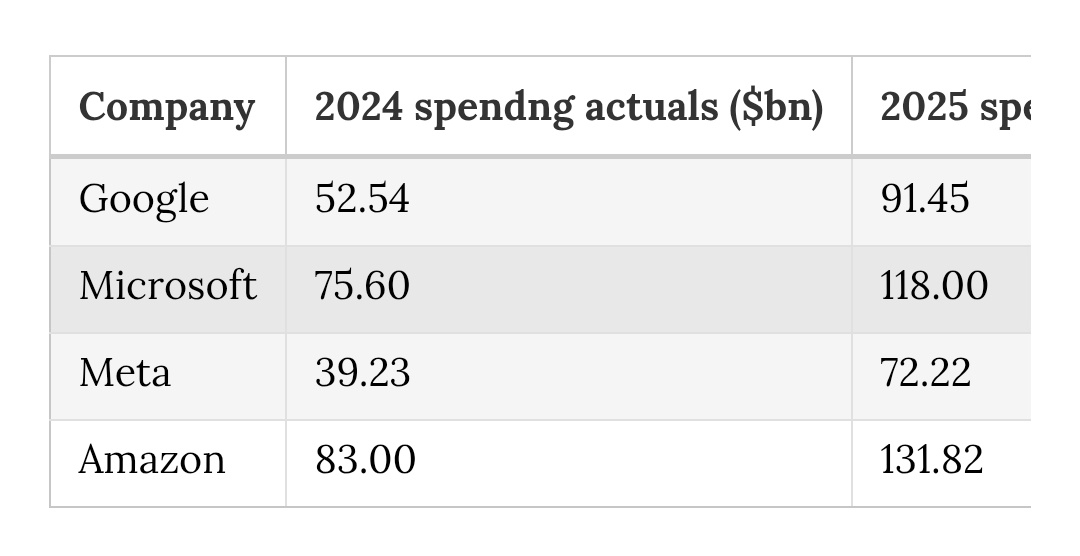
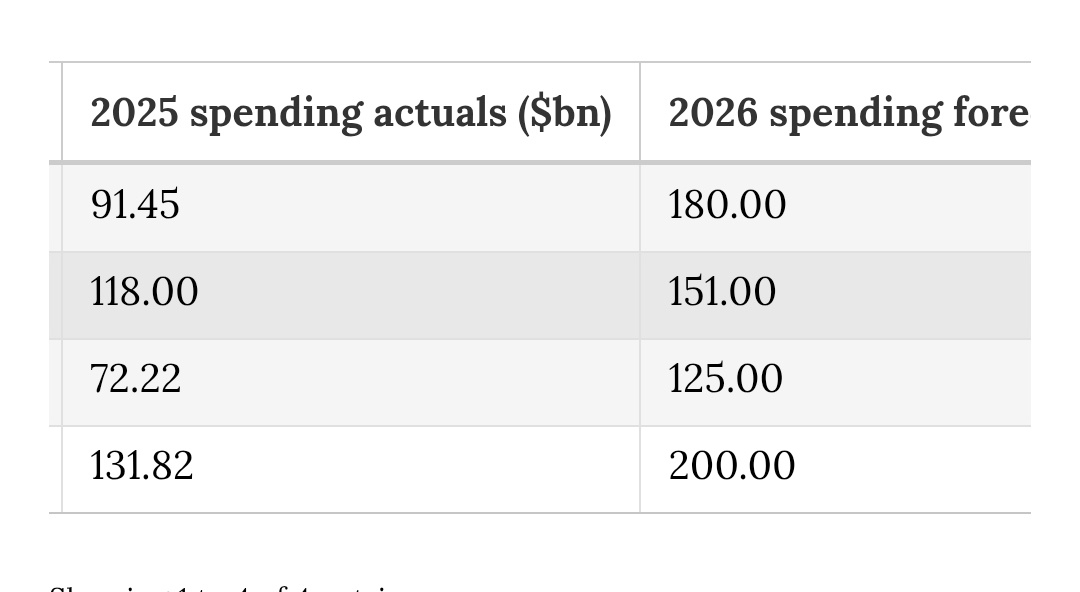
“Country-Sized” Spend
For 2026, Google, Microsoft, Meta, and Amazon are on track to spend more than $630 billion combined on AI-related capital expenditure. This includes investments in data centers, custom AI chips, servers, and the electricity needed to run increasingly large models and cloud workloads.
Individually, these companies already rival industrial conglomerates in scale. Collectively, their AI budgets now exceed what many sectors of the global economy spend in a year.
For context, that total puts Big Tech’s AI outlay in the same league as national economies.
Belgium’s nominal GDP is roughly $700 billion, while Sweden’s is about $660 billion, according to the International Monetary Fund (IMF) data.
In other words, four U.S. technology firms are preparing to deploy capital at a level comparable to the entire annual economic output of a developed European country in a single year.
The AI race is forcing these companies to operate at a scale closer to sovereign infrastructure than traditional corporate investment, with compute capacity and energy availability now acting as binding constraints.
Amazon & Google Lead the Charge
Amazon is projected to be the largest single AI spender in 2026, with roughly $200 billion in capital expenditures, up from about $131 billion in 2025, according to Reuters.
The increase is driven primarily by Amazon Web Services, which is investing heavily in AI and supercomputing infrastructure, custom silicon such as Trainium and Graviton, and large-scale data center expansion to support AI model training and cloud demand.
AWS continues to sign major enterprise and government contracts, requiring ever-larger compute clusters to power generative AI workloads.
Google is close behind, planning to spend $175 billion to $185 billion in 2026 (roughly double its 2025 capex), as it accelerates investment in AI and cloud infrastructure.
The spending targets new and expanded data centers, networking equipment, AI-optimized hardware, and additional capacity for its Gemini models and cloud services.
To help fund the push, Alphabet has even issued rare 100-year bonds, underscoring how central AI investment has become to its long-term strategy.
Together, these budgets are already translating into multi-billion-dollar global projects, as both companies race to secure compute capacity, specialized chips, and the physical infrastructure needed to power advanced AI systems well into the next decade.
Google’s Vertical Climb
Among the tech giants, Google’s trajectory stands out for its sheer steepness.
After spending $91.45 billion in 2025, Alphabet is projected to nearly double its capital expenditure to about $180 billion in 2026, according to Reuters.
The bulk of that spending is being funneled into AI and cloud capacity: new and expanded data centers, networking equipment, and AI-optimized hardware to support its Gemini models and fast-growing cloud business.
Executives have tied the surge directly to rising demand for AI services and the need to scale compute aggressively, with Alphabet even tapping long-dated bond markets to help fund the expansion, an unusual move for a company with its balance sheet strength.
The pace of the increase signals a pivotal moment. Search remains Google’s core profit engine, but generative AI is reshaping how users access information and how advertisers reach them.
The near-doubling of AI spending suggests a strategic pivot toward defending that dominance at all costs, ensuring Google controls the infrastructure layer of AI rather than ceding ground to rivals building equally massive compute advantages.
“Moon Mission” Comparison
To grasp the scale of Big Tech’s AI spending, it helps to step outside corporate balance sheets and into history.
In 2026, Google, Microsoft, Meta, and Amazon are projected to spend more than $630 billion on AI infrastructure, an amount that exceeds the inflation-adjusted cost of the entire Apollo moon program and comes close to twice that figure.
NASA’s Apollo program, which put humans on the Moon between 1960 and 1973, cost about $25.8 billion at the time. Adjusted for inflation, that translates to roughly $250–$280 billion in today’s dollars.
What took the U.S. government more than a decade of coordinated national effort would cost less than half of what these four companies plan to spend in a single year on AI.
Viewed through that lens, Big Tech’s 2026 AI budgets amount to more than two modern-day moon missions. The goals are different, but the financial scale is comparable.
By raw dollars alone, this is the 21st-century moonshot: not powered by rocket fuel, but by silicon, electricity, and compute a planetary scale.
ELI5
In 2026, Google, Microsoft, Meta, and Amazon are expected to spend over $630 billion on AI infrastructure—about the same as a developed country’s annual economic output.