


On March 3, 2026, Binance and Binance Wallet introduced the first batch of AI Agent Skills — a modular intelligence layer designed to equip AI agents with real-time market data, execution capabilities, and built-in security tools.
This launch represents more than just another feature update. It signals Binance’s move to become the intelligence backbone behind autonomous crypto agents.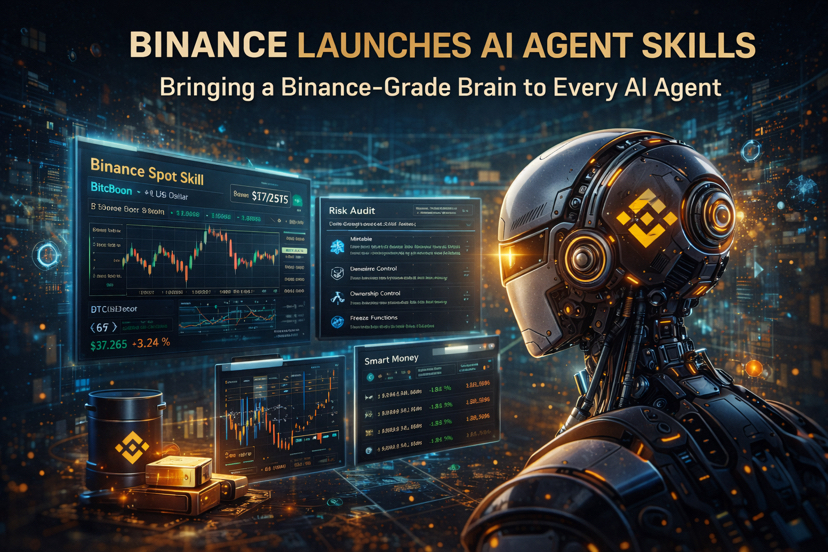
From Fragmented Signals to Structured Execution
Crypto traders today rely on scattered dashboards, social feeds, analytics platforms, and manual workflows. AI agents face the same fragmentation when scraping public data sources.
Binance’s AI Agent Skills aim to remove that friction.
Through a unified interface, AI agents can now plug directly into structured data streams and trading infrastructure across Binance Spot and Binance Wallet. That means market insights and execution logic are no longer disconnected. Detection and action can happen in one pipeline.
In practical terms, this turns passive data monitoring into automated, decision-ready intelligence.
The First 7 AI Agent Skills
The initial release includes seven modular capabilities.
The Binance Spot Skill provides real-time access to exchange data, including ticker prices, order book depth, candlestick charts, and exchange metadata. It also enables trade execution — from standard orders to advanced structures like OCO, OPO, and OTOCO — with support for API authentication across both mainnet and testnet environments.
Query Address Info allows agents to analyze any wallet address, generating structured breakdowns of holdings, valuation, 24-hour performance, and concentration metrics. This is particularly relevant for whale tracking and smart money monitoring.
Query Token Info retrieves token metadata such as symbol, chain, price, liquidity, holder distribution, and trading activity — removing the need for multi-site scraping.
Crypto Market Rank aggregates trending narratives, hot searches, smart money inflows, meme activity, and trader performance into a structured “what to watch” overview.
Meme Rush focuses specifically on tracking meme tokens across lifecycle stages — newly launched, migrating, or fully migrated — while mapping narrative themes to token clusters.
Trading Signal delivers structured buy and sell signals from smart money flows, including trigger price, current price, maximum gain, exit rate, and signal status.
Query Token Audit automatically scans for common contract risks, including mint functions, freeze mechanisms, and ownership privileges — embedding risk awareness directly into execution workflows.
A Unified Intelligence Core
One of the most significant aspects of this launch is architectural.
Instead of separating centralized exchange trading from wallet analytics, Binance is consolidating both into a single intelligence core. An AI agent can identify an opportunity through on-chain signals and immediately execute through centralized liquidity — without switching tools.
That unified model reduces latency between insight and action.
In fast-moving markets, that difference matters.
Smart Money Meets Automated Risk Control
The combination of smart money tracking and automated contract auditing introduces a dual-engine framework.
Agents can monitor inflows from high-performing wallets while simultaneously scanning token contracts for red flags. Execution speed is preserved, but risk filters remain active.
This blend of signal and safety could reshape how autonomous trading systems operate.
Builder-Friendly Infrastructure
Binance has positioned these AI Agent Skills as open and modular. Developers using frameworks such as OpenClaw or Claude-based agents can integrate Binance-grade intelligence through standardized configuration layers.
Instead of building custom scrapers and patchwork APIs, developers can connect directly to structured endpoints.
For builders, this dramatically lowers integration complexity.
For traders, it increases the quality and reliability of AI-driven decisions.
The Bigger Picture: AI-Native Trading Infrastructure
The launch of AI Agent Skills suggests a broader shift.
Crypto is moving toward AI-native workflows — where agents monitor, analyze, filter, and execute continuously. The competitive edge will increasingly belong to systems that combine structured data access, deep liquidity, and embedded security.
Binance is positioning itself at the center of that stack.
As autonomous agents become more prevalent in trading and portfolio management, the platforms that provide reliable intelligence rails may become just as important as the assets being traded.
This announcement is general information only. Product availability may vary by region.
The question now is not whether AI will trade crypto.
It’s which infrastructure AI will trust to do it.
This article is for informational purposes only. The information provided is not investment advice.