

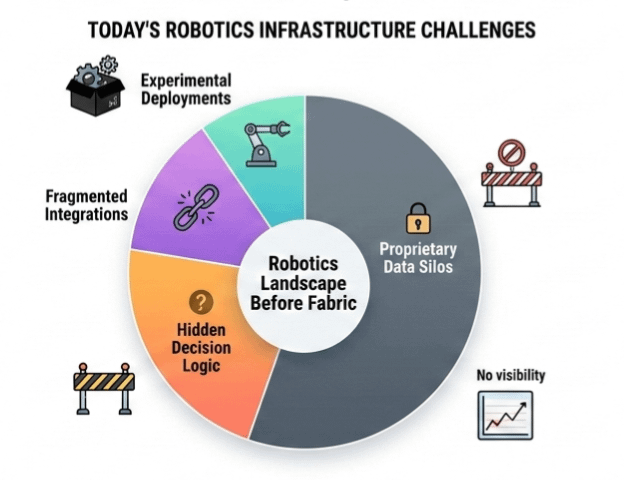
I still remember the first time I watched a robot make a decision entirely on its own. It wasn’t the movement that unsettled me it was the silence behind it. No visibility. No audit trail. No clear governance. Just a machine acting inside a black box.
That’s the real crisis in robotics today. We have built machines that can move, see, calculate, and optimize. But we haven’t built the infrastructure to trust them at scale. Data sits in silos. Computation is opaque. Decision-making logic is hidden behind proprietary walls. And regulators are left trying to oversee systems they cannot fully inspect.
This is the crossroads.Robotics is no longer experimental. It’s operational. It’s in logistics hubs, hospitals, warehouses, infrastructure sites. Yet the architecture supporting it still belongs to a centralized, closed era.
That’s where @Fabric Foundation steps in not as another robotics startup, but as foundational infrastructure.
Fabric is a global open network supported by the non-profit Fabric Foundation. Its purpose is clear: orchestrate how general-purpose robots are built, governed, and evolved through verifiable computing and agent-native infrastructure.
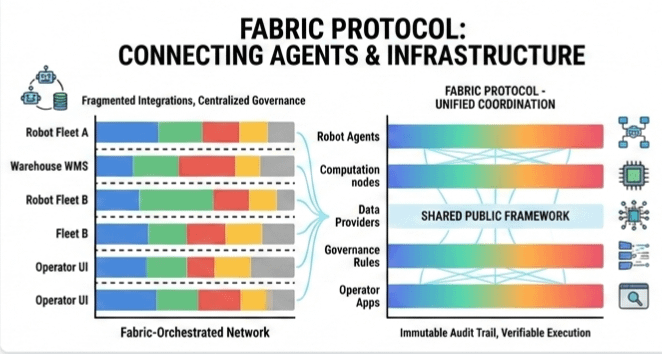
If robots are the body, Fabric is the nervous system.It connects machines, computation, governance, and data into a shared public framework. Instead of isolated systems talking through fragile integrations, Fabric embeds coordination at the protocol layer itself.
Every autonomous agent can operate with a verifiable identity.Every computation can produce proof of execution.Every action can leave an immutable audit trail.
This is not about hype. It’s about accountability.Verifiable computing changes the conversation. Instead of asking operators to “trust” what happened inside a machine, Fabric enables mathematical verification. Proof of execution ensures processes run exactly as defined. Audit trails provide transparency. Public ledger coordination reduces ambiguity.
For industries where safety and compliance matter which is almost all of them this isn’t optional. It’s foundational.
But what makes Fabric truly powerful is its modularity.It isn’t a rigid product. It’s an evolving ecosystem. Developers can build new modules. Enterprises can deploy fleets within compliant frameworks. Governance can adapt over time. The protocol doesn’t dictate outcomes it orchestrates participation.
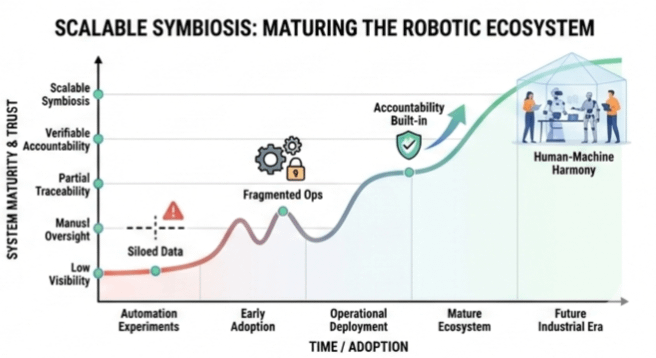
This is collaborative evolution.Robots don’t replace humans in this vision. They operate alongside them, within a transparent system where accountability is built-in, not bolted on.
The real bottleneck in robotics was never intelligence. It was coordination and trust.
Fabric Protocol closes that gap.And when machines can act autonomously and verifiably when humans can oversee without obstructing we move from automation experiments to a structured, scalable symbiosis between human intention and machine execution.
That’s not hype. That’s infrastructure for the next industrial era.
