
When I first started looking into Fabric, I honestly thought it was just another mix of AI and crypto trying to ride two big trends at once. But the deeper I went, the more I realized they’re attempting something much bigger. They’re not just building software for robots, and they’re not just launching a token. They’re trying to create an entire nervous system for machines.
If you think about how humans work, our brains think, our bodies act, and our nervous system connects everything. Now look at robots today. They can move. They can see. AI models can help them reason. But they’re mostly isolated. One company’s robots don’t easily cooperate with another’s. Their work is recorded in private databases. Their actions are controlled within closed systems. There’s no shared, neutral infrastructure that lets machines coordinate, verify what they’ve done, and settle value in an open way.
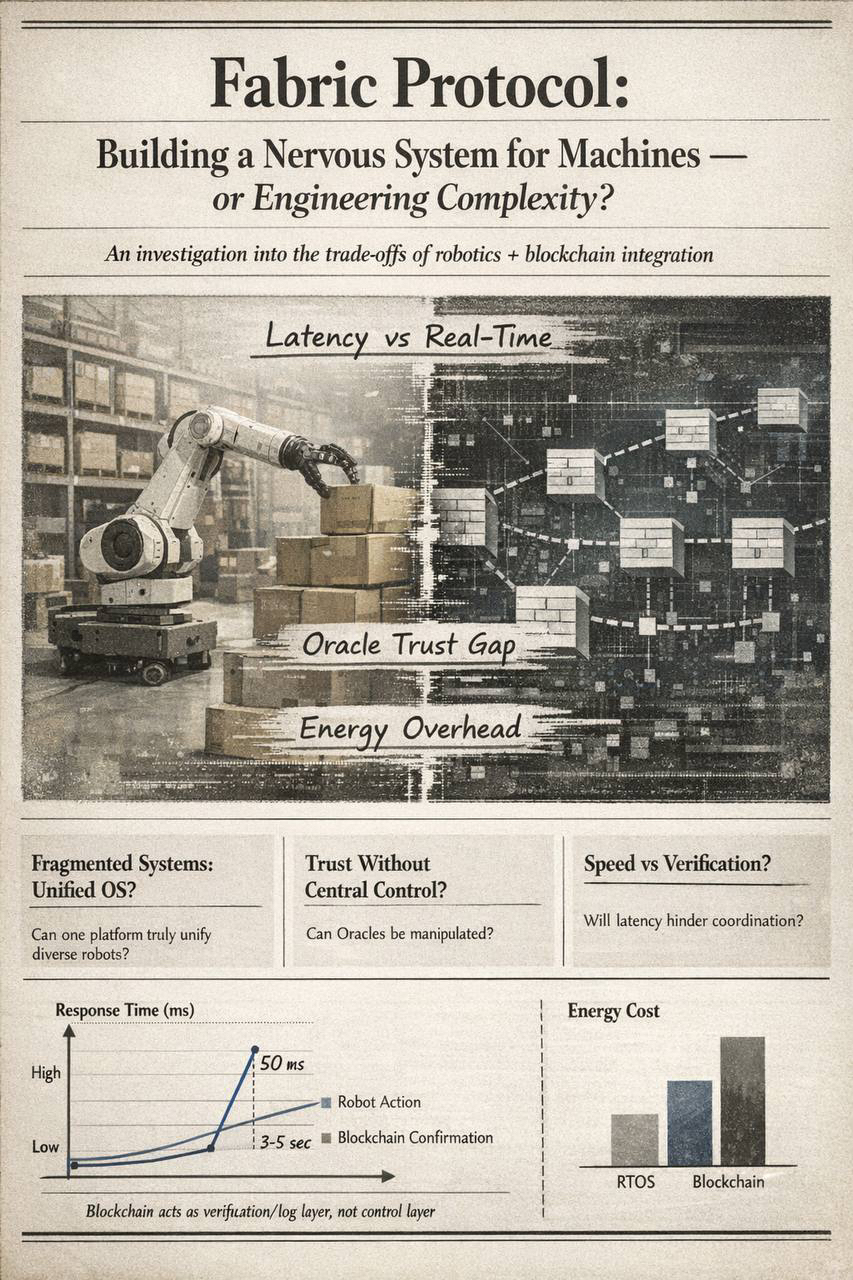
That’s the early idea behind Fabric. What if robots weren’t locked inside silos? What if they could operate on a shared layer that connects intelligence, action, and economic coordination?
They’re building this around something called OM1, an open-source operating system for robots. The goal isn’t to replace every low-level motor controller or industrial real-time system. Instead, it’s to sit above that layer and provide a common framework for perception, reasoning, and coordination. In simple terms, OM1 tries to make different robots speak a similar language.
Right now, robotics is fragmented. Developers deal with different hardware, different software stacks, different integration headaches. If you build for one robot, it doesn’t automatically work for another. Fabric wants to reduce that friction. If OM1 works as intended, developers could plug in AI models for vision or speech, attach sensors or robotic arms through modular components, and deploy across multiple platforms more easily.
I see why they compare it to Android, but in robotics form. Android didn’t control the physics of smartphones. It provided a shared software foundation that unlocked a massive developer ecosystem. Fabric hopes OM1 can do something similar for machines.
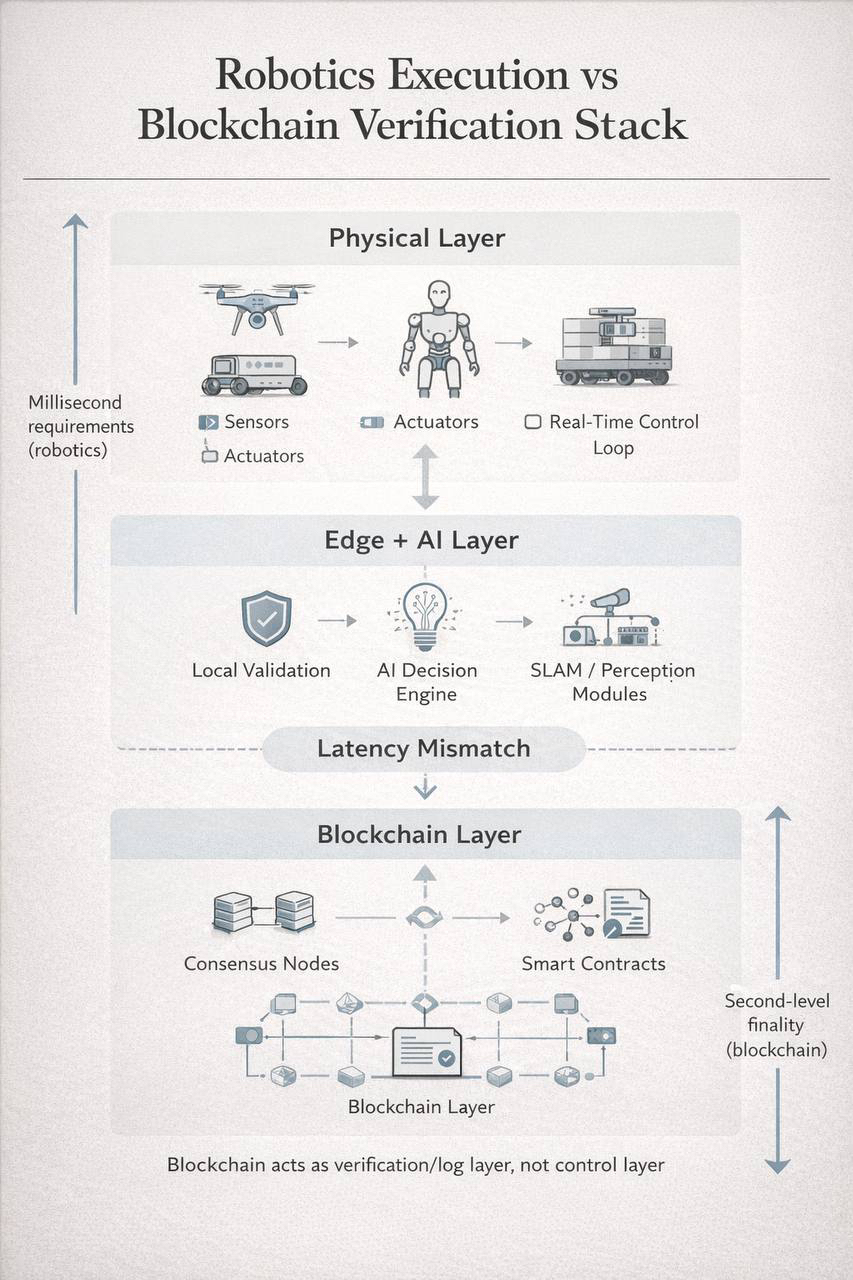
Of course, robotics isn’t as forgiving as mobile apps. Machines operate in milliseconds. Industrial arms require precise timing. You can’t afford unpredictable delays. Fabric seems to recognize this, which is why real-time motor control remains local and hardware-optimized. OM1 handles higher-level reasoning, AI integration, and communication. It’s layered, not all-in-one.
But the operating system is only half the story. The other half is trust.
Fabric builds its coordination layer on a blockchain network, currently using Base, an Ethereum Layer 2. This part is often misunderstood. The blockchain is not driving the robots in real time. That would be too slow and inefficient. Instead, it acts like a public ledger, a shared record of what robots have done.
Imagine a delivery robot completes a job. Instead of logging that action only in a private company database, it creates a cryptographic record. That record is time-stamped and stored in a decentralized system. Smart contracts can release payments automatically once conditions are verified. In theory, no central authority has to manually approve every action.
They call this idea proof of robotic work. Instead of rewarding idle computation like traditional proof-of-work mining, the system aims to reward useful physical tasks. If it becomes mature and stable, machines wouldn’t just act. They would earn, settle, and coordinate economically.
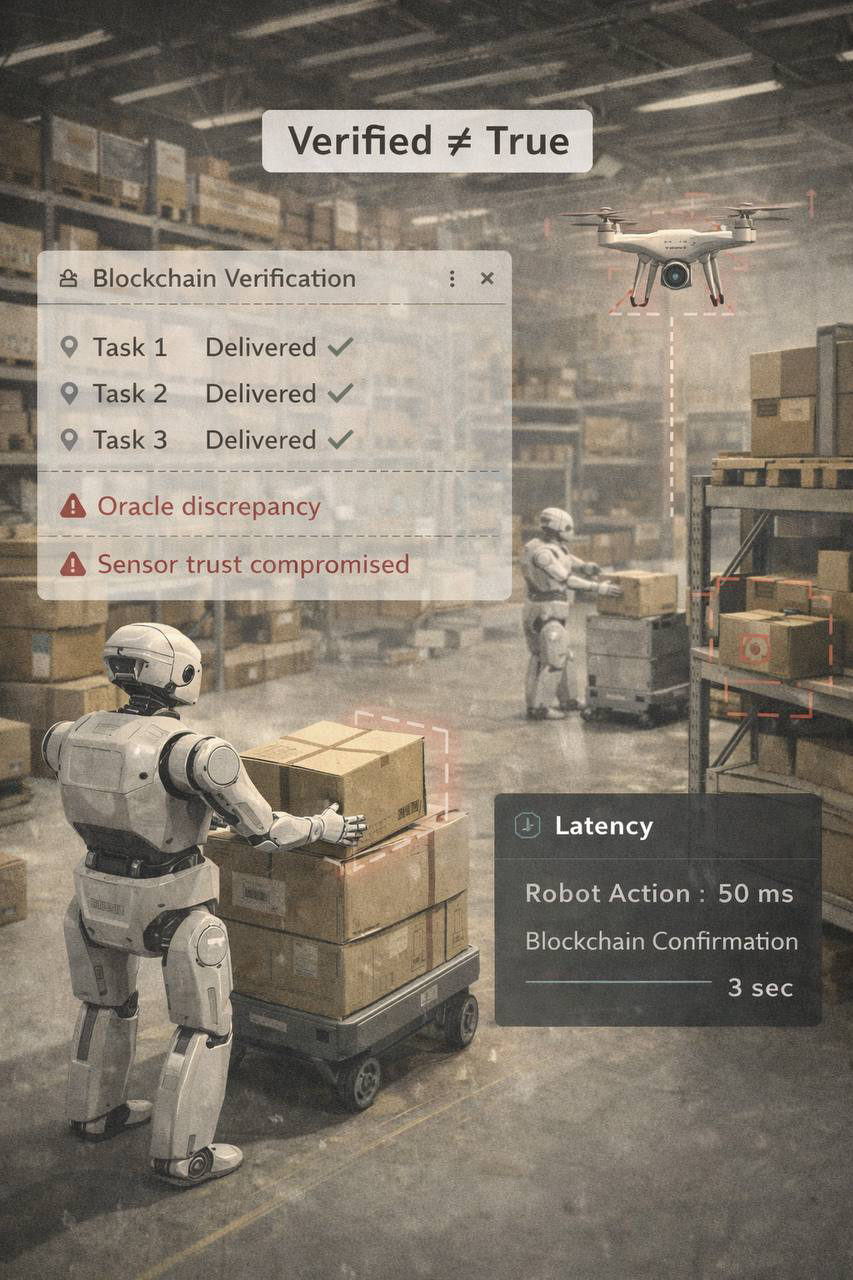
But here’s where things get complicated. Verifying digital events is easy. Verifying physical reality is not. How do you prove a robot really cleaned a room? Or delivered a package to the right place? You rely on sensors, cameras, GPS, and sometimes even other robots to confirm actions. These data feeds, often called oracles in blockchain systems, become critical.
If sensors are compromised or misconfigured, the trust layer weakens. If internet connectivity is unstable, confirmations are delayed. If data is spoofed, false proofs could enter the system. Fabric’s architecture seems to address this by using hybrid verification. Real-time decisions happen locally. Data can be hashed and stored on-chain later. Multiple agents can cross-check each other.
It becomes a balance between speed and decentralization. You can’t push everything onto a blockchain without sacrificing performance. So the system splits responsibilities. Robots act quickly at the edge. The blockchain records and coordinates at a higher level.
When I look at what really matters for this project, I don’t think it’s token price or short-term speculation. What matters is adoption and reliability. How many robots are actually running OM1? How many verified tasks are being recorded daily? How stable is the system under real-world pressure?
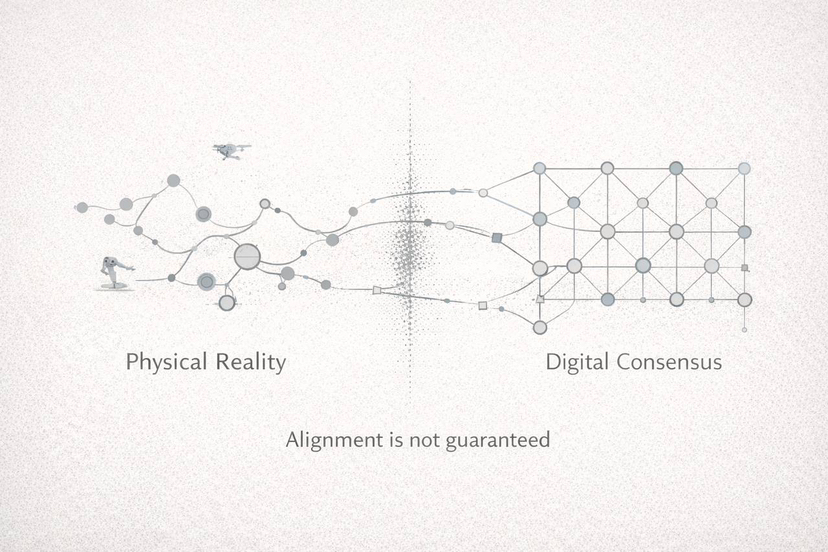
A warehouse with hundreds of robots cannot wait seconds before moving a pallet. That’s why blockchain in this design functions more like an audit layer than a steering wheel. If it becomes widely adopted, the ledger serves as a neutral record of machine labor, not as the machine’s brain.
Then there’s the economic side. Fabric introduces the ROBO token as a coordination and incentive mechanism. It can be used for governance, fees, and rewarding verified robotic tasks. But designing incentives in physical systems is delicate. If rewards are too simplistic, robots might optimize for earning tokens rather than delivering meaningful work. Safeguards have to prevent wasteful or repetitive tasks done purely for rewards.
There’s also volatility. Enterprises prefer predictability. If token value fluctuates wildly, it complicates planning. Long-term success likely depends on utility-driven demand rather than speculation.
Beyond the technical and economic layers, there are real-world risks. Open-source systems require constant maintenance. Hardware diversity increases complexity. Manufacturers may hesitate to adopt a third-party operating system. Regulatory frameworks around crypto payments vary widely by region. Integration with traditional financial systems may become necessary for large-scale adoption.
Privacy is another concern. If robots operate in homes, hospitals, or cities, logging every action permanently on a public ledger could expose sensitive data. Privacy-preserving technologies like encryption and zero-knowledge proofs may help, but they add complexity.
Despite all these challenges, I find the broader direction fascinating. We’re entering a time where machines are not just tools but participants. They make decisions. They perform tasks. They may soon negotiate and settle transactions autonomously.
If Fabric succeeds, it could lay groundwork for a machine economy where robots from different manufacturers coordinate in shared environments without a central gatekeeper. If it struggles, the lessons learned will still shape how future systems are built.
Either way, the attempt itself signals something important. We’re no longer just building smarter robots. We’re trying to build systems that organize, verify, and value their work.
And as machines become more capable, the infrastructure we design today will quietly influence how they fit into our world tomorrow.