

I’ve noticed that the moment a service fee stops being predictable, my behavior changes in small but real ways. I delay requests, I bundle actions that should be separate, and I treat every interaction like it might be the wrong time to transact. When the cost is stable and the settlement is clear, I stop thinking about the payment rail and start thinking about the work I’m actually trying to get done. That shift is what makes transaction settlement feel less like a background detail and more like the foundation of a usable system.
The main friction is the tension between stable pricing and on-chain finality. Data exchange, compute tasks, and API calls need costs that can be quoted in familiar terms, but the network still needs a native settlement unit to keep accounting consistent, verifiable, and enforceable. If everything is priced directly in a volatile token, users and providers inherit noise that has nothing to do with service quality, and operators struggle to commit to quotes. If everything stays off-chain for convenience, you lose the chain’s ability to prove payment, order execution, and standardize how fees are enforced across many participants.
It’s like being billed for a taxi ride in kilometers but paying in a currency that can swing between the moment the meter starts and the moment you step out.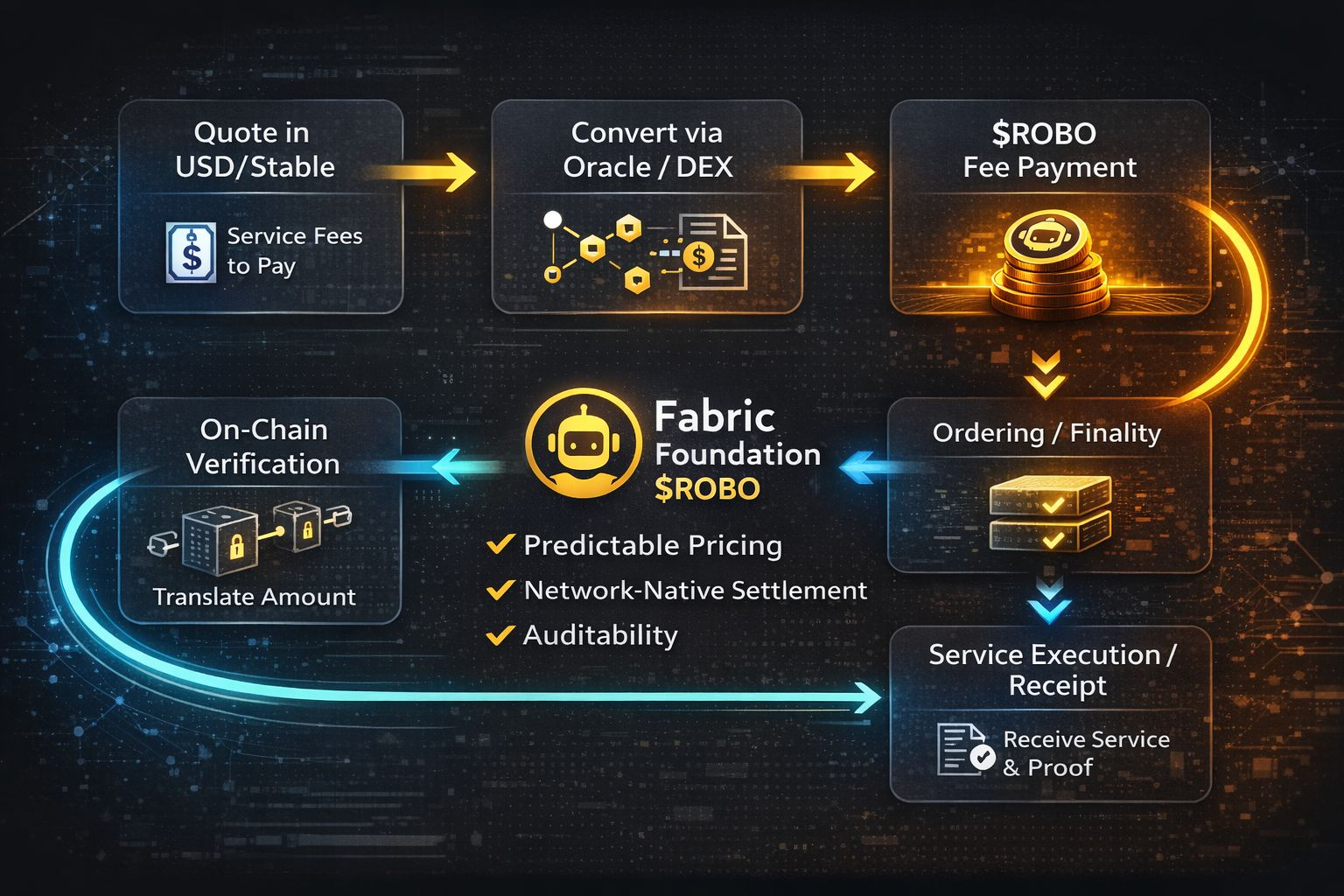
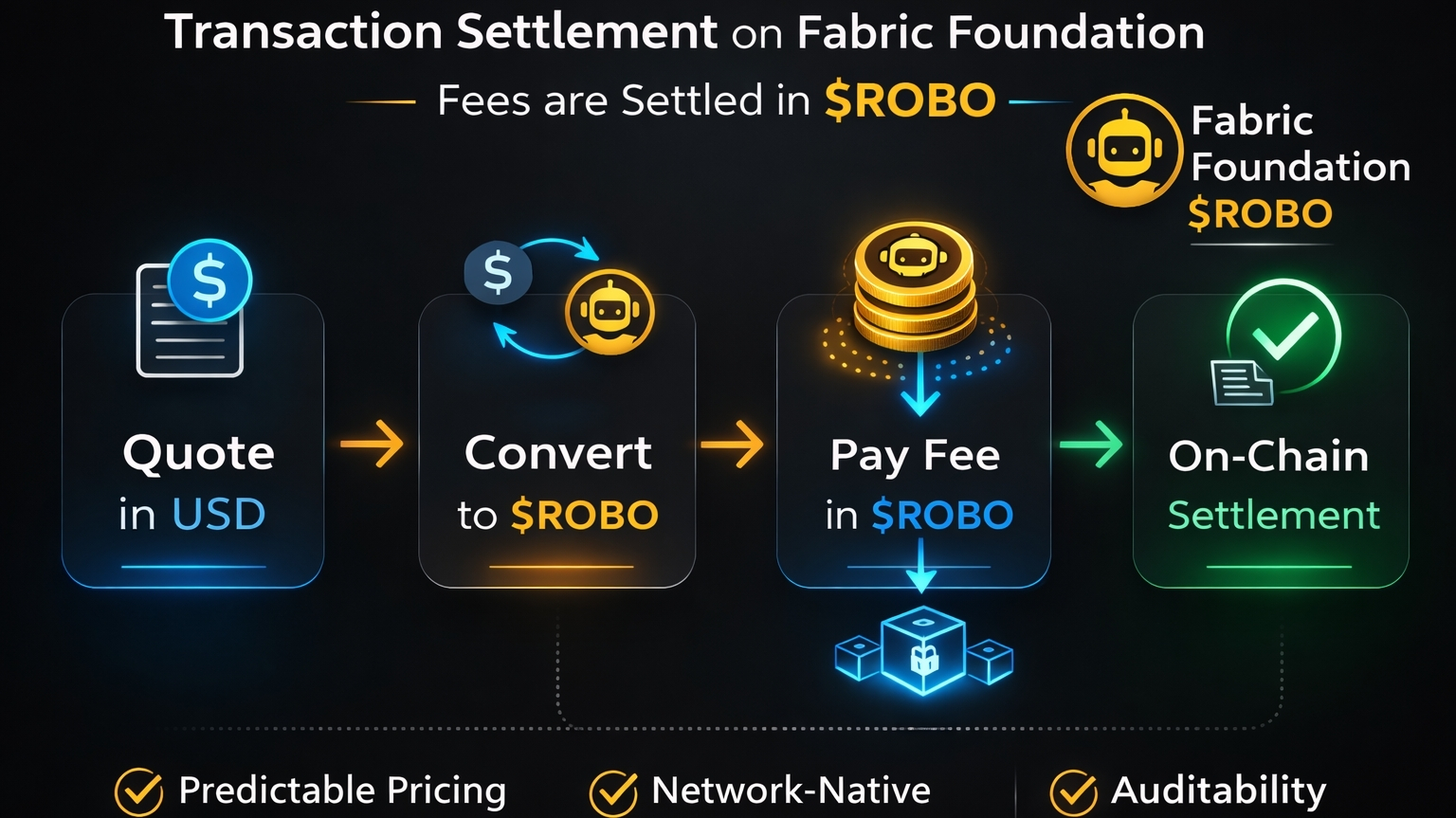
Fabric foundation frames the solution as a separation of concerns: services can be priced in stable terms for predictability, while settlement still happens on-chain in $ROBO as the network-native fee instrument. The main idea is simple but strict: the user-facing price signal should be stable enough to plan around, and the settlement layer should be native enough to audit and compose. Instead of forcing every user to arrive holding the token, the protocol allows off-chain or stable-value payments to be converted into $ROBO for final settlement. That keeps the unit of account for fees consistent at the protocol level while reducing friction for the person paying.
Under the hood, that requires a conversion and verification path the chain can trust. A quote expressed in fiat terms has to map to a $ROBO amount at settlement time, which implies an oracle-fed price reference and rules for when that reference is sampled. The transaction lifecycle is then a familiar cryptographic flow: the payer signs an authorization, the network verifies signature validity and basic constraints, the transaction is ordered, and the state is updated to reflect fee payment and the corresponding service entitlement. What I can’t responsibly pin down from the excerpt alone is the exact consensus selection and finality model—whether the chain targets deterministic finality or relies on probabilistic confirmation depth—and that choice matters because service providers want crisp guarantees about when a payment is truly final.
The state model and execution environment also aren’t fully specified here, so I can’t claim whether it is account-based or UTXO-based, or which virtual machine or modular execution layer performs fee accounting. Still, the requirements are clear: the chain must reliably track balances, apply fee debits, and emit receipts that downstream systems can treat as settlement proofs. For data-heavy workloads, it also implies a practical storage posture where large payloads are not pushed on-chain; instead, the chain anchors commitments, hashes, or receipts, while the bulk data and compute artifacts live off-chain. Settlement then becomes the authoritative ledger for “who paid for what,” without pretending the chain should store every byte of the work.
Utility and incentives follow from this architecture. When ROBO is the settlement medium, token demand is tied to actual usage because fees are paid in the native unit. Pricing can still be communicated in stable terms, but value capture happens through conversion into ROBO at the point of settlement, keeping the protocol’s accounting coherent. “Price negotiation” here is not a trading story; it’s the ordinary market mechanism of fee selection under scarcity. Users express urgency through the fees they are willing to pay, and block producers prioritize transactions within protocol rules, producing a negotiated price for timely inclusion. If staking, bonding, or governance locking exists elsewhere in the system, it complements settlement by aligning participants to keep execution available and honest, but it doesn’t replace the central role of fees as the operational heartbeat.
One clear limitation is that real-world performance depends on oracle robustness, liquidity conditions during conversions, and implementation choices around consensus and finality that can shift with upgrades or policy changes.
When I zoom out, the part that stays with me is how settlement design quietly shapes behavior. Predictable quoting reduces hesitation, and native on-chain settlement reduces ambiguity, which is exactly what high-frequency service markets need. If the chain can keep that separation intact—stable-facing prices with strict native settlement—then fees become a measured cost of doing work rather than a constant distraction that changes how people use the system.
@Fabric Foundation $ROBO #ROBO
